
Crypto Tax Policies in Various Countries: US, EU, Japan, South Korea, and Vietnam

What is crypto tax and common taxable events
You can understand crypto tax as “tax on profits/income from crypto-related activities.” Three basic terms:
Taxable event: the most common are selling crypto for fiat currency; swapping coin A for coin B; using crypto to purchase goods/services (many jurisdictions consider this as having sold crypto in exchange for something else).
Cost basis: the cost of purchasing/receiving a coin calculated in fiat currency at the time of receipt. Profit/loss = value received – cost basis.
Income upon receipt: mining/staking/airdrop are often taxed as income at the moment you receive and gain control over them; subsequently, when selling the coin, you may incur a second capital gain or loss.
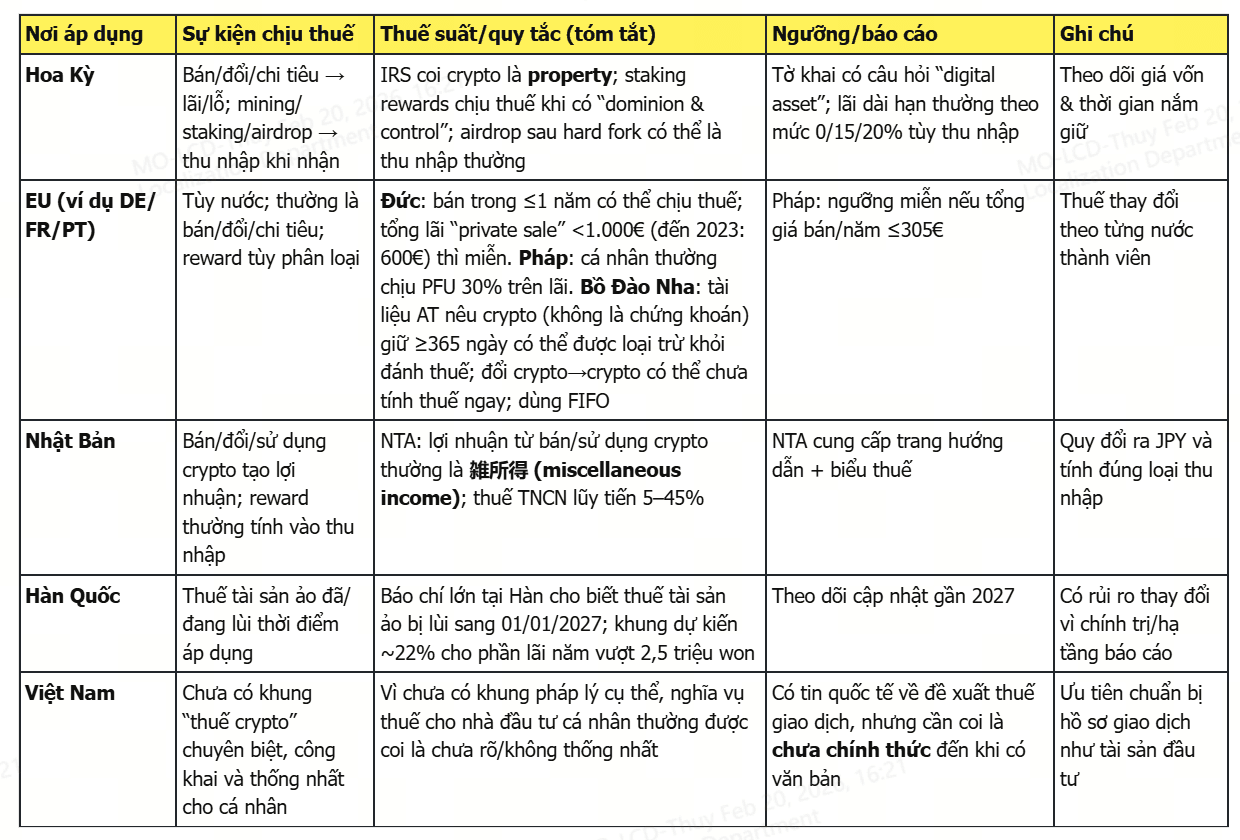
Comparison table of crypto tax policies by country
The EU does not have a unified “crypto tax”; each country sets its own laws. At the EU level, DAC8 applies from 01/01/2026 (the first reporting year being 2026) to increase the exchange of crypto information between tax authorities. On a broader scale, the OECD has issued the Crypto-Asset Reporting Framework (CARF) to standardize reporting and the exchange of cross-border crypto transaction data between tax authorities.
Crypto tax calculation examples for beginners
Examples using rounded numbers to understand the calculation method (not actual tax amounts to be paid).
Trading (capital gains/losses): Buy 0.1 BTC at 20,000 USD/BTC → cost basis 2,000 USD. Sell 0.1 BTC at 30,000 USD/BTC → receive 3,000 USD. Profit 1,000 USD. In the US, profit = “amount realized” – “adjusted basis” and must be reported; short-term vs long-term gains are treated differently.
Mining/Staking (2 steps): Receive 5 token X, price at receipt 20 USD → income 100 USD. Later sell at 30 USD → receive 150 USD → capital gain 50 USD. US: staking rewards are taxed when you gain control of the rewards.
Airdrop (2 steps): Receive airdrop worth 200 USD → income 200 USD; sell later for 300 USD → capital gain 100 USD. US: airdrops after a hard fork may generate income upon receipt.
Compliance procedures and practical tips
Although crypto tax policies vary, the “standard” process is usually the same: gather data, categorize events, convert to fiat currency, calculate profit/loss + income, and file the correct forms.
Conclusion
To reduce crypto tax risks, keep records from the beginning (date, time, quantity, fees, exchange rate, tx hash/wallet address), save reports from exchanges, and avoid “data loss” when switching exchanges/changing wallets. If you have complex DeFi activities or change your country of residence, you should consult a local tax professional.
Related articles from WEEX
- What is Liora Nuclear Beam (BEAM) Coin?
- What is War Coin Crypto? Explaining the War Coin concept for beginners
- How does a Bitcoin spot ETF affect the price of Bitcoin?
Open a crypto trading account on WEEX
WEEX provides:
- A simple, easy-to-use interface even for those who have never invested before.
- 24/7 customer support in Vietnamese, quickly answering all questions.
- A multi-layer security system, ensuring your assets are always safe.
- A deep repository of investment knowledge, helping you track market trends and make accurate decisions.
WEEX is the ideal choice if you are looking for a reputable platform to start your crypto investment journey and discover potential AI projects.
Disclaimer:
WEEX and its affiliates provide digital asset exchange services, including derivatives and margin trading, only where legal and for eligible users. All content is general information, not financial advice - seek independent advice before trading. Trading cryptocurrency carries high risk and can lead to total loss. By using WEEX services, you accept all related risks and terms. Never invest more than you can afford to lose. See our Terms of Use and Risk Disclosure for details.