
USDC to USDT Swap Exploited with a $215k Loss, How Does MEV Attack Stablecoin Trades?




Original Article Title: Crypto trader gets sandwich attacked in stablecoin swap, loses $215K
Original Article Author: Brayden Lindrea, Cointelegraph Author
Original Article Translation: ChatGPT
Editor's Note: This article covers a sandwich attack incident that occurred in a cryptocurrency trade, where a trader lost over $215,000 during a stablecoin exchange. The article provides a detailed account of the attack, including how MEV bots profited through frontrunning and discusses potential money laundering activities. Additionally, it mentions the protective measures taken by the Uniswap platform to prevent such attacks and clarifies initial criticisms.
Below is the original content (slightly rephrased for better readability):
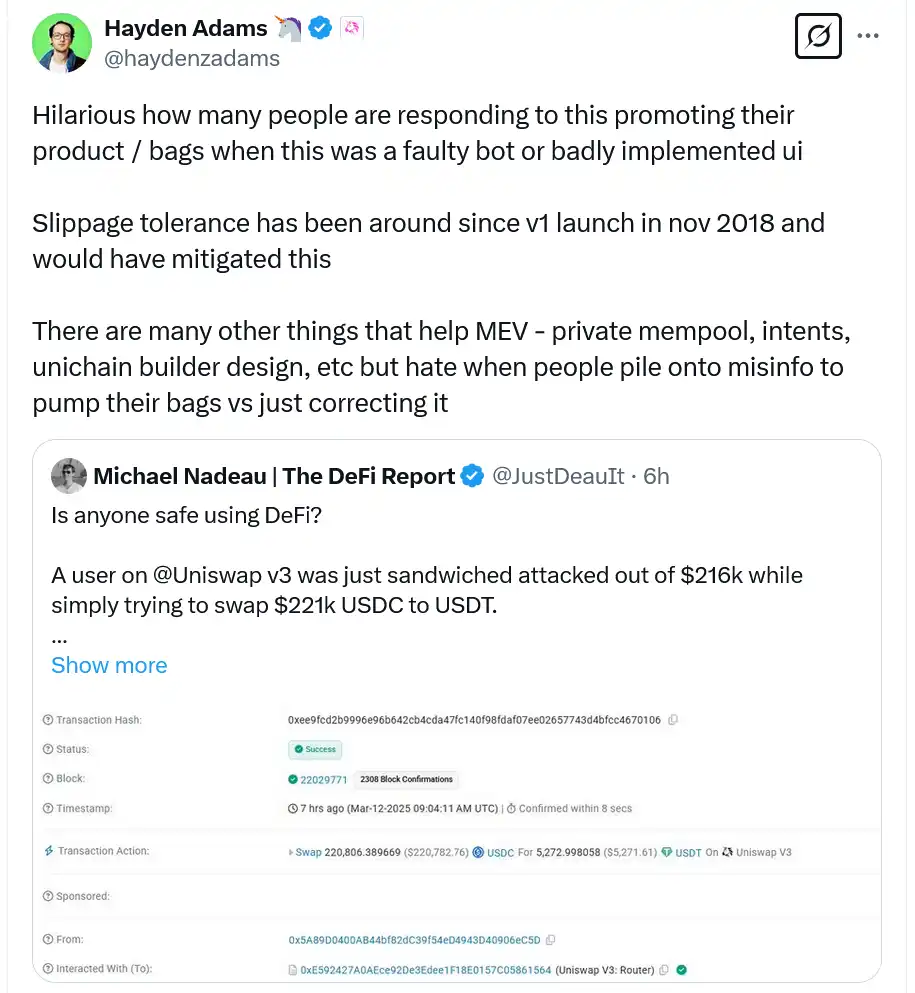
On March 12, a crypto trader fell victim to a sandwich attack while transferring $220,764 in stablecoins, losing nearly 98% of its value, amounting to $215,000, which was captured by a MEV bot.
A $220,764 USDC stablecoin value was swapped to $5,271 Tether USDT within 8 seconds, as the MEV bot successfully front-ran the transaction, profiting over $215,500 from it.
Data from the Ethereum block explorer shows that this MEV attack occurred in the USDC-USDT liquidity pool of the decentralized exchange Uniswap v3, with assets worth $19.8 million locked in the pool.
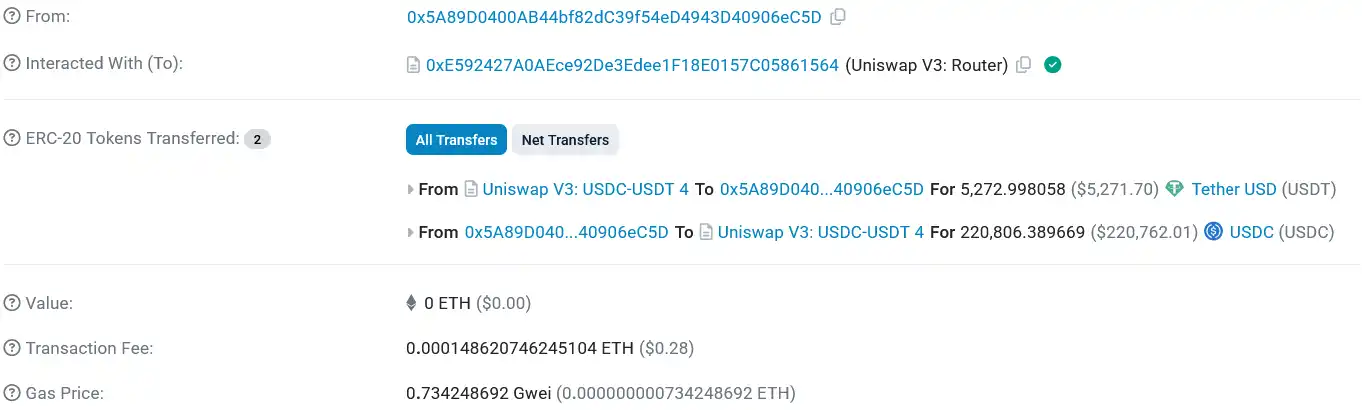
Details of the Sandwich Attack Transaction Source: Etherscan
According to Michael Nadeau, the founder of The DeFi Report, the MEV bot front-ran by swapping out all USDC liquidity from Uniswap v3's USDC-USDT pool and then putting it back after the transaction execution.
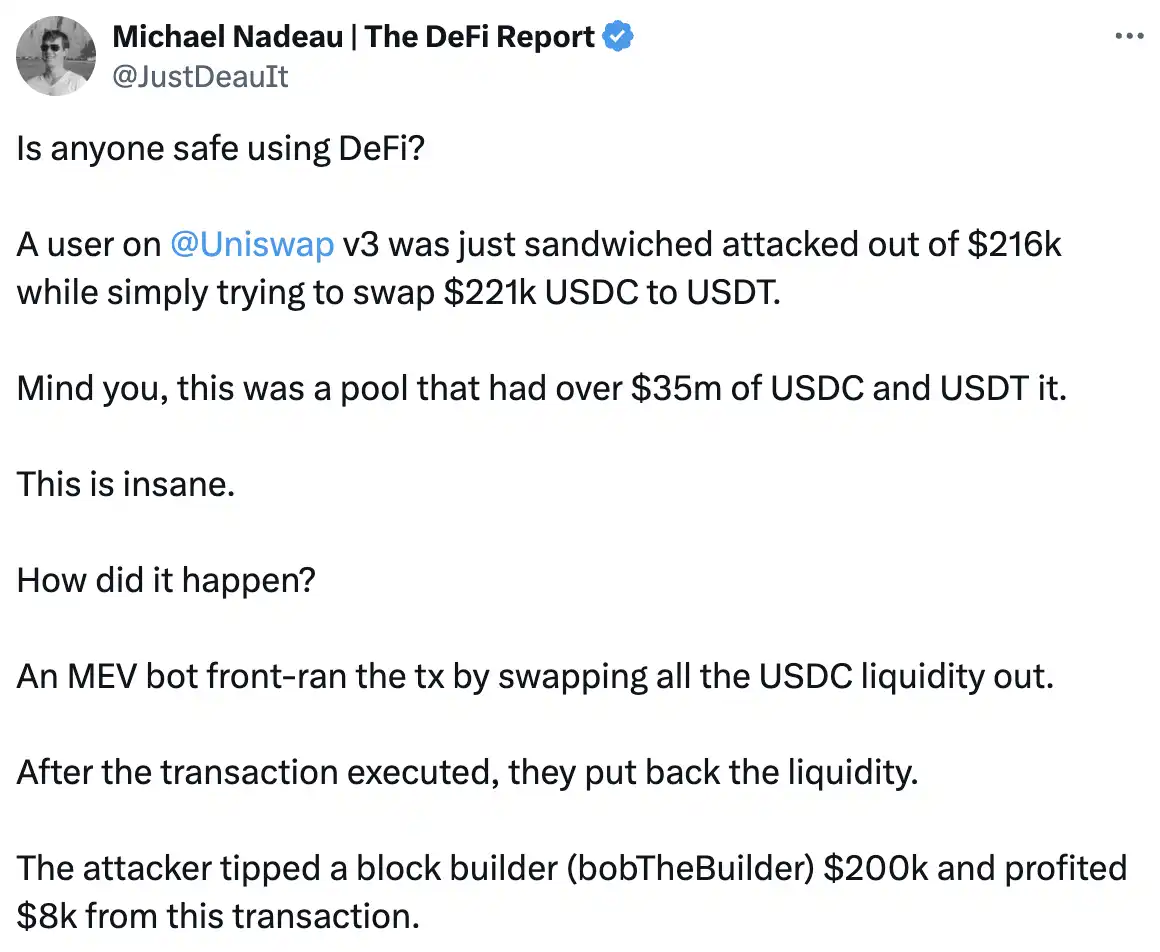
Nadeau stated that the attacker paid a $200,000 fee to the Ethereum block builder "bob-the-builder.eth" from the $220,764 transaction and pocketed $8,000 for themselves.
DeFi researcher "DeFiac" speculated that the same trader using different wallets may have experienced a total of six sandwich attacks, citing "internal tools" as evidence. They noted that all funds were sourced from the Aave lending protocol before being deposited into Uniswap.
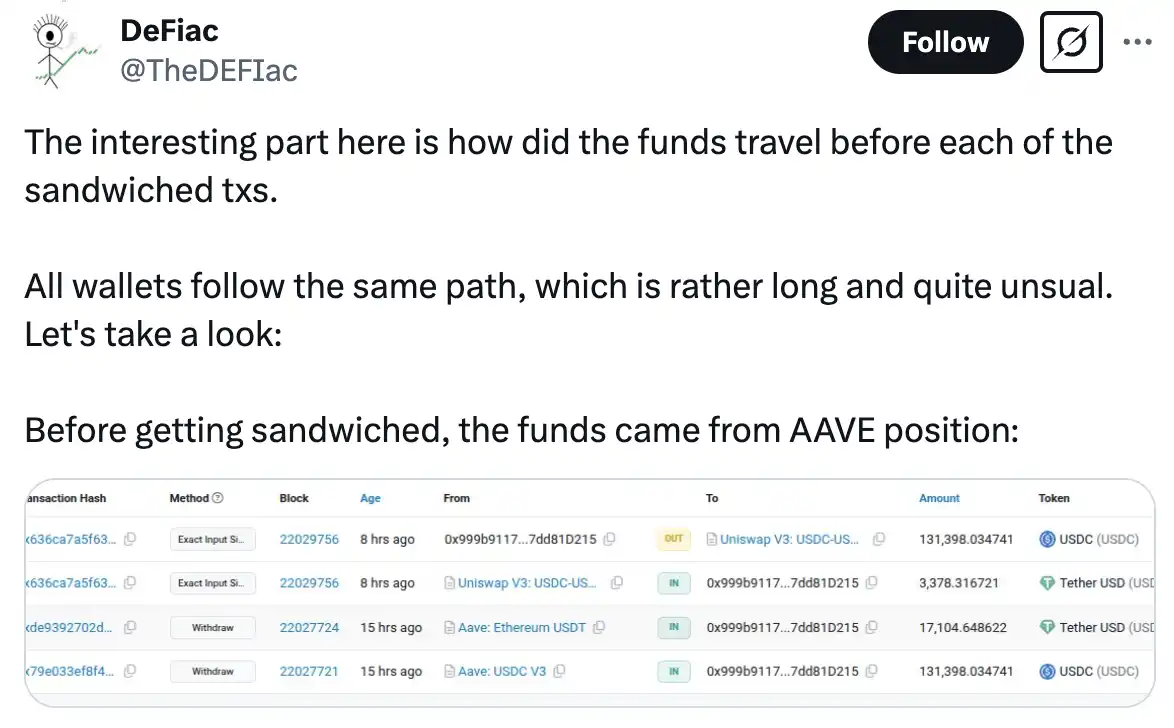
Two wallets fell victim to MEV sandwich attacks around 9 a.m. UTC on March 12th. Ethereum wallet addresses "0xDDe…42a6D" and "0x999…1D215" were sandwich attacked in transactions that occurred three to four minutes apart, resulting in losses of $138,838 and $128,003, respectively.
These two traders conducted trades in the Uniswap v3 liquidity pool similar to a trader exchanging $220,762.
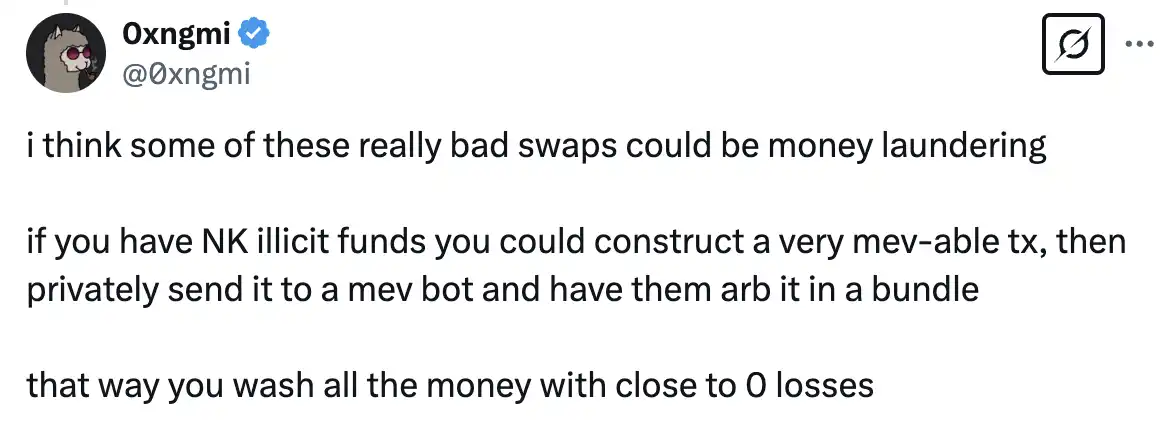
Speculation arose that these transactions might be related to money laundering.
0xngmi, the founder of the crypto data dashboard DefiLlama, stated, "If you have NK illicit funds, you can construct a transaction that is very easily exploited by MEV and privately send it to an MEV bot, allowing them to arbitrage in a bundle. This way, you can wash all the money with close to zero loss."
While Nadeau initially criticized Uniswap, he later acknowledged that these transactions did not originate from Uniswap's frontend, which has MEV protection and default slippage settings.
After Uniswap CEO Hayden Adams and others clarified the protective measures taken by Uniswap to prevent sandwich attacks, Nadeau retracted those criticisms.
You may also like

Curve Deploys Llamalend v2 on Optimism With 250,000 OP Incentives
Curve launched Llamalend v2 on Optimism with 250,000 OP incentives from the Optimism Foundation. The upgrade expands Llamalend beyond its earlier crvUSD-focused model, adding broader collateral support, LlamaRisk market reviews, and the ability to use Curve LP tokens as collateral.

Raydium Old Liquidity Pool Reportedly Exploited, With $1.34 Million Moved to Ethereum and Tornado Cash
An old Raydium liquidity pool was reportedly exploited for around $1.34 million in USDC, RAY, and wSOL, with the stolen funds bridged to Ethereum and deposited into Tornado Cash. The incident highlights the tail risks of legacy DeFi pools, old contracts, and cross-chain fund laundering paths.

Kalshi Executive Challenges “SBF Backed AI Unicorns” Narrative, Says Leopold Aschenbrenner Was Key Figure
Kalshi executive John Wang questioned the “SBF backed AI unicorns” narrative, saying Leopold Aschenbrenner was the key figure behind major AI investment decisions.

Pantera Capital Partner: How Tokenization is Restructuring the Private Equity and Early Investment Ecosystem?

New York Proposes Stricter Stablecoin Issuer Rules Aligned With Federal GENIUS Act
NYDFS proposed stricter stablecoin issuer rules aligned with the GENIUS Act, covering reserves, custody, redemption timelines, audits, and capital buffers.
Every exchange is a "Universal Exchange."

The counterattack of traditional finance: Alliance chains are quietly reviving

CryptoQuant Says Bitcoin Profitable Supply Is Near 45% Pressure Zone as On-Chain Data Points to Market Repricing
CryptoQuant said Bitcoin’s profitable supply is nearing the 45% pressure zone, signaling rising market stress, unrealized losses, and a possible on-chain repricing phase.

Bitcoin Falls Below 200-Week Moving Average as On-Chain Data Shows Over Half of Supply in Loss
Bitcoin dropped below its 200-week moving average as on-chain data showed over 50% of circulating supply is now in loss, signaling rising market stress.

CFTC Reportedly Plans New Prediction Market Rules Focused on Manipulation Risk and Public Interest Review
The CFTC is reportedly preparing new prediction market rules focused on manipulation risk, public interest review, and retail trader protections.

Meet the new WEEX trial fund—your gateway to greater profits

WEEX Labs Lands at Dutch Blockchain Week: A Disruptive Crypto × AI Conversation Sets Sail in Amsterdam

SK Hynix Reportedly Plans U.S. ADR Listing as Early as August, With SEC Approval Possible in Late June
SK Hynix may pursue a U.S. ADR listing as early as August, with SEC approval reportedly possible in late June amid strong AI chip supply chain demand.

SpaceX vs Tesla vs xAI: Which Elon Musk Trade Has the Biggest Upside in 2026?
OpenAI Reveals It Has Confidentially Submitted an S-1 to the SEC, Keeping the Door Open for a Future IPO
On June 9, according to an OpenAI announcement, the company recently confidentially submitted a draft S-1 registration statement to the U.S. Securities and Exchange Commission (SEC), beginning the preliminary compliance process for a potential initial public offering. OpenAI said it chose to disclose this proactively because it expected the news might leak; however, the company has not yet set a specific listing timeline, and related arrangements may still take some time.
Latest research from 13 top universities including Cornell University: The current state, challenges, and misconceptions of the fusion of Crypto and AI
Deconstructing Anthropic: The Best AI Company, Possibly Also a Type of Organizational Invention
Apollo and Blackstone Reportedly Back $35 Billion Anthropic Chip Financing as Deal Details Remain Unclear
On June 9, according to currently available news alerts, Apollo and Blackstone Group participated in a $35 billion financing for an Anthropic “chip project.” Based on the original wording of the report, the funding has already been raised, but public information remains limited. The financing structure, use of proceeds, project entity, and whether Apollo and Blackstone participated through equity, debt, or project financing have not yet been disclosed.
Curve Deploys Llamalend v2 on Optimism With 250,000 OP Incentives
Curve launched Llamalend v2 on Optimism with 250,000 OP incentives from the Optimism Foundation. The upgrade expands Llamalend beyond its earlier crvUSD-focused model, adding broader collateral support, LlamaRisk market reviews, and the ability to use Curve LP tokens as collateral.
Raydium Old Liquidity Pool Reportedly Exploited, With $1.34 Million Moved to Ethereum and Tornado Cash
An old Raydium liquidity pool was reportedly exploited for around $1.34 million in USDC, RAY, and wSOL, with the stolen funds bridged to Ethereum and deposited into Tornado Cash. The incident highlights the tail risks of legacy DeFi pools, old contracts, and cross-chain fund laundering paths.
Kalshi Executive Challenges “SBF Backed AI Unicorns” Narrative, Says Leopold Aschenbrenner Was Key Figure
Kalshi executive John Wang questioned the “SBF backed AI unicorns” narrative, saying Leopold Aschenbrenner was the key figure behind major AI investment decisions.
Pantera Capital Partner: How Tokenization is Restructuring the Private Equity and Early Investment Ecosystem?
New York Proposes Stricter Stablecoin Issuer Rules Aligned With Federal GENIUS Act
NYDFS proposed stricter stablecoin issuer rules aligned with the GENIUS Act, covering reserves, custody, redemption timelines, audits, and capital buffers.
Every exchange is a "Universal Exchange."


