
Trump-Appointed Individual Makes Crypto Strategic Reserve Shortlist, Is Cardano Riding on an "Air" Narrative Relying Solely on Connections?




Original Title: "Trump Specifically Mentioned in US Cryptocurrency Strategic Reserve Selection, How Does Cardano Use Narrative to Create Bull Market Illusion?"
Original Author: Nancy, PANews
Through the ups and downs of the crypto market cycle, the veteran public blockchain Cardano always seems to have a built-in BUFF, performing exceptionally well. In this current cycle, Cardano has undergone a transformation, anchoring its narrative to Bitcoin's L2, and more recently, it has been frequently hitting the headlines with multiple identities such as the US cryptocurrency reserve asset, ETF application target, and a popular choice for institutional allocation, boosting its presence to the maximum.
Ecosystem Indicators Crushed by Policy BUFF, Alleged Relationship Building
On March 2, Trump tweeted announcing that his digital assets executive order directed the President's Working Group to advance a cryptocurrency strategic reserve including BTC, ETH, XRP, SOL, and ADA. However, this news was not entirely unexpected. In late January of this year, Ripple CEO Garlinghouse confirmed having discussed with Trump the possibility of XRP becoming a US strategic reserve asset, emphasizing the need for reserve diversification. It now appears that this game had already begun.
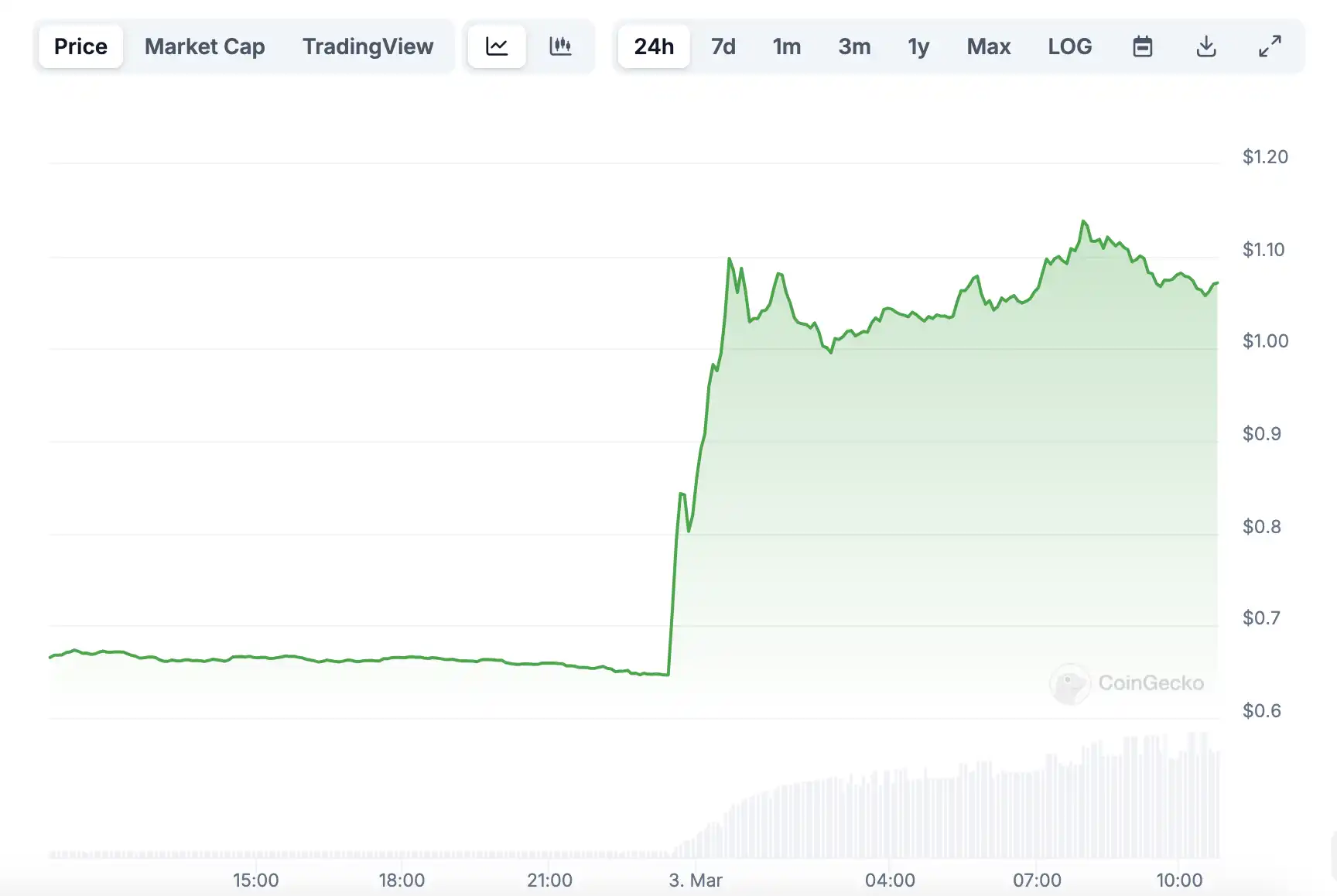
Stimulated by this news, the crypto market experienced an "overnight resurrection." Among them, Cardano's ADA performance was particularly eye-catching. According to CoinGecko data, its highest surge in 24 hours exceeded 78.1%, directly topping the trending searches. However, amidst the high market sentiment, there were also doubts raised: compared to other selected assets, Cardano's technical strength and ecosystem development seem slightly inferior, so why was it chosen as a US reserve asset?
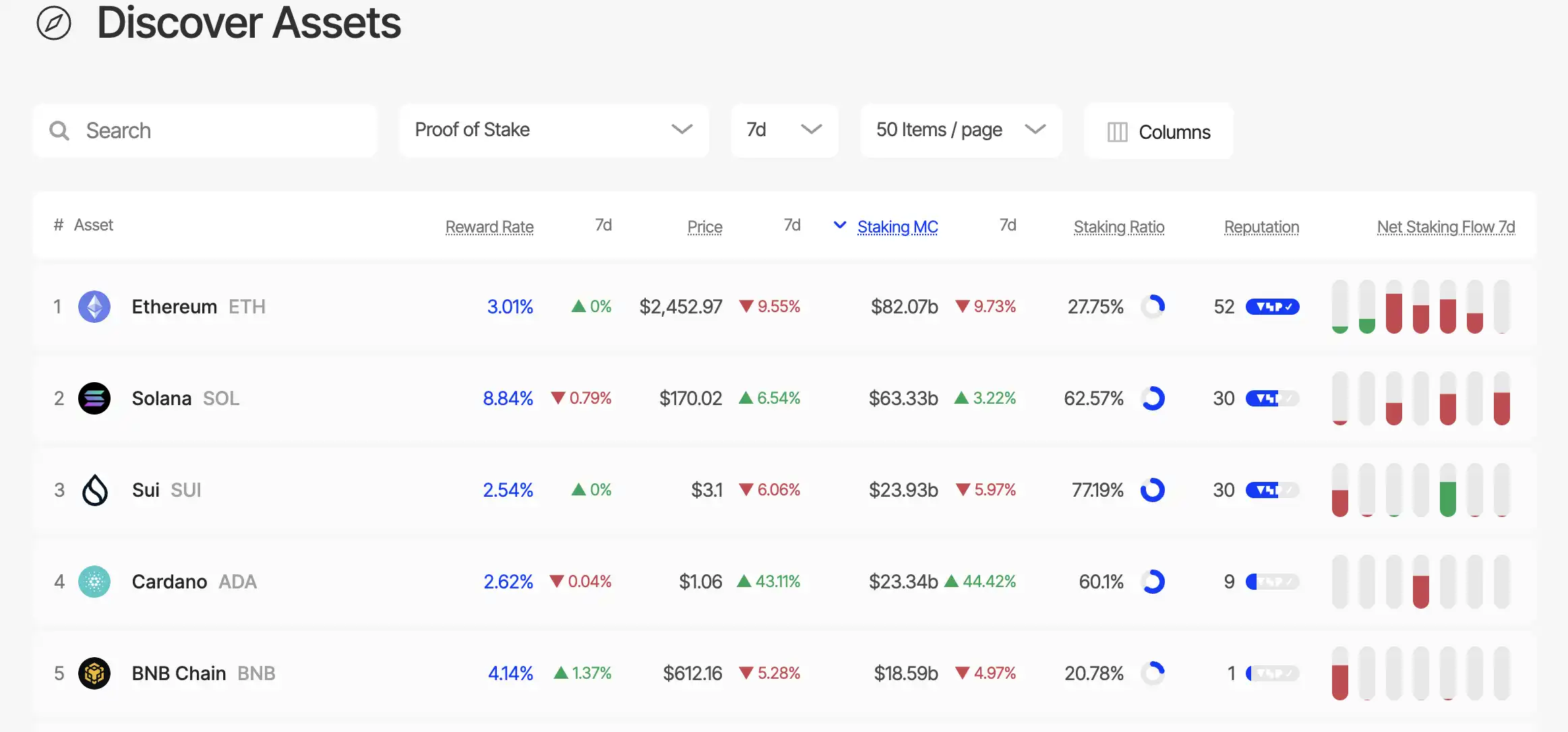
Cardano holders have a higher long-term holding intention, with over 60% choosing to stake and support the network, which has also increased the network's health. According to data from the staking website Staking Rewards, Cardano is the fourth-largest POS blockchain network, with a staked amount of $23.34 billion and a staking ratio of 60.1%.
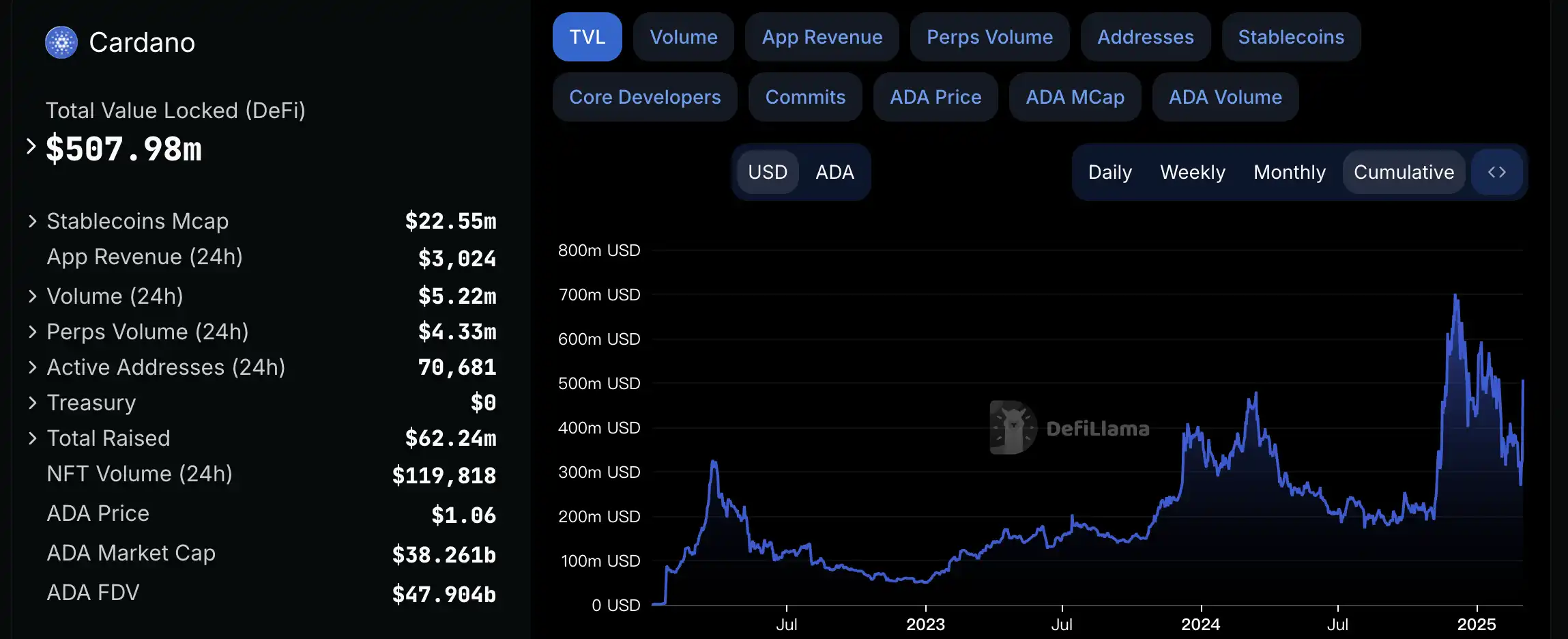
However, according to DeFillama data, as of March 3, Cardano's TVL is nearly $508 million, on-chain stablecoin market value is $22.55 million, and the application revenue in the past 24 hours is only $3,024. In contrast, Solana's TVL reached as high as $8.38 billion, with daily revenue of approximately $836,000. Looking at ecosystem performance indicators, Cardano lags behind among the selected assets. Despite its impressive staking scale, the staked ADA has not translated into actual dApp usage, indicating that its ecosystem still has significant white space to fill.
So does this mean we have to rename ourselves to "American Digital Assets"? Cardano founder Charles Hoskinson quipped in a recent tweet.
In fact, the outside world has always referred to Cardano as the "Japanese public chain," but Cardano is a U.S.-based project founded by American Charles Hoskinson, who was one of the original eight co-founders of Ethereum and has invested heavily in blockchain, longevity science, space exploration, and other areas. In 2014, after leaving Ethereum due to disagreements over its development direction with Vitalik Buterin, Hoskinson founded Input Output Global based in the United States and launched Cardano. While Cardano has been touted as the "Japanese Ethereum" in the Japanese market, much of its early popularity there was due to its initial fundraising model. It is reported that almost 95% of buyers in Cardano's public sale were Japanese investors, also known as "retirement investments." This was mainly because the public sale was led by the Japanese company Emurgo, and at that time, Japan's regulatory environment was relatively more lenient compared to Europe and the U.S., leading to Cardano being mistakenly perceived as a Japanese project. However, with the gradual opening up of U.S. crypto policies, Cardano is gradually shedding its Japanese image.
As for the market's speculation on Cardano's inclusion in strategic asset reserves, many people speculate that this is not due to its technology but rather its close ties with the U.S. government, especially as hinted at by founder Charles Hoskinson several times. For example, in November 2024, amid rumors that Charles Hoskinson was being considered by Trump as a cryptocurrency policy advisor, he hinted in a conversation that he has a close relationship with a member of the Trump team. He stated that he would work with legislators and the government to push through a bipartisan bill. Input Output Global, the development company behind Cardano, plans to establish a cryptocurrency regulatory policy office in early 2025 and intends to engage with "key leaders in certain positions in the U.S. government" to advance legislation agendas related to cryptocurrency securities and commodities. However, as of now, the specific progress of this plan has not been made public, and there is no evidence that he has been formally hired by the U.S. government.

On March 2, Charles Hoskinson also clarified, "No one has been appointed to any executive role related to cryptocurrency tonight, and the meeting does not imply endorsement or confer magical new powers. That's just how the legislative process works; it takes time and effort. Until there is exact and meaningful news about the legislative process, I will not comment on this topic again. This news must be about crafting new laws to make the industry survive and thrive in the U.S."
From Academicism to Bitcoin Sidekick, Cardano Revisits Hot Topics
A flowing narrative, a Cardano made of iron.
Recently, several market dynamics of Cardano have made it one of the hot topics of market attention. For example, ADA is among the top three weighted assets in Grayscale's Smart Contract Fund's latest holdings, accounting for 18.23%; Grayscale's application for a Cardano spot ETF has been accepted by the U.S. SEC; Cardano plans to integrate Ripple's RLUSD stablecoin to enhance its own DeFi ecosystem and provide broader use cases for RLUSD, among other developments.
Furthermore, not long ago, Charles Hoskinson also revealed that Input Output Global (IOG) will focus on developing the Bitcoin DeFi ecosystem by 2025. The team plans to collaborate with the multi-party computation protocol developer Fair Gate Labs, with the goal of releasing a demo version before the Bitcoin conference in May 2025. The technology developed by Fair Gate Labs will be the foundation of BitcoinOS, requiring no additional token issuance, and enabling cross-chain transactions using only Bitcoin. The project will also collaborate with community projects and wallet service providers to achieve the goal of "awakening a sleeping giant."
This leverage of the strategic reserve policy undoubtedly further brought additional policy support to Cardano, providing new fund flows and attention in the market.
Looking back at Cardano's development journey, through several rounds of market baptism, Cardano has always been adept at constructing attention-grabbing narratives to shape a unique market image and increase market attention through external events.
From its origins as a "research-driven third-generation blockchain" to the environmentally friendly label of the "Ethereum Killer," and to the ecosystem moment of smart contract deployment, it has now transformed into a new role as a "Bitcoin Layer2." These narratives are sometimes not entirely based on the technology itself but are more driven by external events and public opinion. Especially, bull market cycles often amplify its potential and, with its strong pumping capability, quickly make it the focus of market attention.
However, from its initial academicism to today's Bitcoin "sidekick," despite Cardano's success in narrative evolution, the practical application issues behind it remain its biggest weakness. With the added boost from the "U.S. policy bandwagon," whether Cardano can break the inherent impression under the illusion of past bull market constraints still remains to be seen.
Alleged Empty Promise, Mystery Surrounds Execution Plan
However, regarding altcoins such as ADA being called out by Trump to be included in the strategic reserve assets, apart from the criticism of vested interests, the implementation method, timeline, specific scale, and funding source are still unclear. The market believes that it is mostly at the intention stage, with the execution plan being a mystery.
Udi Wertheimer, founder of Taproot Wizards, believes, "So far, the best view I've seen about the strategic reserve is that this is just a typical Trump negotiation strategy. To truly build a reserve, Trump has to convince Congress; he can't decide alone. Whenever Trump needs to persuade other stakeholders, he always starts with a ludicrous claim that he can retract later. Therefore, in Trump's chess game language, this just means he is telling Congress, if you don't agree to a Bitcoin reserve, I'll have to propose even more outlandish terms."
Arthur Hayes, co-founder of BitMEX, pointed out, "There's nothing new here, just talks. Tell me when they get congressional approval to borrow money or raise the price of gold. Without these, they don't have the money to buy Bitcoin and altcoins."
"Investing in Bitcoin alone may be the best option - the simplest, and as the heir to gold, the logic behind it is also clear; if people want a more diversified option, they can build a market-cap-weighted crypto asset index to maintain its impartiality," said Brian Armstrong, co-founder and CEO of Coinbase.
You may also like

Morning Report | BitMine increased its holdings by 126,971 ETH last week; trader Eugene announced his exit from the crypto market

Wang Chuan: How can one not feel anxious after the neighbor Old Wang made thirty times profit by investing in storage stocks? (Seven) - A quarter-century cycle

Cryptocurrency CEXs are flocking to sell US stocks, and traditional brokerages are facing an "uninvited guest."

$75 billion in foreign capital has fled, and South Korean retail investors have absorbed it all using leverage

Japan’s Three Megabanks Plan Joint Stablecoin Issuance in Fiscal 2026
MUFG, SMBC, and Mizuho reportedly plan to jointly issue fiat-pegged stablecoins in fiscal 2026, signaling Japan’s growing push into bank-led digital payment infrastructure.

Humanity Discloses H Token Dual-Chain Attack Details, With Losses on Ethereum and BSC Exceeding $36 Million
Humanity said the H token attack across Ethereum and BSC caused more than $36 million in losses after leaked ProxyAdmin keys enabled malicious contract upgrades and token minting.
White House Discusses CLARITY Act With Law Enforcement Ahead of Senate Vote
The White House discussed the CLARITY Act with law enforcement ahead of a Senate vote, focusing on illicit finance risks and developer protections.

Bitcoin Trading Guide 2026: Strategies for Experienced Traders

What Is XAUT and PAXG? Why Tokenized Gold Is Booming in 2026

Will the SpaceX IPO Hurt Bitcoin? Here's What Traders Are Watching

Foreign selling in the South Korean stock market accelerates, with cumulative net sales reportedly reaching $75 billion this year
On June 9, The Kobeissi Letter, citing Goldman Sachs data, reported that global investors are selling South Korean stocks at an unusually rapid pace. In the latest trading session, foreign investors sold about $801 million worth of Kospi constituent stocks again; total foreign outflows last week reached about $10 billion, and the market has been in net foreign selling on nearly every trading day over the past month. According to the data cited in the report, foreign investors have sold about $75 billion worth of South Korean stocks so far this year. Meanwhile, South Korean retail and institutional investors together recorded roughly $69 billion in net buying over the same period, suggesting that the market’s main buying support has come from domestic capital rather than returning overseas funds. The information currently disclosed still mainly comes from The Kobeissi Letter’s retelling and Goldman Sachs data summaries, while public details on the statistical period and the specific definition of “selling” remain relatively limited.

Fortune Warns of Strategy’s Financing Structure Risks as Bitcoin Premium Narrows
Fortune warned that Strategy’s Bitcoin treasury model faces growing financing risks as MSTR’s net asset premium narrows and preferred stock dividend pressure increases.

Ferrari Challenge Le Mans: Carl Moon to Dominate in WEEX Livery

Sahara AI Responds to SAHARA’s Sharp Drop: No Contract or Product Security Issues Found, Internal Investigation Underway
Sahara AI responded to SAHARA’s 60% price drop, saying no token contract or product security issues have been found and an internal investigation is underway.

WEEX Deposit/Withdrawal Dynamic Island: Your Asset Status, Always in Sight
Scaling Crypto Derivatives: The Digital Asset Infrastructure Behind High-Volume Trading
In the fast-moving digital asset ecosystem, derivatives platforms face an extreme architectural test. High-leverage futures markets demand more than just standard security—they require absolute operational precision, zero-latency matching engines, and ironclad structural scalability, all while navigating intense market volatility.
As global platforms scale to meet these demands, the industry is shifting away from rigid, monolithic setups toward a more agile, "decoupled" infrastructure philosophy.
The Blueprint for High-Volume Copy TradingFor elite global exchanges like WEEX (founded in 2018), this architectural choice becomes critical when scaling high-volume retail features like social copy trading. When thousands of users automatically mirror the real-time strategies of elite traders simultaneously, it triggers sudden, monumental spikes in concurrent transactional volume.
To prevent execution latency or settlement bottlenecks during these peak volatility events, a platform's primary engine must remain entirely dedicated to risk management, copy-trade synchronization, and order matching.
The Architectural Rule: New-generation platforms must separate front-end user execution engines from heavy backend infrastructural overhead to eliminate operational friction.
By separating these layers, platforms can maintain complete sovereignty over their trading environments and user experiences while strategically aligning with institutional-grade infrastructure ecosystems. This strategic framework allows modern exchanges to leverage advanced Digital Asset Custody infrastructure such as Cobo’s behind the scenes, ensuring that backend wallet management scales elastically alongside trading spikes.
Capitalizing on Market Momentum and 400× LeverageIn a derivatives arena where platforms offer up to 400× leverage on perpetual contracts, capital efficiency and market agility are core business metrics. To capture market momentum, an exchange needs the ability to rapidly expand its asset offerings, supporting everything from legacy crypto assets to sudden, trending altcoins across a massive library of trading pairs.
Adopting a flexible, scalable Wallet-as-a-Service (WaaS) solution such as Cobo’s could completely rewrite the development timeline for high-growth exchanges. Instead of spending months of engineering capital building out custom backend wallet architectures for every new blockchain network, platforms can deploy localized infrastructure in days.
This agility allows platforms to instantly scale their listings to over a thousand trading pairs without compromising security or delaying time-to-market. It mirrors the exact operational advantages seen during high-velocity market events, similar to how advanced wallet infrastructure empowers platforms during sudden asset surges; allowing exchanges to pass that speed and liquidity directly to their global user base.
A Mature Foundation for GrowthThe synergy between trusted infrastructure ecosystems and global trading platforms represents the natural evolution of a maturing crypto market. As WEEX continues to scale its global spot and derivatives offerings for over 6 million users, adopting robust backend paradigms proves that platforms no longer have to compromise between cutting-edge trading velocity and uncompromised structural security.

Get Paid to Onboard? Try WEEX’s New Homepage with Rewards for Registration, Deposit & Trade
WEEX Custom Layout: Build Your Perfect Trading Workspace in Seconds
Morning Report | BitMine increased its holdings by 126,971 ETH last week; trader Eugene announced his exit from the crypto market
Wang Chuan: How can one not feel anxious after the neighbor Old Wang made thirty times profit by investing in storage stocks? (Seven) - A quarter-century cycle
Cryptocurrency CEXs are flocking to sell US stocks, and traditional brokerages are facing an "uninvited guest."
$75 billion in foreign capital has fled, and South Korean retail investors have absorbed it all using leverage
Japan’s Three Megabanks Plan Joint Stablecoin Issuance in Fiscal 2026
MUFG, SMBC, and Mizuho reportedly plan to jointly issue fiat-pegged stablecoins in fiscal 2026, signaling Japan’s growing push into bank-led digital payment infrastructure.
Humanity Discloses H Token Dual-Chain Attack Details, With Losses on Ethereum and BSC Exceeding $36 Million
Humanity said the H token attack across Ethereum and BSC caused more than $36 million in losses after leaked ProxyAdmin keys enabled malicious contract upgrades and token minting.


