
RedStone "False Advertising"? Anger Erupts as Only 4,000 out of 230,000 Community Members Receive Airdrop


Original Title: "Only 4000 Qualified Addresses, Has RedStone's Airdrop Angered the Masses?"
Original Author: Alex Liu, Foresight News
On the evening of March 5th, RedStone initiated its airdrop query. Since its pre-market listing on Binance on February 28th, RED has hit Binance's latest circuit breaker for 3 consecutive days, breaking above $1.40 after the price limit was removed, and is now trading at $0.87 with a market cap of $34 million and a fully diluted market cap of $860 million.
As the latest Launchpad project on Binance, RedStone saw significant participation in its airdrop event, garnering attention in the community. Known for its low-cost reputation as a price oracle provider, the project has not experienced any major pricing errors since its launch and has received support from notable investment firms such as Coinbase Ventures and Blockchain Capital. However, this shining star's reputation took a nosedive in the community after the launch of the airdrop query page last night, with some netizens even labeling it a "scam project." But why?
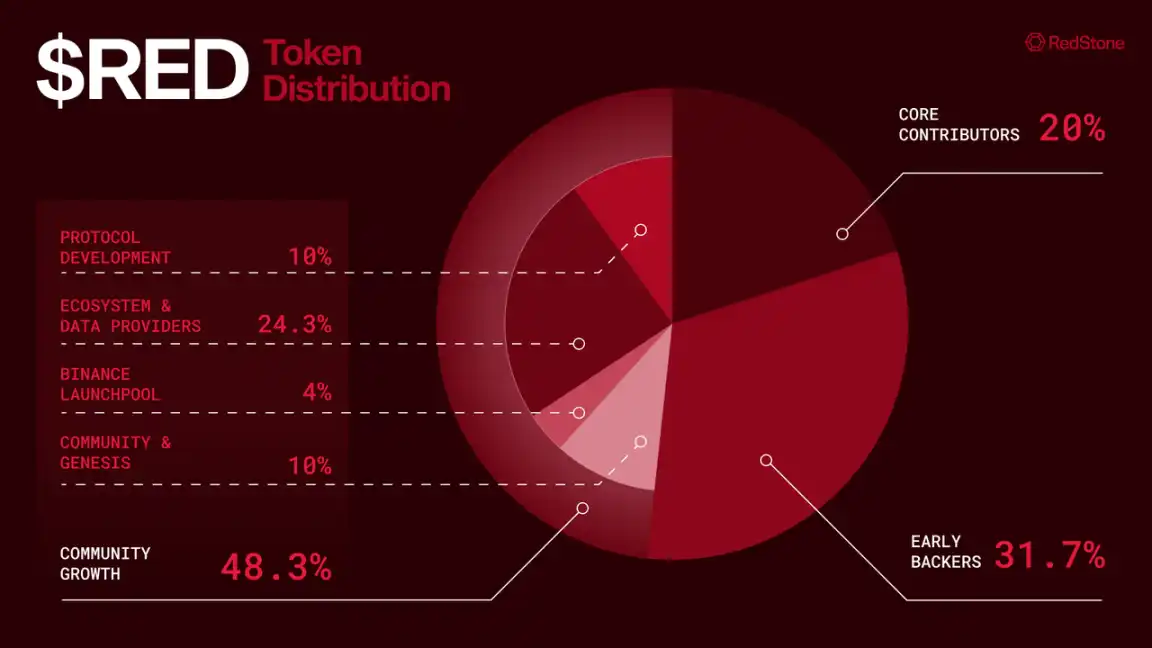
Looking at its tokenomics, a 10% community airdrop allocation is not considered low and does not seem to be the root of the issue. On social media platforms, community members have provided feedback that they participated in multi-year tasks (such as mining activities in Seasons 1-3, over a hundred tasks on Zealy, Lunar New Year events, etc.) but still did not receive the airdrop. In RedStone's official statement, the author found the answer.
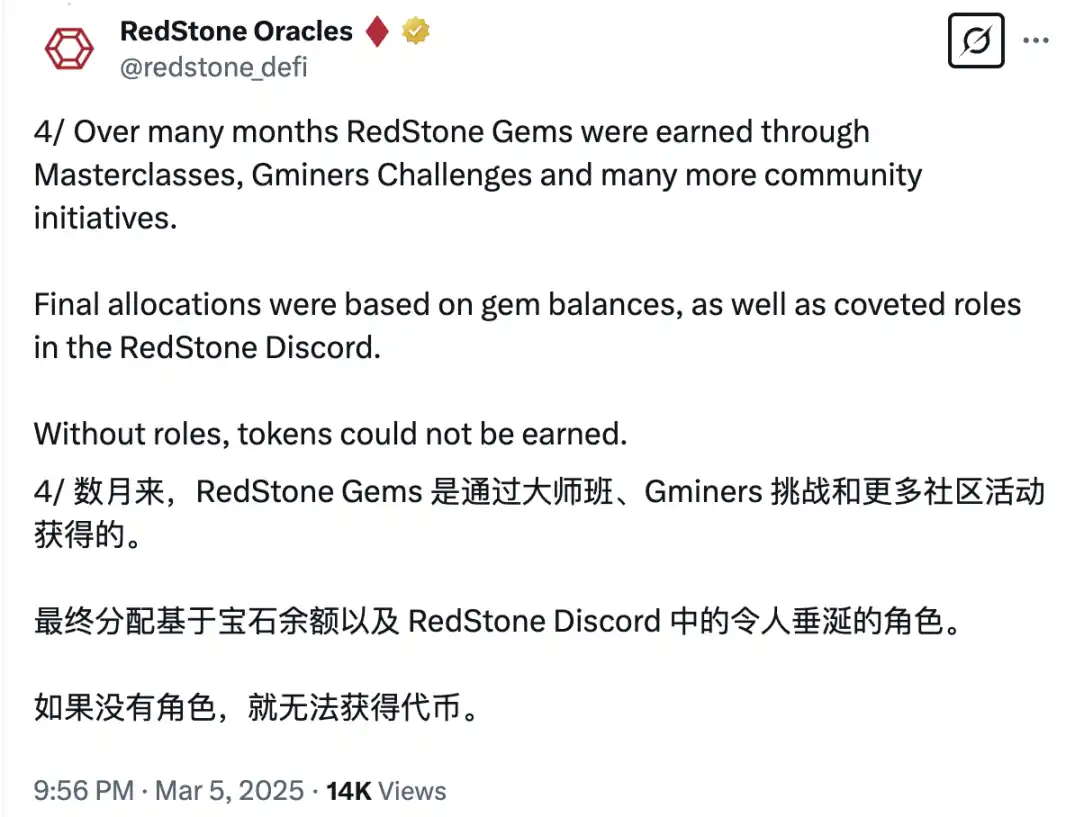
Only those with specific roles in the RedStone Discord are eligible to receive tokens! Qualified roles include Vein Master, Deep Miner, Professor, IRL (participated in offline events), etc., and the proportion of RedStone Discord's nearly 230,000 community members with any of these roles is less than 2%!
Merely offering a small amount of tokens may not have angered community users to this extent (RedStone DC has now activated "slow mode" due to excessive criticism), but the actual reward mechanism being inconsistent with the project's promotion has led many users to feel that their efforts were in vain, which is likely the crux of the issue.
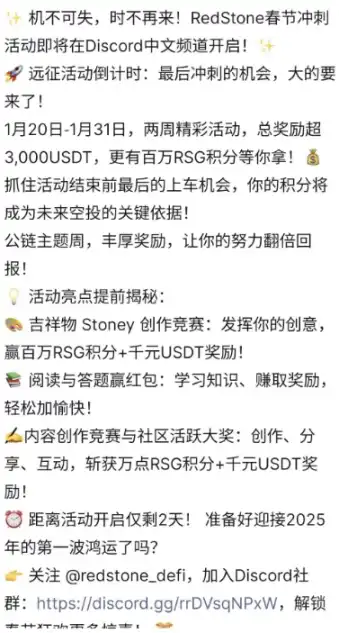
In past promotions, the project team exclaimed, "Your points will be the key basis for future airdrops!" However, in reality, the top 10 holders in the RSG Points ranking, including the 5th and 7th places, were disqualified from receiving RED tokens because they did not have a Discord role. Out of more than 170,000 people on the leaderboard, only 2296 addresses were eligible. With around 200,000 members in the entire community, only about four thousand people ultimately met the airdrop criteria, with many users receiving only a few hundred tokens. The distribution logic appeared to be very "selective" compared to other mainstream projects in the market.
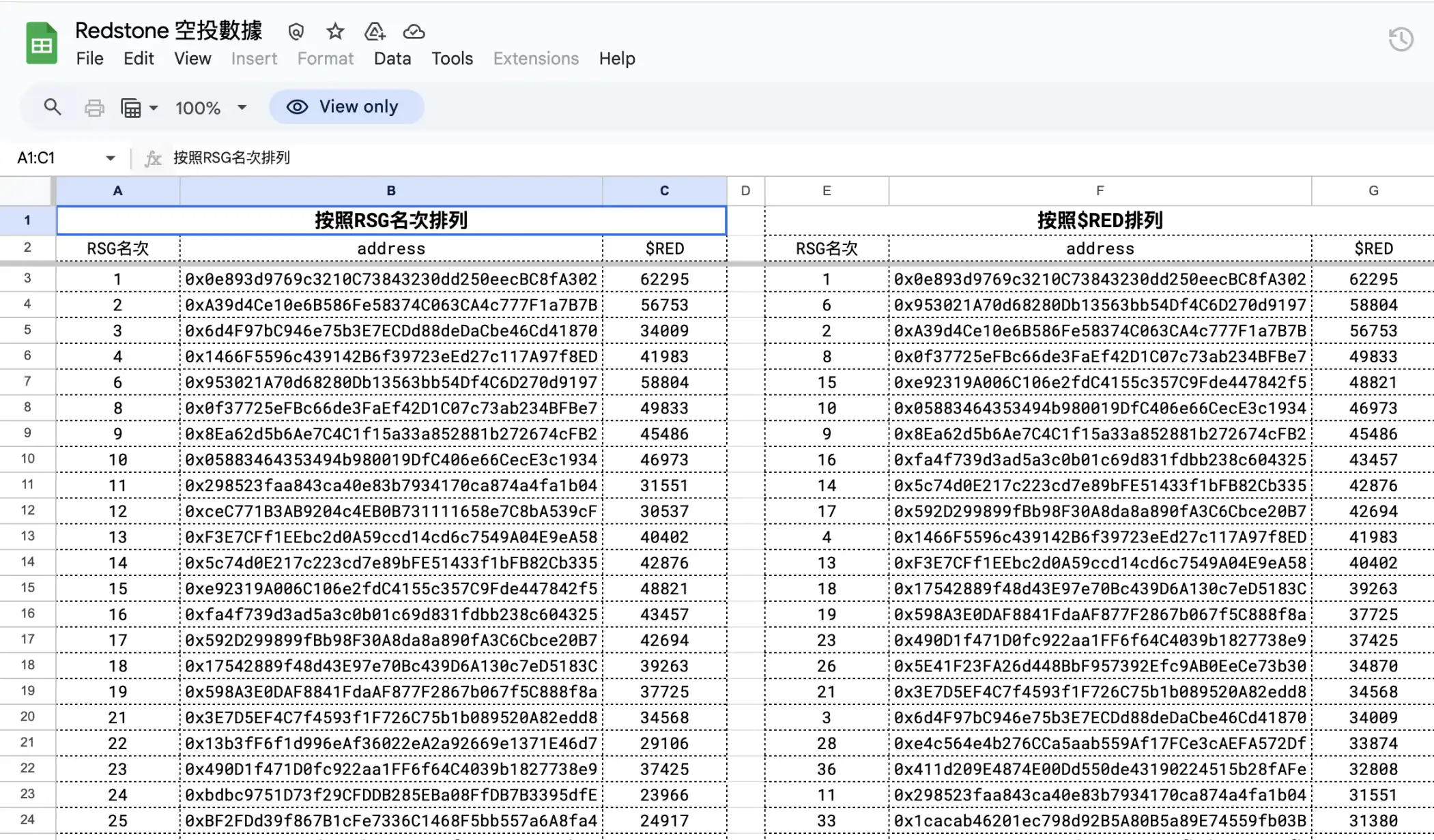
Data Source: @OshinoAJ_eth
So what truly sparked the anger of community members is that RedStone's event design was full of intense "PUA" style marketing: by continuously releasing tasks to attract user participation, it created an illusion of "as long as you are diligent enough, you can receive rewards." In reality, there were invisible barriers in the threshold setting, causing many ordinary users who invested a significant amount of time and resources to be excluded at the last moment.
This goes against industry norms. Other airdrop projects in the industry usually focus more on the broad participation of users in the distribution mechanism. In dYdX's airdrop event, tens of thousands of participating and eligible users generally receive a certain amount of governance tokens; and in projects like Optimism, their airdrop rules are clear, fair, and transparent, aiming to encompass a larger number of ecosystem users.
In contrast, RedStone's "special role" threshold appears too narrow, making it difficult to incentivize long-term community activity and trust.
Conclusion
The project team may have attempted to achieve a more sophisticated incentive mechanism in airdrop distribution, ensuring that core users receive a higher percentage of rewards. However, this approach undoubtedly overlooks the contributions and expectations of the broader participants.
In the long run, airdrops are not only a means to attract users as a promotional tool but also a crucial indicator of project governance transparency and ecosystem health. The current controversy undoubtedly sounds an alarm for the entire industry: only by establishing a fair, open, and reasonable incentive distribution mechanism can users truly feel the value of participation and thus drive the continuous prosperity of the entire ecosystem.
You may also like

SpaceX vs Tesla vs xAI: Which Elon Musk Trade Has the Biggest Upside in 2026?

OpenAI Reveals It Has Confidentially Submitted an S-1 to the SEC, Keeping the Door Open for a Future IPO
On June 9, according to an OpenAI announcement, the company recently confidentially submitted a draft S-1 registration statement to the U.S. Securities and Exchange Commission (SEC), beginning the preliminary compliance process for a potential initial public offering. OpenAI said it chose to disclose this proactively because it expected the news might leak; however, the company has not yet set a specific listing timeline, and related arrangements may still take some time.

Latest research from 13 top universities including Cornell University: The current state, challenges, and misconceptions of the fusion of Crypto and AI
Deconstructing Anthropic: The Best AI Company, Possibly Also a Type of Organizational Invention
Apollo and Blackstone Reportedly Back $35 Billion Anthropic Chip Financing as Deal Details Remain Unclear
On June 9, according to currently available news alerts, Apollo and Blackstone Group participated in a $35 billion financing for an Anthropic “chip project.” Based on the original wording of the report, the funding has already been raised, but public information remains limited. The financing structure, use of proceeds, project entity, and whether Apollo and Blackstone participated through equity, debt, or project financing have not yet been disclosed.

Humanity Protocol Security Incident Escalates: More Than $31 Million Stolen From Related Addresses as Attacker Continues Selling H for ETH
On June 9, according to monitoring by Onchain Lens, more than $31 million has been stolen from addresses linked to Humanity Protocol, and the attack is still ongoing, with the hacker continuously swapping H tokens for ETH. Project founder Terence Kwok later confirmed the security incident on X, saying the issue involved a private key leak.

Bloomberg: As Bitcoin Weakens, Stablecoins and RWA Continue to Drive Expansion in Crypto Businesses
In June, Bloomberg reported that despite Bitcoin falling below $60,000 last week, wiping out about $235 billion in market value within seven days, and dropping close to 50% from last year’s peak, some core businesses in the crypto industry are still expanding, mainly in stablecoins, real-world asset tokenization (RWA), payments, and infrastructure. The report also noted that overall altcoin activity has contracted significantly: altcoin market capitalization has fallen from a peak of about $431 billion in November 2021 to around $170 billion, and among the tens of millions of tokens issued in recent years, fewer than 1,700 still maintain meaningful trading activity.

Galaxy Deep Research Report: How Hyperliquid's HIP-4 Upgrade Changes the Landscape of Prediction Markets?
Binance Research: RWA Market Expected to Expand Nearly 6x from Early 2025, with Public Equities and Onchain Payments Heating Up Together
In June, Binance Research said in its monthly market report that the real-world asset (RWA) market is expected to grow by about 589% from the beginning of 2025. Bond- and money market fund-related RWA expanded by about $6.5 billion, up 83% year over year, while publicly traded equity RWAs grew by about 422%. The report also noted that monthly crypto debit card transaction volume exceeded $747 million in May, up 48.6% year to date.

Japan to Assess a Framework for Yen Stablecoins and Crypto ETFs as Asia’s Compliant Payments Narrative Heats Up
Recently, according to the original report, Japan is considering the launch of yen stablecoins and cryptocurrency ETFs. Public information remains limited at this stage, and there is still no complete policy text, regulatory draft, or clear implementation timeline, so this is better characterized as a “policy discussion” rather than formal implementation. The original wording also noted that advancing stablecoin regulation in Asia is driving XRP usage and supporting growth in the XRPL ecosystem. However, based on currently available public information, there is not enough evidence to directly establish a clear causal relationship between this round of discussion in Japan and XRP or XRPL.

ZachXBT: Humanity private key leak and abnormal surge in H token should be viewed separately
On June 9, according to related disclosures, on-chain investigator ZachXBT posted an update on Humanity’s roughly $31 million security incident, saying that after further analyzing fund flows, he currently tends to believe the project team was not involved in an “inside job” or a self-staged attack. According to him, the official explanation about the private key leak was broadly accurate, but before the token unlock, the price of H had been artificially pushed higher, and the hacker later took advantage of that market environment; therefore, the private key leak and the earlier abnormal price pumping should be regarded as two separate and independent events. This reframing has shifted the market’s understanding of the nature of the incident. Earlier discussion around Humanity had focused on whether the team directly participated in the attack or used the security incident to cover up internal operations. ZachXBT’s latest remarks shift the focus from “whether it was self-theft” to “whether there were pre-unlock market structure issues.” He also questioned whether the team may have.

Morning Report | OpenAI has submitted an S-1 registration statement draft to the U.S. SEC; Morpho completes $175 million financing

Morning Report | BitMine increased its holdings by 126,971 ETH last week; trader Eugene announced his exit from the crypto market

Wang Chuan: How can one not feel anxious after the neighbor Old Wang made thirty times profit by investing in storage stocks? (Seven) - A quarter-century cycle
Cryptocurrency CEXs are flocking to sell US stocks, and traditional brokerages are facing an "uninvited guest."
$75 billion in foreign capital has fled, and South Korean retail investors have absorbed it all using leverage

Japan’s Three Megabanks Plan Joint Stablecoin Issuance in Fiscal 2026
MUFG, SMBC, and Mizuho reportedly plan to jointly issue fiat-pegged stablecoins in fiscal 2026, signaling Japan’s growing push into bank-led digital payment infrastructure.

Humanity Discloses H Token Dual-Chain Attack Details, With Losses on Ethereum and BSC Exceeding $36 Million
Humanity said the H token attack across Ethereum and BSC caused more than $36 million in losses after leaked ProxyAdmin keys enabled malicious contract upgrades and token minting.
SpaceX vs Tesla vs xAI: Which Elon Musk Trade Has the Biggest Upside in 2026?
OpenAI Reveals It Has Confidentially Submitted an S-1 to the SEC, Keeping the Door Open for a Future IPO
On June 9, according to an OpenAI announcement, the company recently confidentially submitted a draft S-1 registration statement to the U.S. Securities and Exchange Commission (SEC), beginning the preliminary compliance process for a potential initial public offering. OpenAI said it chose to disclose this proactively because it expected the news might leak; however, the company has not yet set a specific listing timeline, and related arrangements may still take some time.
Latest research from 13 top universities including Cornell University: The current state, challenges, and misconceptions of the fusion of Crypto and AI
Deconstructing Anthropic: The Best AI Company, Possibly Also a Type of Organizational Invention
Apollo and Blackstone Reportedly Back $35 Billion Anthropic Chip Financing as Deal Details Remain Unclear
On June 9, according to currently available news alerts, Apollo and Blackstone Group participated in a $35 billion financing for an Anthropic “chip project.” Based on the original wording of the report, the funding has already been raised, but public information remains limited. The financing structure, use of proceeds, project entity, and whether Apollo and Blackstone participated through equity, debt, or project financing have not yet been disclosed.
Humanity Protocol Security Incident Escalates: More Than $31 Million Stolen From Related Addresses as Attacker Continues Selling H for ETH
On June 9, according to monitoring by Onchain Lens, more than $31 million has been stolen from addresses linked to Humanity Protocol, and the attack is still ongoing, with the hacker continuously swapping H tokens for ETH. Project founder Terence Kwok later confirmed the security incident on X, saying the issue involved a private key leak.


