
On-chain Data Academy (Part 5): How Many People Are Actually Making Money? A Five-Minute Overview of the Objective Sentiment Indicator PSIP


Original Article Title: "On-Chain Data Classroom (Part 5): How Many People Are Actually Making Money? A Five-Minute Guide to the Objective Sentiment Indicator PSIP!"
Original Article Author: Mr. Berg, On-Chain Data Analyst
This article is the 5th part of the On-Chain Data Classroom series, with a total of 10 parts. It will take you step by step through understanding on-chain data analysis. Interested readers are welcome to follow this series.
Related Reading: "On-Chain Data Classroom (Part 4): Visualized BTC Chip Price Distribution Chart"
TL;DR
- This article will introduce the on-chain indicator PSIP
- PSIP = Percentage of Supply in Profit, among circulating $BTC
- It can serve as a guide to market sentiment, with applications in recognizing market tops and bottoms
What is PSIP?
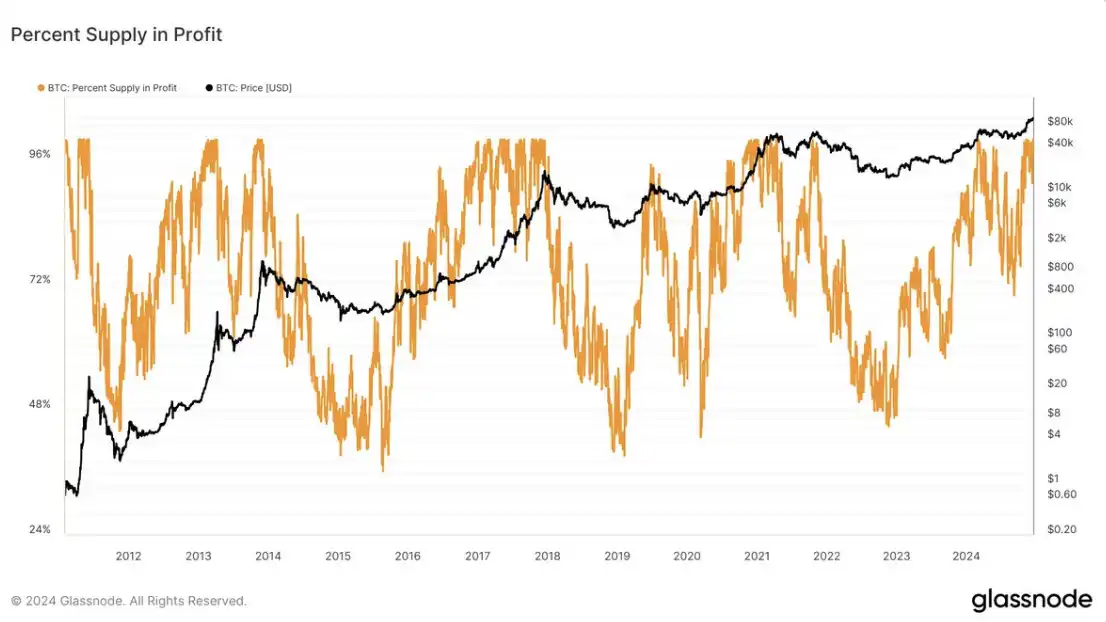
PSIP, short for Percent Supply in Profit, is defined as "the percentage of circulating $BTC that is in a state of profit."
Calculation method:
It distinguishes profit and loss chips by "comparing each $BTC's last transfer price with the current price."
When the current price is higher than a certain $BTC's last transfer price, this $BTC is considered a profit chip.
What if Most Chips Are in a Loss...?
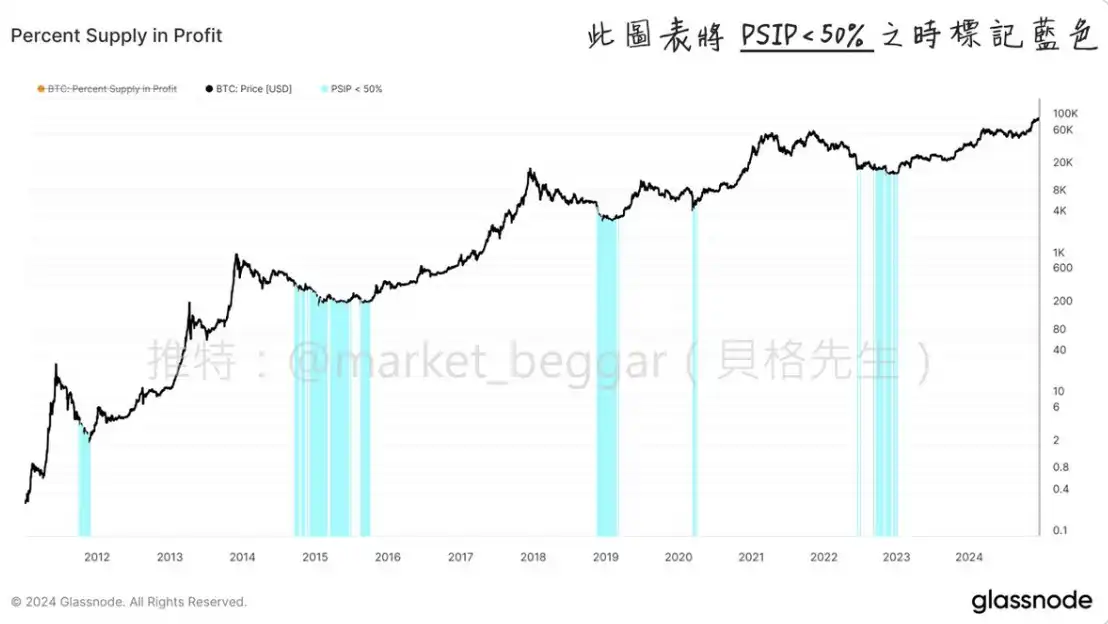
An important application scenario of PSIP is market bottoms. When most chips are in a loss, it is usually a good time to buy the dip.
The logic is straightforward:
Under similar conditions, the more profitable holders, the greater the selling pressure from profit-taking in the market, and vice versa.
As shown in the chart below, historical points where $BTC had PSIP <50% are marked, indicating very precise opportunities to buy the dip
What if the Majority of Chips are in Profit?
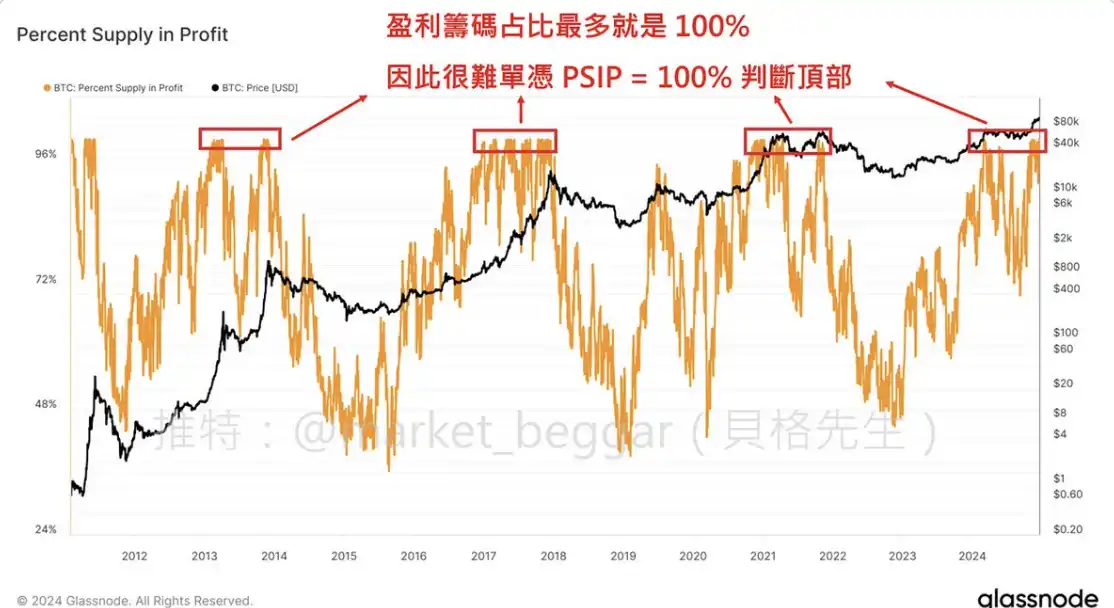
As shown in the chart below, the percentage of chips in profit reaches a maximum value of 100%. Therefore, it is difficult to determine a top based solely on high PSIP.
Here is an interesting logic to share: “Observe the Correlation Change between PSIP and Price”
This idea is derived from the following analysis: The Market Pulse – Week 36, 2022
Conclusion
The above is all the content of On-Chain Data School (Part Five). For readers interested in further studying on-chain data analysis, remember to keep track of this series of articles!
If you want to see more analysis and teaching content on on-chain data, feel free to follow my Twitter account (X)!
I hope this article has been helpful to you. Thank you for reading.
You may also like

a16z Crypto Partner: Cash flow is the moat

Citibank releases "2030 Asset Tokenization Market Outlook": 6 major trends may create a $8.2 trillion market

The trillion-dollar valuation test: Are the three major super IPOs a celebration for tech stocks or a nightmare for the crypto market?

Morning Report | Digital Asset completes $355 million financing led by a16z Crypto; Meta completes operational separation from Manus

Morning News | CME Group launches Nasdaq Cryptocurrency Index futures; Asset management giant Janus Henderson strategically invests in Ethena

Bitcoin Layer 2 Network Botanix: Why Did We Choose to Dissolve?

Why did Oracle deliver the strongest financial report in history, yet its stock price fell?
When the P2P illicit funds from ten years ago turned into 60,000 bitcoins

Dialogue with OmenX Founder: Why does the prediction market need an evolution from "spot" to "derivatives"?
Galaxy in-depth report: Is Solana still worth paying attention to?

Young people in South Korea make a "final effort" in the epic bull market
The pricing controversy of Trade.xyz exposes the fatal weakness of Pre-IPO perpetual contracts
How much longer can Ethereum's last big buyer hold on?

World Cup 2026 Coming – WEEX Celebrates with $1M Prize Pool & Michael Owen Live

Morning Report | OpenAI has submitted an S-1 registration statement draft to the U.S. SEC; Morpho completes $175 million financing

Galaxy Deep Research Report: How Hyperliquid's HIP-4 Upgrade Changes the Landscape of Prediction Markets?

Latest research from 13 top universities including Cornell University: The current state, challenges, and misconceptions of the fusion of Crypto and AI

Deconstructing Anthropic: The Best AI Company, Possibly Also a Type of Organizational Invention
a16z Crypto Partner: Cash flow is the moat
Citibank releases "2030 Asset Tokenization Market Outlook": 6 major trends may create a $8.2 trillion market
The trillion-dollar valuation test: Are the three major super IPOs a celebration for tech stocks or a nightmare for the crypto market?
Morning Report | Digital Asset completes $355 million financing led by a16z Crypto; Meta completes operational separation from Manus
Morning News | CME Group launches Nasdaq Cryptocurrency Index futures; Asset management giant Janus Henderson strategically invests in Ethena
Bitcoin Layer 2 Network Botanix: Why Did We Choose to Dissolve?


