
Market Panic Spreading, Which Assets Are Still Holding Strong?



Original Title: "Highlights and Shadows in a Downtrend | Frontier Lab Cryptocurrency Market Weekly Report"
Original Author: Frontier Lab
Market Overview
Overall Market Situation
This week, the cryptocurrency market has been in a rapid downtrend, with the market sentiment index dropping from 33% to 11%. The market capitalization of stablecoins has essentially ceased continuous growth (USDT reaching 142 billion, USDC reaching 55.9 billion, with changes of 0.02% and -0.53% respectively), indicating that as the market experienced a significant decline, institutional funds have stopped entering, leading to signs of exiting. Market sentiment saw panic mainly due to the Bybit exchange being hacked for $1.5 billion in assets and Trump's aggressive tariff policy, intensifying market concerns about inflation. This has reduced the likelihood of a Fed rate cut, heightened market fears of a U.S. economic recession, and had a strong impact on market sentiment, plunging it into extreme fear. Altcoins have generally underperformed the benchmark index.
Next Week Forecast Targets
Bullish Targets: LTC, S, SOSO, BERA
LTC: LTC rose against the trend this week, showing strength in the market as a whole declined. This strong performance was mainly due to market expectations for its LTC ETF approval. This week, the spot LTC ETF proposed by Canary Capital has been listed in the Depository Trust & Clearing Corporation (DTCC) system, and LTC has received 87% approval for staking on Polymarkt. The market currently has high expectations for the approval of the LTC spot ETF, so there will be continuous hype around the LTC spot ETF event until its formal approval.
S: Sonic has recently entered the DeFi industry, attracting a large number of on-chain users and funds through its on-chain DeFi project with high APY. In its on-chain primary liquidity staking projects, Beets and Origin, the APY for liquidity pools based on the S token can reach up to 32.22% and 123% respectively. The average interest rate for users borrowing the S token in Sonic's on-chain lending protocol is 10.21%, allowing users to achieve a yield of over 20%. Additionally, the recent surge in demand for the S token due to the popularity of Sonic's on-chain activities has driven up the price of the S token against the trend. This increase in price has further boosted the earnings of Sonic's on-chain users. Therefore, in the current bear market, users can still gain over 20% in risk-free returns, attracting a large number of users to participate through borrowing, increasing the market demand for the S token and driving its price into a spiral uptrend.
SOSO: The SoSoValue project team is able to continuously adjust its future development direction according to the market trend. Originally, SoSoValue positioned itself as an AI-technology-enhanced all-in-one investment service platform, aiming to keep up with the market trend of AI Agents. After the decline of AI Agents, market attention and funding shifted back to Defi projects. As a result, SoSoValue seized the current trend of high APY to attract users and transformed itself into a financial service center. While still leveraging its AI technology within the product, the focus of promotion shifted to highlighting the high APY it could provide. Recently, the project launched its second season of mining activities, allowing users to mine the SOSO token by holding or staking the SSI packaged index token. Through this initiative, users can earn staking rewards along with additional airdropped SOSO tokens, with APY reaching up to 42%. This move attracted more users to participate in mining, further increasing the bullish sentiment towards the SOSO token.
BERA: The overall market was in a downtrend this week. Initially, BERA was also affected by the market and experienced a decline. However, the Berachain project team quickly adjusted the on-chain APY of the LSD project. In Berachain's main LSD project, Infrared Finance, the APY of WBERA was increased to a maximum of 123%, and the borrowing rate of BERA in the on-chain lending project reached 23.68%. This adjustment allowed arbitrage participants to earn a 100% risk-free annualized return, swiftly reversing the downtrend to an uptrend. The strategy employed by the Berachain project team was similar to Sonic's, focusing on attracting on-chain users and funds through high APY to facilitate staking, liquidity provision, DeFi empowerment, and token appreciation. By offering high APY, the project aimed to increase the demand for the on-chain primary coin BERA in the market, thereby promoting an increase in the BERA token price.
Bearish Targets: ETH, SOL, ADA, AI, TKO, RUNE
ETH: Bybit was hacked this week, resulting in the theft of 491,000 ETH. Although Bybit has already fully recovered the stolen ETH through purchase and redemption, the buying pressure generated has not been reflected in the market price. This indicates that market investors still hold FUD sentiments towards ETH, as they anticipate continued selling pressure from the hacker. Furthermore, the investigation report on the Bybit hack explicitly stated that the main reason for the theft was a vulnerability in the platform's safe system, rather than a flaw in the exchange's infrastructure. This raised significant doubts in the market regarding safe technology, which is commonly used by most projects in the Ethereum ecosystem. Therefore, this poses a potential risk to the security of most projects in the Ethereum ecosystem. Additionally, Ethereum's Pectra upgrade is scheduled to go live on the testnet this weekend. Historically, price pumps occur before technical upgrades, followed by retracements post-implementation. Given that the Pectra upgrade has not injected much bullish momentum into ETH's price, a probable scenario after its implementation is a price decline for ETH.
SOL: This week, SOL experienced a significant drop following the overall market trend. This was mainly due to the recent retreat of the Meme coin craze. Solana, as the public chain with the highest Meme coin returns, also faced various FUD (Fear, Uncertainty, Doubt) voices in the market. This led to an outflow of funds from Solana's chain, with its Total Value Locked (TVL) dropping from $12.1 billion to $7.3 billion, a decrease of 39.66%. The on-chain liquidity staking yield on Solana also decreased from 10.29% to 7.26%. Additionally, on-chain transaction volume decreased from $35.5 billion to $2.4 billion, plunging by 93.23%. These indicators suggest that Solana's on-chain ecosystem is on the brink of collapse. Moreover, on March 1st, 11.2 million SOL tokens will be unlocked, with these tokens predominantly held by institutions. This unlocking may lead to continued selling pressure, exacerbating market investors' fear and panic regarding SOL.
ADA: This week, Cardano's on-chain TVL experienced a significant decline, dropping by 26.88% to $3.08 billion. This marks a 56.06% decrease from its peak of $7.01 billion. The TVL of all ecosystem projects on its chain also saw declines of over 10%, indicating a rapid outflow of funds from the Cardano ecosystem. This trend reflects the current market sentiment of FUD towards the Cardano ecosystem. Trading volume on its on-chain DEX has decreased by over 68%, and the ADA token's borrowing rate is currently at 3.29%. These numbers suggest that very few participants are engaging in borrowing and lending activities in the Cardano ecosystem, leading to borrowing rates significantly lower than those of other public chain tokens. Therefore, if outflows from the Cardano on-chain funds continue, it is expected that ADA will continue to decline next week.
AI: Sleepless AI is an AI-based GameFi project. Among all AI and GameFi projects, Sleepless AI experienced the deepest retracement during this downturn. This is because investors in the market have lost interest in the Play-to-Earn model of GameFi, resulting in a gradual decrease in users and minimal new capital inflow. There is a widespread belief that AI projects are currently overvalued, leading to a significant pullback trend in the AI track. Additionally, AI is set to unlock 17.27 million tokens next week, accounting for 1.73% of the current circulating supply. With a large unlocking percentage and the recent downturn in this track, it is expected that a downturn will occur shortly after the token unlocking.
TKO: Tokocrypto is the largest cryptocurrency exchange in Southeast Asia. Due to the recent Bybit hack incident, various centralized exchanges have been negatively impacted, causing the tokens of various exchanges to underperform. Additionally, TKO is about to unlock 100 million tokens, which accounts for 2.02% of the current circulating supply. The high unlock percentage is expected to lead to a price decline after the unlock.
RUNE: THORChain is a decentralized cross-chain AMM trading protocol. This week, it experienced a significant counter-trend surge from Monday to Wednesday. This surge was mainly caused by the hacker who stole from Bybit continually transferring ETH into THORChain to conduct money laundering transactions. As a result, THORChain saw a substantial increase in trading volume and fees. Despite not following the overall market trend, the exposure of the hacker's use of THORChain for money laundering led to THORChain's developer, Pluto, announcing resignation. It is expected that next week, the price will continue to fall due to reduced transaction volume and market FUD regarding its alleged money laundering activities.
Market Sentiment Index Analysis
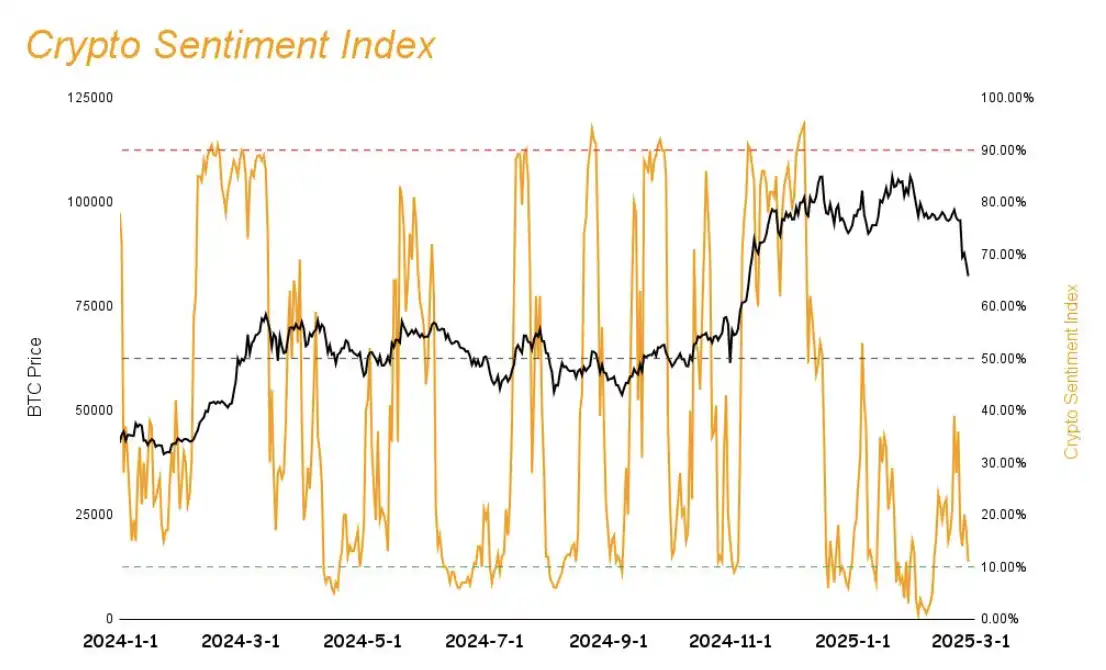
The market sentiment index decreased from 33% last week to 11%, placing it close to the extreme fear zone overall.
Hot Track
Sonic
· Current Status
In recent weeks, Sonic's chain TVL has maintained a rapid growth trend. This week, while the TVL of most other chains on the network experienced a downward trend, Sonic was the only chain with a TVL exceeding $50 million to maintain a 10% growth rate. The TVL on the chain increased to $683 million, demonstrating that its on-chain ecosystem can continue to attract funds even in a severely bearish market. Sonic's token, S, also saw a 7.63% increase this week. Although the rise is not significant, achieving an increase while the overall market is collapsing indicates market recognition.
· Reasons for Hot Trend
Recently, Sonic has shifted its project focus from GameFi to DeFi on-chain, using high APY to attract on-chain users. In its main liquidity projects on the chain, users can receive up to 123% APY, while the borrowing and lending side offers around 10% interest rates, enabling users to achieve over 100% APY arbitrage opportunity. In the current bearish market, APY over 100% is highly attractive to on-chain users, prompting them to participate in arbitrage through buying or borrowing, increasing the demand for token S and leading to its outperformance compared to most other tokens.
· Future Outlook
The recent popularity of the Sonic ecosystem can be attributed to the LSD project within the Sonic ecosystem, which increased the annual percentage yield (APY), attracting more on-chain users to participate in arbitrage activities. Therefore, we can see that a quick development path for an ecosystem is to achieve efficient driving of its economic flywheel, with the project focusing on the DeFi track to empower assets efficiently. In order to empower assets around DeFi, emphasis needs to be placed on asset collateralization and liquidity, allowing assets to generate compound returns in DEX, lending, and asset management. The on-chain ecosystem's economic flywheel must be formed through staking + liquidity + DeFi empowerment + user growth in a positive feedback loop. The core driving force lies in the dual-wheel drive of on-chain native token staking and liquidity release, enabling the generation of compound returns in scenarios such as DEX, lending, and asset management, achieving "staking as productivity." Once on-chain users are attracted by high APY to the on-chain ecosystem, it is necessary to establish a positive cycle of staking lockup → liquidity release → DeFi empowerment → token appreciation → user retention → re-staking → developer aggregation. Otherwise, if new users' funds entering the ecosystem are insufficient to cover the selling pressure from arbitrage, the token price will decline, leading to a reduction in project yields and causing arbitrageurs to exit. This would be a significant blow to an ecosystem, so we need to continue monitoring the APY of Sonic's on-chain DeFi projects to assess if the Sonic chain still has development momentum through on-chain APY.
However, it is important to note that although Sonic's TVL was the fastest-growing among all chains with over $1 billion TVL this week, its TVL did not consistently rise this week but experienced a peak and retreat phenomenon.
Berachain
· Current Status
This week, the entire market was in a rapid downturn trend, and the top ten projects by TVL were all in a declining state except for Berachain. Although Berachain's TVL only increased by 4.66% this week, maintaining positive growth in the current environment is already commendable. The TVL reached $3.194 billion, ranking sixth in TVL among all public chains, surpassing the Base chain. The price of its token, BERA, also saw an increase this week, with a rise of 7.26%, placing it in a strong position among Altcoins.
· Reasons for Popularity
This week, the TVL of the top DEX, Lending, and LSD projects in the Berachain ecosystem showed a slowing growth rate compared to the previous weeks. Additionally, there was a decrease in Berachain's TVL in the first half of the week. However, the situation reversed when the primary LSD project on Berachain, Infrared Finance, offered the highest WBERA APY of 121%, and the emerging LSD project, Stride, achieved an APY of 190.12%. Simultaneously, the borrowing rate for BERA in Berachain's lending projects was 23.68%, allowing arbitrageurs to earn a risk-free 100% annual percentage yield. This quickly halted the downward trend and shifted it towards an upward movement.
· Future Outlook
Berachain remained vibrant this week mainly due to the increased APY of its on-chain DeFi projects, maintaining a high level of attractiveness to on-chain users. This led to a substantial inflow of funds into Berachain. Berachain's development path is somewhat similar to Sonic, so it faces similar challenges. Currently, Berachain has achieved a process of staking lockups → liquidity release → DeFi empowerment → token value appreciation. However, it has not seen outstanding on-chain projects in the process of user retention → re-staking → developer aggregation. Therefore, while the high-yield model has enabled rapid development of the on-chain ecosystem in the short term and promoted a swift rise in the project's token, BERA, it will inevitably face increasing selling pressure in the future. When the capital from new users is insufficient to offset the sell pressure from arbitrage, the BERA token price will decline. Subsequently, the returns of various projects will decrease, causing arbitrageurs to exit. Therefore, in the future, more attention should be paid to whether new stellar projects emerge in the Berachain on-chain projects and whether the interest rates for on-chain LSD projects significantly decline.
Market Theme Overview
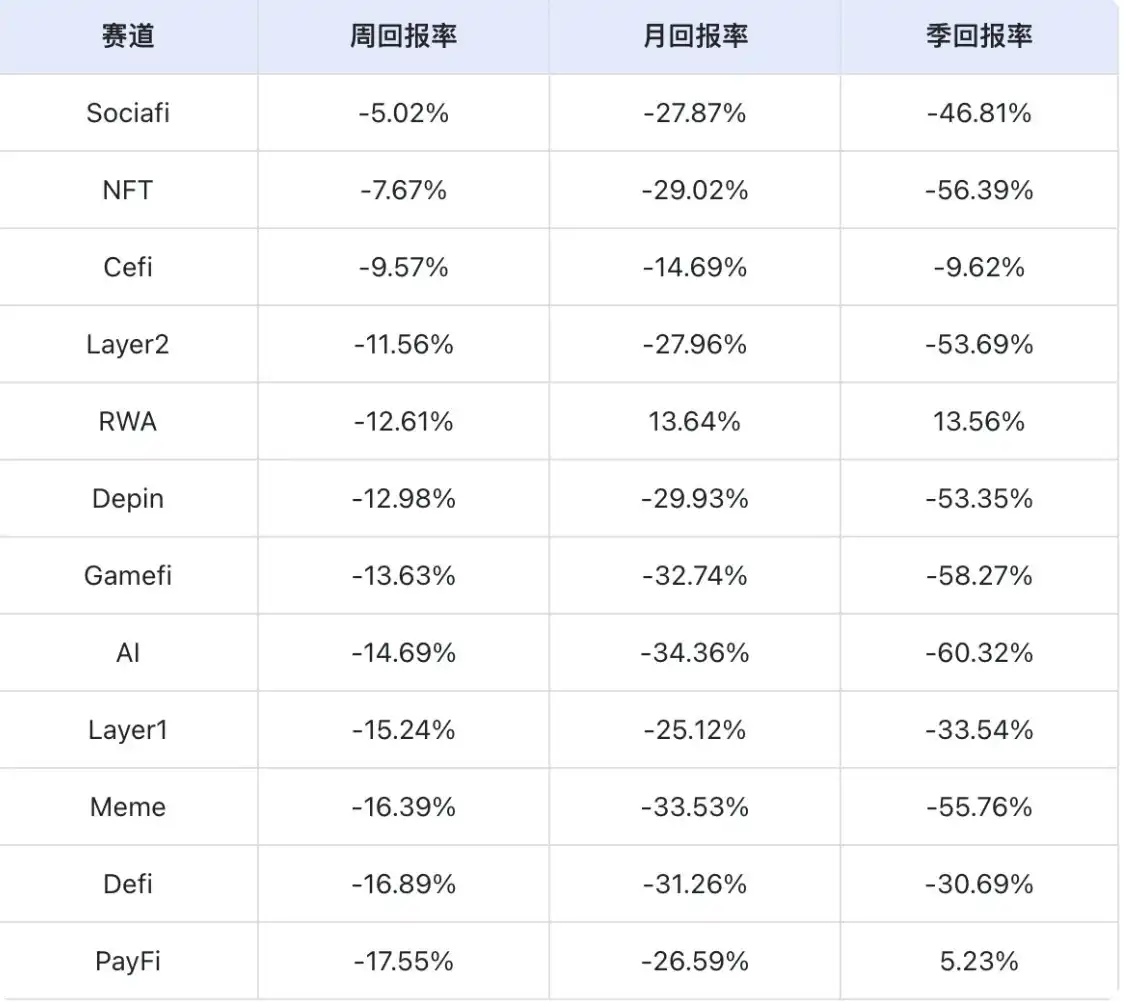
Data Source: SoSoValue
In terms of weekly returns, the Sociafi track performed the best, while the PayFi track performed the worst.
· Sociafi Track: In the Sociafi track, TON and CHZ account for a significant portion, totaling 95.17%. Their respective weekly declines were: -4.86% and -4.79%. Although both are in a downward trend, they still outperformed other Altcoins, resulting in the best performance of the entire Sociafi track index.
· PayFi Track: In the PayFi track, XRP, LTC, and XLM account for a significant portion, totaling 94.62%. Their weekly declines were: -19.23%, -1.21%, and -16.96%, respectively, making the PayFi track the worst performer.
Next Week's Crypto Major Events Preview
Monday (March 3rd): U.S. February ISM Manufacturing PMI
Wednesday (March 5th): U.S. February ADP Employment Change; Pectra Network upgrade plan launches on the Ethereum testnet
Friday (March 7th): U.S. February Seasonally Adjusted Nonfarm Payrolls; U.S. February Unemployment Rate
Summary
This week, the cryptocurrency market experienced a significant decline, with the market sentiment index plummeting sharply, reflecting investors' widespread concerns. However, some projects such as LTC, Sonic, SoSoValue, and Berachain attracted users through high APY strategies. In the long run, market stability and the emergence of new projects will be key factors. It is advisable for investors to closely monitor market dynamics and exercise caution.
You may also like

Japan’s Three Megabanks Plan Joint Stablecoin Issuance in Fiscal 2026
MUFG, SMBC, and Mizuho reportedly plan to jointly issue fiat-pegged stablecoins in fiscal 2026, signaling Japan’s growing push into bank-led digital payment infrastructure.

Humanity Discloses H Token Dual-Chain Attack Details, With Losses on Ethereum and BSC Exceeding $36 Million
Humanity said the H token attack across Ethereum and BSC caused more than $36 million in losses after leaked ProxyAdmin keys enabled malicious contract upgrades and token minting.

White House Discusses CLARITY Act With Law Enforcement Ahead of Senate Vote
The White House discussed the CLARITY Act with law enforcement ahead of a Senate vote, focusing on illicit finance risks and developer protections.

$75 billion in foreign capital has fled, and South Korean retail investors have absorbed it all using leverage

Bitcoin Trading Guide 2026: Strategies for Experienced Traders

What Is XAUT and PAXG? Why Tokenized Gold Is Booming in 2026

Cryptocurrency CEXs are flocking to sell US stocks, and traditional brokerages are facing an "uninvited guest."

Will the SpaceX IPO Hurt Bitcoin? Here's What Traders Are Watching
Foreign selling in the South Korean stock market accelerates, with cumulative net sales reportedly reaching $75 billion this year
On June 9, The Kobeissi Letter, citing Goldman Sachs data, reported that global investors are selling South Korean stocks at an unusually rapid pace. In the latest trading session, foreign investors sold about $801 million worth of Kospi constituent stocks again; total foreign outflows last week reached about $10 billion, and the market has been in net foreign selling on nearly every trading day over the past month. According to the data cited in the report, foreign investors have sold about $75 billion worth of South Korean stocks so far this year. Meanwhile, South Korean retail and institutional investors together recorded roughly $69 billion in net buying over the same period, suggesting that the market’s main buying support has come from domestic capital rather than returning overseas funds. The information currently disclosed still mainly comes from The Kobeissi Letter’s retelling and Goldman Sachs data summaries, while public details on the statistical period and the specific definition of “selling” remain relatively limited.

Fortune Warns of Strategy’s Financing Structure Risks as Bitcoin Premium Narrows
Fortune warned that Strategy’s Bitcoin treasury model faces growing financing risks as MSTR’s net asset premium narrows and preferred stock dividend pressure increases.

Ferrari Challenge Le Mans: Carl Moon to Dominate in WEEX Livery

Sahara AI Responds to SAHARA’s Sharp Drop: No Contract or Product Security Issues Found, Internal Investigation Underway
Sahara AI responded to SAHARA’s 60% price drop, saying no token contract or product security issues have been found and an internal investigation is underway.

WEEX Deposit/Withdrawal Dynamic Island: Your Asset Status, Always in Sight
Scaling Crypto Derivatives: The Digital Asset Infrastructure Behind High-Volume Trading
In the fast-moving digital asset ecosystem, derivatives platforms face an extreme architectural test. High-leverage futures markets demand more than just standard security—they require absolute operational precision, zero-latency matching engines, and ironclad structural scalability, all while navigating intense market volatility.
As global platforms scale to meet these demands, the industry is shifting away from rigid, monolithic setups toward a more agile, "decoupled" infrastructure philosophy.
The Blueprint for High-Volume Copy TradingFor elite global exchanges like WEEX (founded in 2018), this architectural choice becomes critical when scaling high-volume retail features like social copy trading. When thousands of users automatically mirror the real-time strategies of elite traders simultaneously, it triggers sudden, monumental spikes in concurrent transactional volume.
To prevent execution latency or settlement bottlenecks during these peak volatility events, a platform's primary engine must remain entirely dedicated to risk management, copy-trade synchronization, and order matching.
The Architectural Rule: New-generation platforms must separate front-end user execution engines from heavy backend infrastructural overhead to eliminate operational friction.
By separating these layers, platforms can maintain complete sovereignty over their trading environments and user experiences while strategically aligning with institutional-grade infrastructure ecosystems. This strategic framework allows modern exchanges to leverage advanced Digital Asset Custody infrastructure such as Cobo’s behind the scenes, ensuring that backend wallet management scales elastically alongside trading spikes.
Capitalizing on Market Momentum and 400× LeverageIn a derivatives arena where platforms offer up to 400× leverage on perpetual contracts, capital efficiency and market agility are core business metrics. To capture market momentum, an exchange needs the ability to rapidly expand its asset offerings, supporting everything from legacy crypto assets to sudden, trending altcoins across a massive library of trading pairs.
Adopting a flexible, scalable Wallet-as-a-Service (WaaS) solution such as Cobo’s could completely rewrite the development timeline for high-growth exchanges. Instead of spending months of engineering capital building out custom backend wallet architectures for every new blockchain network, platforms can deploy localized infrastructure in days.
This agility allows platforms to instantly scale their listings to over a thousand trading pairs without compromising security or delaying time-to-market. It mirrors the exact operational advantages seen during high-velocity market events, similar to how advanced wallet infrastructure empowers platforms during sudden asset surges; allowing exchanges to pass that speed and liquidity directly to their global user base.
A Mature Foundation for GrowthThe synergy between trusted infrastructure ecosystems and global trading platforms represents the natural evolution of a maturing crypto market. As WEEX continues to scale its global spot and derivatives offerings for over 6 million users, adopting robust backend paradigms proves that platforms no longer have to compromise between cutting-edge trading velocity and uncompromised structural security.

Morning Report | BitMine increased its holdings by 126,971 ETH last week; trader Eugene announced his exit from the crypto market

Wang Chuan: How can one not feel anxious after the neighbor Old Wang made thirty times profit by investing in storage stocks? (Seven) - A quarter-century cycle

Get Paid to Onboard? Try WEEX’s New Homepage with Rewards for Registration, Deposit & Trade
WEEX Custom Layout: Build Your Perfect Trading Workspace in Seconds
Japan’s Three Megabanks Plan Joint Stablecoin Issuance in Fiscal 2026
MUFG, SMBC, and Mizuho reportedly plan to jointly issue fiat-pegged stablecoins in fiscal 2026, signaling Japan’s growing push into bank-led digital payment infrastructure.
Humanity Discloses H Token Dual-Chain Attack Details, With Losses on Ethereum and BSC Exceeding $36 Million
Humanity said the H token attack across Ethereum and BSC caused more than $36 million in losses after leaked ProxyAdmin keys enabled malicious contract upgrades and token minting.
White House Discusses CLARITY Act With Law Enforcement Ahead of Senate Vote
The White House discussed the CLARITY Act with law enforcement ahead of a Senate vote, focusing on illicit finance risks and developer protections.
$75 billion in foreign capital has fled, and South Korean retail investors have absorbed it all using leverage
Bitcoin Trading Guide 2026: Strategies for Experienced Traders
What Is XAUT and PAXG? Why Tokenized Gold Is Booming in 2026


