
L2 vs. L1: The Hidden War, Who Will Emerge as the Winner in dApp Revenue?




Original Article Title: The L2 vs L1 Battle that Nobody is Talking About
Original Article Author: 0xtaetaehoho, Chief Security Officer at EclipseFND
Original Article Translation: zhouzhou, BlockBeats
Editor's Note: L2 has a cost advantage over L1 in terms of operation cost, as L2 only needs to pay the cost of a single sequencer, while L1 needs to pay for the security of all validators. L2 has unique advantages in speed and reducing MEV, and can support dApp revenue maximization through innovative economic models. Although L2 cannot compete with L1 in terms of liquidity, its potential in the dApp economy will drive the crypto industry's transition from infrastructure to profit-driven long-term business models.
The following is the original content (slightly reorganized for clarity):
Here is a decision matrix from the dApp perspective, analyzing the choice to deploy on L1 or L2 in the current environment, assuming both support similar types of applications (i.e., L1/L2 are not customized for specific application types).
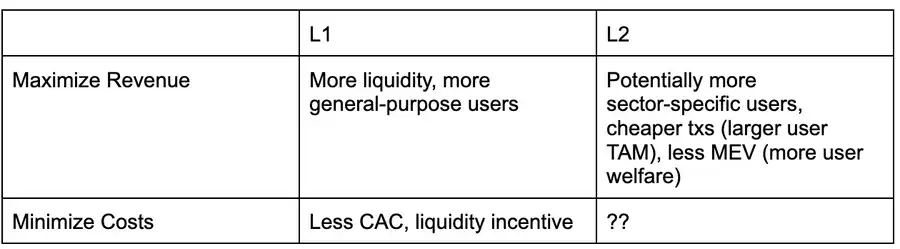
Other than relatively less MEV (Miner Extractable Value) due to the centralization of block producers, L2 has not fully utilized its other advantages. For instance, while L2 has the potential for lower transaction costs and higher throughput, Solana currently leads in performance and transaction costs compared to L2 in the EVM ecosystem.
As Solana continues to improve throughput and advance MEV capture mechanisms (such as ASS and MCP), L2 needs to explore new ways to help dApps maximize revenue and reduce costs. In my current view, L2 is structurally more advantageous than L1 and can execute dApp revenue maximization strategies more quickly.
One of the key roles of the execution layer in maximizing application revenue is the allocation of fees/MEV.
Currently, achieving MEV capture or fee sharing relies on "honest block proposers," who are willing to follow ordering rules of precedence, or proposers who share revenue with the application according to preset rules. Another approach is to allocate a portion of the base fee from EIP1559 to user-interacting dApps, which Canto CSR and EVMOS seem to adopt. This can at least enable dApps to enhance their ability to bid on their own MEV revenue, making them more competitive in the transaction inclusion market.
In the L2 ecosystem, if the block proposer is operated by a team (i.e., a single block proposer), then it is inherently "honest" and can ensure the transparency of the block construction algorithm through a reputation mechanism or TEE (Trusted Execution Environment) technology. Currently, two L2s have adopted fee splitting and priority ordering for block construction, and the Flashbots Builder can also provide similar functionality to the OP-Stack ecosystem with minor modifications.
In the SVM (Solana Virtual Machine) ecosystem, similar infrastructure like Jito can proportionally reallocate MEV revenue to dApps (such as calculated by CUs, similar to the mechanism adopted by Blast).
This means that while L1 is still researching MCP and built-in ASS schemes (Solana may advance this effort, but there is no equivalent CSR revival plan in the EVM ecosystem), L2s can implement these features more quickly. Since L2s can rely on trusted block producers or TEE technology without the need to adopt the OCAproof mechanism mandatorily, they can more quickly adjust a dApp's MRMC (revenue, cost, MEV competition) model.
However, the advantages of L2s are not only in development speed or fee reallocation capabilities; they also face fewer structural constraints.
The survival conditions of the L1 ecosystem (i.e., the conditions to maintain the validator network) can be described by the following equation: Total Validators × Validator Operating Cost + Staking Capital Requirement × Capital Cost < TEV (Inflation + Total Network Fee + MEV Tip)
From the perspective of a single validator: Validator Operating Cost + Staking Capital Requirement × Capital Cost > Inflation Reward + Transaction Fees + MEV Revenue
In other words, L1 faces a hard constraint to reduce inflation or decrease fees (through sharing with dApps)—validators must remain profitable!
If the Validator Operating Cost is high, this constraint becomes more apparent. For example, Helius pointed out in a related article to SIMD228 that if inflation is reduced according to the proposed issuance curve, at a 70% staking rate, 3.4% of current validators may drop out due to declining profitability (assuming REV maintains 2024 levels of volatility).
REV (MEV share in staking rewards) experiences extreme volatility:· On the day of the TRUMP event, the REV share reached 66%· On November 19, 2024, the REV share was 50%· Currently (at the time of writing), the REV share is only 14.4%
This means that in the L1 ecosystem, due to validator profit pressure, reducing inflation or adjusting fee distribution has a ceiling, while L2 is not bound by this constraint and can therefore more freely explore strategies to optimize dApp revenue.
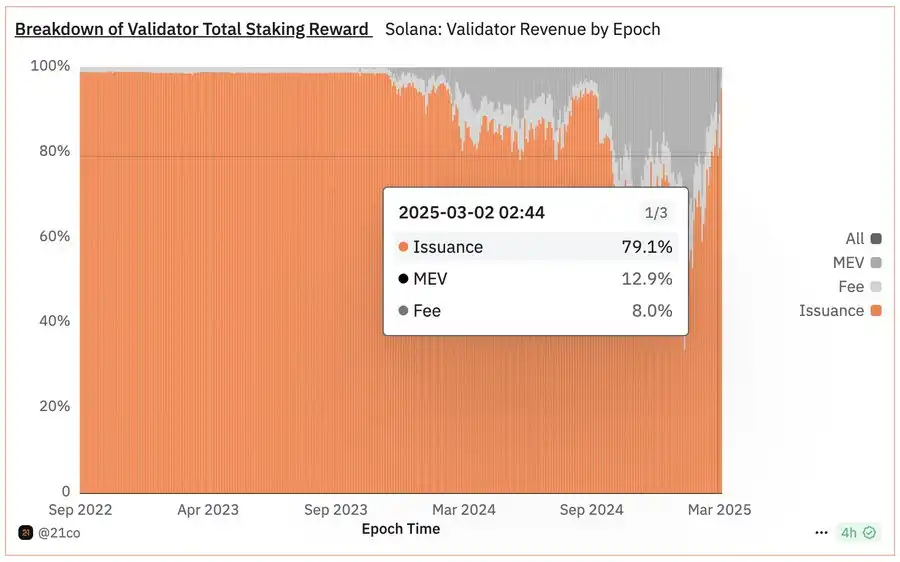
Solana validators currently face high operating costs, directly limiting the "shareable profit space," especially as the inflation rate decreases. If Solana validators must rely on REV (MEV share in staking rewards) to remain profitable, then the total proportion that can be allocated to the dApp will be strictly limited.
This brings an interesting trade-off: the higher the validator operating costs, the higher the network's overall fee take-rate must be.
From the perspective of the entire network, the following formula must be met: Total Network Operating Costs (including capital costs) < Total Network REV + Circulating Supply
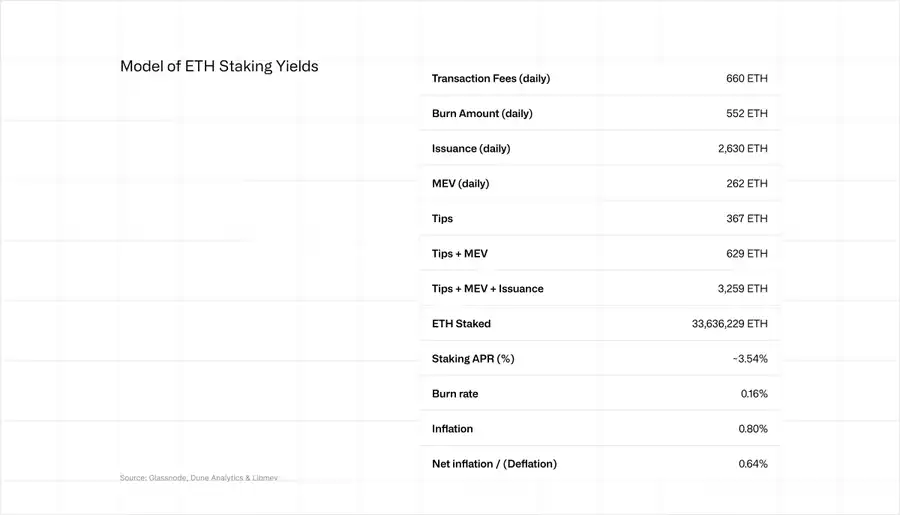
Ethereum faces a similar situation, but to a lesser extent. Currently, the APR (Annual Percentage Rate) of ETH staking ranges from 2.9% to 3.6%, with approximately 20% coming from REV. This also means that Ethereum's ability to optimize dApp revenue is similarly constrained by validator profit requirements.
This is where L2 has a natural advantage. On L2, the total network operating cost is only the operating cost of a sequencer, with no capital costs because there is no staking requirement.
Compared to L1 with a large number of validators, the profit margin required to maintain a break-even on L2 is minimal. This means that while maintaining the same profit margin, L2 can allocate more value to the dApp ecosystem, significantly increasing the dApp's revenue potential.
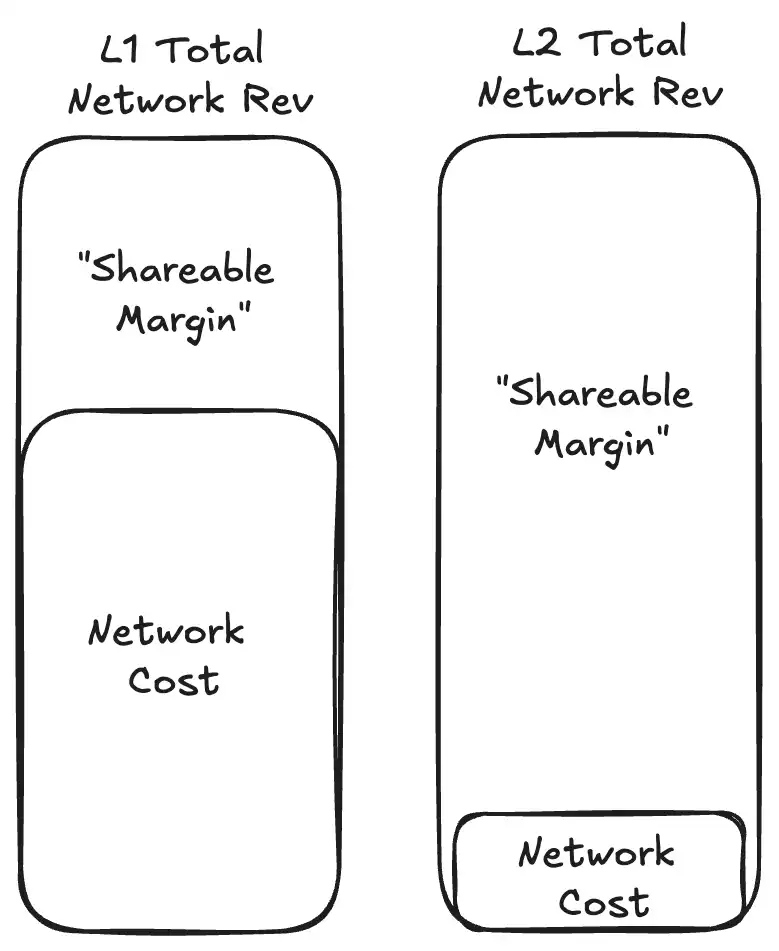
The network cost of L2 will always be lower than an equivalent-sized L1 because L2 only needs to periodically "borrow" the security of L1 (occupying part of L1's block space), while L1 must bear the full cost of securing its entire block space.
L1 vs L2 Battle: Who Can Dominate the dApp Economy?
By definition, L2 cannot compete with L1 in terms of liquidity, and since the user base still primarily resides on L1, L2 has also struggled to directly challenge L1 at the user level (although Base is changing this trend).
However, to date, few L2 solutions have truly leveraged their unique advantages as L2—those characteristics derived from the centralization of block production.
Superficially, the most discussed benefits of L2 are:
1. Mitigating malicious MEV
2. Increasing transaction throughput (some L2 solutions are exploring this direction)
But more importantly, the next main battleground in the L1 vs. L2 war will be the dApp economic model.
Advantage of L2: Non-OCAproof TFM (Non-Orthogonal Composability TFM)
Advantage of L1: CSR (Contract Self-Revenue) or MCP (Minimal Consensus Protocol) + MEV Tax
This competition is the most bullish thing for the crypto industry
Because it directly brings:
· dApp revenue maximization, cost minimization, thereby incentivizing developers to build better dApps.
· Changing the incentive structure of the crypto industry from the previous infrastructure token premium (L(x) premium) to a profit-driven long-term crypto business.
· Combining DeFi regulatory clarity, protocol-level token value capture, and institutional capital inflow, driving the crypto market into an era centered on "actual business models."
Just as in the past few years we have seen funds flowing into infrastructure development, driving innovation in areas such as applied cryptography, performance engineering, consensus mechanisms, etc., today, inter-chain competition will bring about a significant transformation in industry incentive structures and attract the smartest talent to Crypto application layers.
Now is truly the starting point for the large-scale adoption of crypto!
You may also like

CFTC Reportedly Plans New Prediction Market Rules Focused on Manipulation Risk and Public Interest Review
The CFTC is reportedly preparing new prediction market rules focused on manipulation risk, public interest review, and retail trader protections.

Meet the new WEEX trial fund—your gateway to greater profits

WEEX Labs Lands at Dutch Blockchain Week: A Disruptive Crypto × AI Conversation Sets Sail in Amsterdam

SK Hynix Reportedly Plans U.S. ADR Listing as Early as August, With SEC Approval Possible in Late June
SK Hynix may pursue a U.S. ADR listing as early as August, with SEC approval reportedly possible in late June amid strong AI chip supply chain demand.

SpaceX vs Tesla vs xAI: Which Elon Musk Trade Has the Biggest Upside in 2026?
OpenAI Reveals It Has Confidentially Submitted an S-1 to the SEC, Keeping the Door Open for a Future IPO
On June 9, according to an OpenAI announcement, the company recently confidentially submitted a draft S-1 registration statement to the U.S. Securities and Exchange Commission (SEC), beginning the preliminary compliance process for a potential initial public offering. OpenAI said it chose to disclose this proactively because it expected the news might leak; however, the company has not yet set a specific listing timeline, and related arrangements may still take some time.

Latest research from 13 top universities including Cornell University: The current state, challenges, and misconceptions of the fusion of Crypto and AI
Deconstructing Anthropic: The Best AI Company, Possibly Also a Type of Organizational Invention
Apollo and Blackstone Reportedly Back $35 Billion Anthropic Chip Financing as Deal Details Remain Unclear
On June 9, according to currently available news alerts, Apollo and Blackstone Group participated in a $35 billion financing for an Anthropic “chip project.” Based on the original wording of the report, the funding has already been raised, but public information remains limited. The financing structure, use of proceeds, project entity, and whether Apollo and Blackstone participated through equity, debt, or project financing have not yet been disclosed.

Humanity Protocol Security Incident Escalates: More Than $31 Million Stolen From Related Addresses as Attacker Continues Selling H for ETH
On June 9, according to monitoring by Onchain Lens, more than $31 million has been stolen from addresses linked to Humanity Protocol, and the attack is still ongoing, with the hacker continuously swapping H tokens for ETH. Project founder Terence Kwok later confirmed the security incident on X, saying the issue involved a private key leak.

Bloomberg: As Bitcoin Weakens, Stablecoins and RWA Continue to Drive Expansion in Crypto Businesses
In June, Bloomberg reported that despite Bitcoin falling below $60,000 last week, wiping out about $235 billion in market value within seven days, and dropping close to 50% from last year’s peak, some core businesses in the crypto industry are still expanding, mainly in stablecoins, real-world asset tokenization (RWA), payments, and infrastructure. The report also noted that overall altcoin activity has contracted significantly: altcoin market capitalization has fallen from a peak of about $431 billion in November 2021 to around $170 billion, and among the tens of millions of tokens issued in recent years, fewer than 1,700 still maintain meaningful trading activity.

Galaxy Deep Research Report: How Hyperliquid's HIP-4 Upgrade Changes the Landscape of Prediction Markets?
Binance Research: RWA Market Expected to Expand Nearly 6x from Early 2025, with Public Equities and Onchain Payments Heating Up Together
In June, Binance Research said in its monthly market report that the real-world asset (RWA) market is expected to grow by about 589% from the beginning of 2025. Bond- and money market fund-related RWA expanded by about $6.5 billion, up 83% year over year, while publicly traded equity RWAs grew by about 422%. The report also noted that monthly crypto debit card transaction volume exceeded $747 million in May, up 48.6% year to date.

Japan to Assess a Framework for Yen Stablecoins and Crypto ETFs as Asia’s Compliant Payments Narrative Heats Up
Recently, according to the original report, Japan is considering the launch of yen stablecoins and cryptocurrency ETFs. Public information remains limited at this stage, and there is still no complete policy text, regulatory draft, or clear implementation timeline, so this is better characterized as a “policy discussion” rather than formal implementation. The original wording also noted that advancing stablecoin regulation in Asia is driving XRP usage and supporting growth in the XRPL ecosystem. However, based on currently available public information, there is not enough evidence to directly establish a clear causal relationship between this round of discussion in Japan and XRP or XRPL.

ZachXBT: Humanity private key leak and abnormal surge in H token should be viewed separately
On June 9, according to related disclosures, on-chain investigator ZachXBT posted an update on Humanity’s roughly $31 million security incident, saying that after further analyzing fund flows, he currently tends to believe the project team was not involved in an “inside job” or a self-staged attack. According to him, the official explanation about the private key leak was broadly accurate, but before the token unlock, the price of H had been artificially pushed higher, and the hacker later took advantage of that market environment; therefore, the private key leak and the earlier abnormal price pumping should be regarded as two separate and independent events. This reframing has shifted the market’s understanding of the nature of the incident. Earlier discussion around Humanity had focused on whether the team directly participated in the attack or used the security incident to cover up internal operations. ZachXBT’s latest remarks shift the focus from “whether it was self-theft” to “whether there were pre-unlock market structure issues.” He also questioned whether the team may have.

Morning Report | OpenAI has submitted an S-1 registration statement draft to the U.S. SEC; Morpho completes $175 million financing

Morning Report | BitMine increased its holdings by 126,971 ETH last week; trader Eugene announced his exit from the crypto market

Wang Chuan: How can one not feel anxious after the neighbor Old Wang made thirty times profit by investing in storage stocks? (Seven) - A quarter-century cycle
CFTC Reportedly Plans New Prediction Market Rules Focused on Manipulation Risk and Public Interest Review
The CFTC is reportedly preparing new prediction market rules focused on manipulation risk, public interest review, and retail trader protections.
Meet the new WEEX trial fund—your gateway to greater profits
WEEX Labs Lands at Dutch Blockchain Week: A Disruptive Crypto × AI Conversation Sets Sail in Amsterdam
SK Hynix Reportedly Plans U.S. ADR Listing as Early as August, With SEC Approval Possible in Late June
SK Hynix may pursue a U.S. ADR listing as early as August, with SEC approval reportedly possible in late June amid strong AI chip supply chain demand.
SpaceX vs Tesla vs xAI: Which Elon Musk Trade Has the Biggest Upside in 2026?
OpenAI Reveals It Has Confidentially Submitted an S-1 to the SEC, Keeping the Door Open for a Future IPO
On June 9, according to an OpenAI announcement, the company recently confidentially submitted a draft S-1 registration statement to the U.S. Securities and Exchange Commission (SEC), beginning the preliminary compliance process for a potential initial public offering. OpenAI said it chose to disclose this proactively because it expected the news might leak; however, the company has not yet set a specific listing timeline, and related arrangements may still take some time.


