
Is Wall Street's largest market maker, Citadel Securities, shorting ETH?


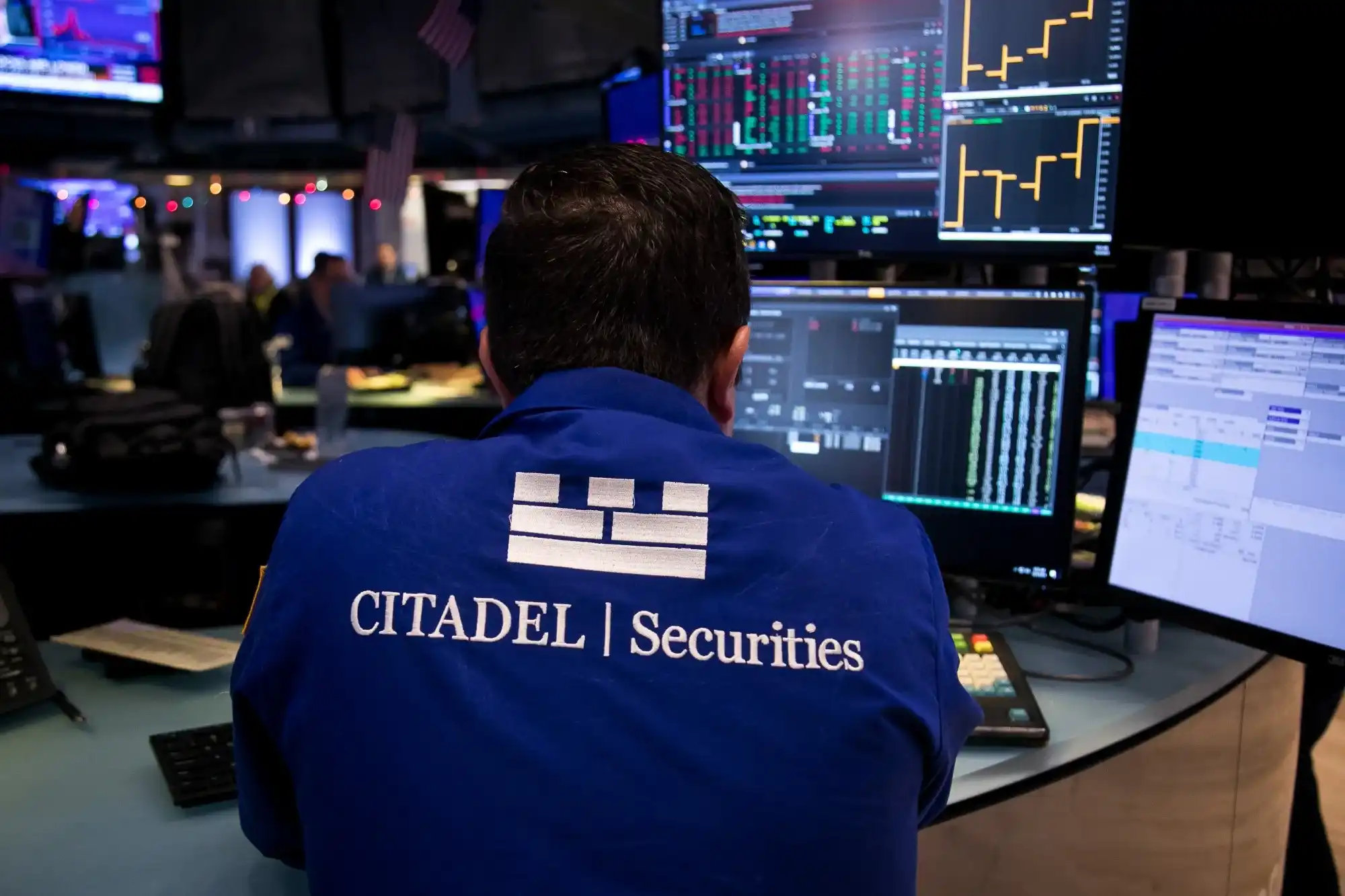
Who Is Shorting ETH?
Recently, an asset allocation table from a mysterious institution leaked, notably showing a "31 billion US dollars' worth of Ethereum short position" in a "multi-strategy" investment portfolio.
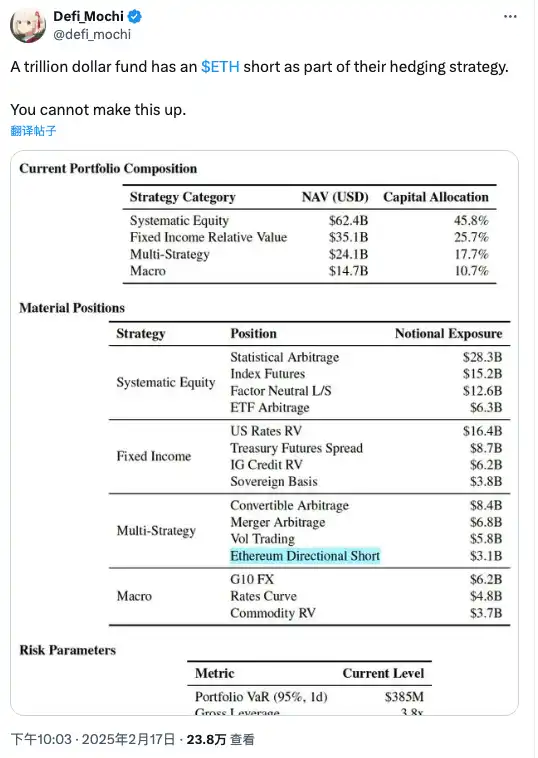
So the question is, who is the holder of this $31 billion Ethereum short position?
BlockBeats reached out to various sources of this asset allocation table and speculated on the two most likely candidates:
First is Bridgewater Associates. Some other sources' leaked data aligns with this asset allocation table, and Bridgewater Associates' CEO Ray Dalio has expressed interest in cryptocurrency, being a Bitcoin maximalist to some extent, which aligns with the logic of shorting ETH.
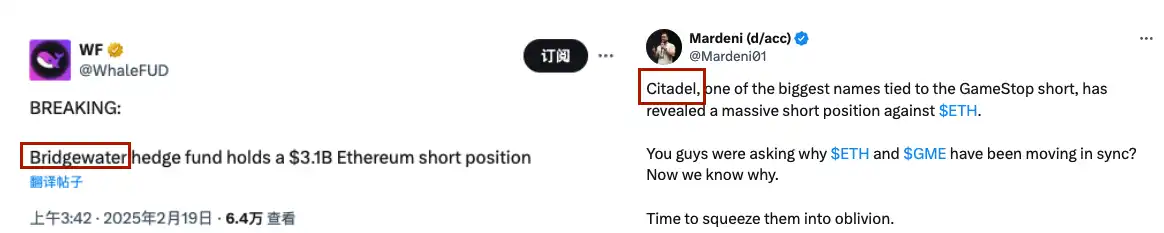
Another highly discussed possibility is Citadel Securities, the focus of our discussion today.
A "Big Player" Falls, Another "Big Player" Rises
If you still remember Black Monday in August 2024, triggered by Japan's interest rate hike.
Japan's first rate hike post abandoning negative interest rates caused the yen to surge against the dollar, leading to a reversal in arbitrage trades that triggered massive liquidation. The global financial market instantly collapsed, with a 9% drop in Japan's stock market, the Nikkei index hitting the circuit breaker twice, marking the largest single-day drop in eight years. The South Korean and Taiwanese stock markets were not spared, with the cryptocurrency market also facing heavy losses, Bitcoin dropping below $50,000 briefly, and Ethereum plummeting more than 25%, completely erasing its year-to-date gains.
However, attributing the cryptocurrency crash solely to the Japanese economy was not convincing to everyone until some old-timers revealed insider information.
As an OG crypto kingpin predating even SBF, BitMEX co-founder Arthur Hayes took to social media to share that through traditional financial channels, he learned that a certain "big player" was liquidating their crypto assets.
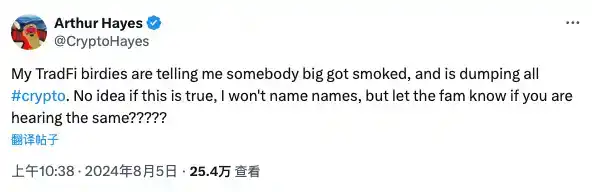
While no names have been explicitly mentioned, the community's indications have been quite clear, pointing directly to Jump Trading and its cryptocurrency arm, Jump Crypto. Since June last year, the U.S. Commodity Futures Trading Commission (CFTC) has been investigating Jump Crypto. In addition to facing regulatory pressure, Jump Crypto has also been embroiled in several controversial events. Firstly, the collapse of FTX resulted in significant losses for Jump Crypto. Furthermore, Jump has attracted regulatory attention for its involvement in the TerraUSD stablecoin collapse event.
As the CFTC investigation deepened, Jump Crypto's young CEO, Kanav Kariya, announced his resignation, and Jump's official Twitter account also stopped updating, seemingly signaling Jump's gradual exit from the cryptocurrency industry's spotlight.
However, as one "big player" fell, another "big player" stepped onto the stage.
Yesterday, Citadel Securities, a market maker, announced plans to enter the cryptocurrency market-making field. Like a relay race among traditional financial giants, with Jump Crypto exiting, Citadel Securities, also from a traditional financial background, chose to take over the baton in the crypto market.
Both Jump and Citadel, as representatives of traditional financial giants, share similar backgrounds and strategies. Both companies started with market-making businesses, with Jump establishing a presence in the financial markets through high-frequency trading and Citadel becoming one of the largest market makers globally through hedge funds and equally high-frequency quantitative analysis. When Jump entered the crypto market, it brought a strong technical team, hardware, and financial support, and Citadel also possesses these advantages.
The Wall Street Legend of Citadel Securities
Citadel Securities is one of the largest market makers on the NYSE. Its daily trading volume accounts for nearly 35% of U.S. stock trading volume, equivalent to the daily turnover of the Shanghai and Shenzhen stock markets, with annual revenues around $7 billion. Related Read: "Earning Billions a Day, Why Is Citadel Securities So Profitable?"
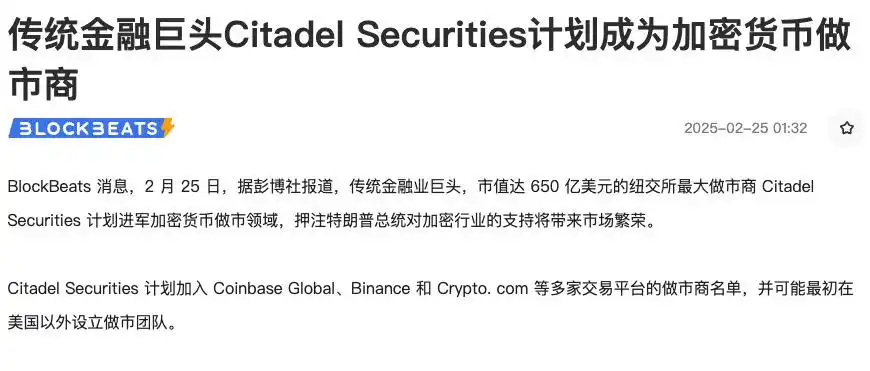
Outside of Citadel Securities' market-making business, the main business that Citadel was built on is its hedge fund, managing $65 billion in assets. It is a tech-savvy player in the hedge fund world, focusing on investment value fundamentals while analyzing the market through extensive information and various mathematical models. It is said to invest billions of dollars annually in models and hardware.
According to LCH Investments data, in 2022, the top 20 hedge fund firms collectively generated $22.4 billion in profit (after fees), with Citadel ranking first with a profit of $16 billion in 2022, setting a new annual return record for hedge fund firms. The latest data this year shows that among all global hedge funds in terms of net income and valuation rankings since their inception, Citadel still ranks first, with Bridgewater Associates ranking fourth.
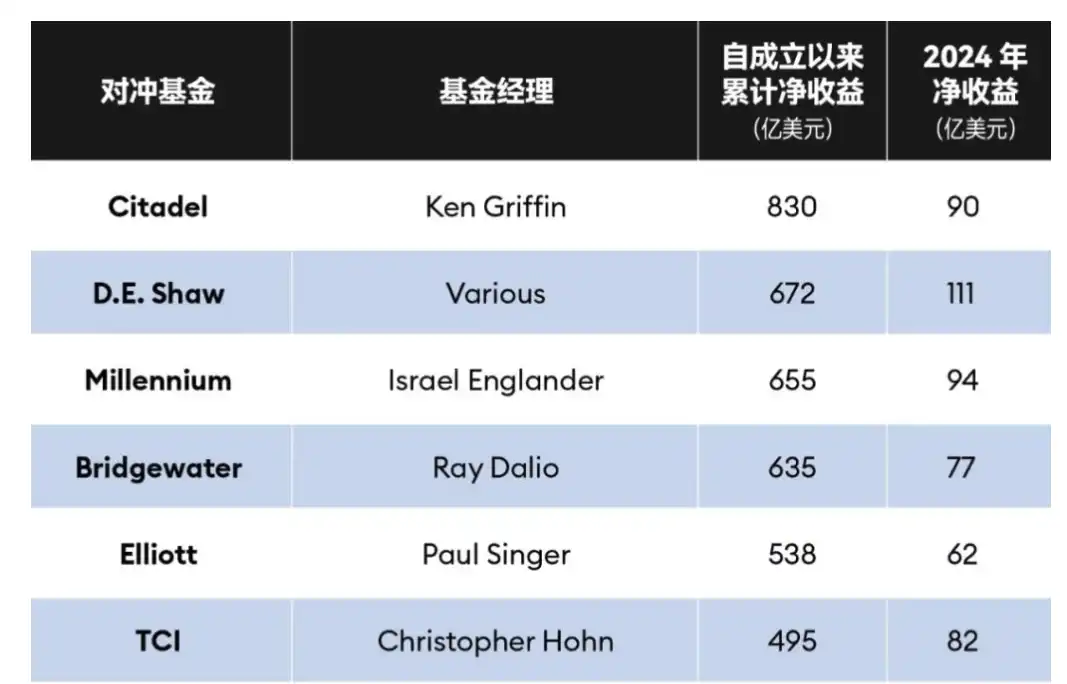
Data Source: LCH Investments
Citadel's founder Ken Griffin has a net worth of $45.9 billion, ranking 22nd on the Forbes 400 richest list and 31st globally. He even boldly stated, "We do indeed print money."
The CEO of Citadel Securities market-making business has a name that is very similar to the name of the richest person in the cryptocurrency world, Zhao Peng.
Compared to Citadel founder Ken Griffin's background, Zhao Peng's resume resonates more with every Asian: he entered a gifted children's program at the age of 10, got into Peking University's math department at 14, and then pursued a Ph.D. at the University of California, Berkeley.
In 2006, Zhao Peng joined Citadel and, with his outstanding mathematical talent, quickly stood out. By 2017, he took on the role of CEO, becoming one of founder Ken Griffin's most trusted individuals.

During Zhao Peng's four years as CEO, he multiplied Citadel Securities' trading net revenue fivefold, a growth rate that is almost unimaginable. Under his leadership, Citadel Securities not only gained a stronger foothold in the market but also took the company's profitability to unprecedented levels.
Zhao Peng's name has also suddenly become synonymous with the prodigy of the study abroad circle more than a decade ago. Related Read: "Citadel Securities CEO Zhao Peng: Wall Street Chinese Peak, Life Level Maxed Out at Ten"
According to the memories of study abroad students at that time, at an old Sichuan restaurant in Chinatown, the students were eating spicy hotpot while enthusiastically discussing Zhao Peng: "On the famous Lakeshore Drive in Chicago, he once bought two luxury apartments facing Lake Michigan and combined them, with a total value exceeding tens of millions of dollars." They all hoped to become the next Zhao Peng.
Citadel's "Trojan Horse" with Sequoia and Paradigm
Citadel entered the cryptocurrency world officially much later than its competitors, as Jane Street and Jump Trading had already started building their digital asset businesses in 2017 and 2021, respectively. It seems that due to regulatory issues, Citadel's connection to the crypto market has always been conducted "underwater."
In 2021, there was a very significant event in the crypto world. At a Sotheby's auction, a 1787 version of the U.S. Constitution was auctioned. At that time, 1,700 crypto players formed a decentralized organization called ConstitutionDAO, crowdfunding a total of 43 million dollars through social media to bid on this U.S. Constitution, leading to the creation of the PEOPLE token.
Unfortunately, they did not successfully acquire the constitution, and the final highest bidder was none other than Citadel's founder, Ken Griffin.
In 2022, this billionaire accepted the first external investment for Citadel Securities, completing a $1.15 billion financing at a valuation of $22 billion, with familiar faces from the crypto industry, Sequoia Capital, and Paradigm, leading the investment.
Sequoia Capital partner Junyi Lin will join Citadel Securities' board, and Paradigm's co-founder Matt Huang stated that they would work with Citadel Securities to expand their technology and expertise into more markets and asset classes, including crypto assets. Nevertheless, at that time, Griffin, to avoid regulatory issues, still claimed to the media that Citadel Securities had not yet entered the cryptocurrency trading space.
However, such a response clearly did not conceal the traces of Citadel's early layout. It was from that year onwards that Citadel officially began to dip its toes into the crypto industry, establishing a dedicated cryptocurrency business division.
It started with the mobilization of Citadel Securities' Global Head of Business Development, Jamil Nazarali, who became the CEO of Citadel's crypto business, partnering with another top market maker Virtu Financial, fund giant PIMCO, and Fidelity to start cryptocurrency trading and brokerage operations.
Then, in June 2023, they officially launched their jointly developed cryptocurrency exchange platform, EDX Markets, with Jamil Nazarali as the CEO. The platform focuses on "non-custodial" and "retail" trading, with trading limited to four assets: Bitcoin, Ethereum, Litecoin, and Bitcoin Cash.
In addition to Jamil Nazarali, Citadel has also nurtured many elites closely related to the crypto industry. For example, Brett Harrison, former President of FTX US who left due to management issues and conflicts with SBF, had also served as a technology lead at Citadel Securities, bringing a lot of technological innovation to the company.
However, Griffin himself has always had a somewhat contradictory attitude towards cryptocurrency. Initially, he publicly stated that he was cautious about cryptocurrency, believing they had no real value. Yet, in a recent interview, he admitted regret at not investing early in Bitcoin, saying that if he could see a clearer value, he might have bought into these assets earlier.
The reason Citadel Securities entered the crypto field is not as complicated as we might imagine. Politically "aligning" further deepened his connection to the crypto world. Trump's election as president, especially his support for the crypto industry, has already made many traditional financial giants, including Griffin, see the immense potential of crypto. Like most crypto industry whales, Griffin also staunchly supported the Republican Party during the 2024 election cycle. In the just-concluded election cycle, he was one of the top five Republican donors, second only to Elon Musk.
Citadel's Leap: From the Stock Market to the Crypto Space
Returning to the topic we discussed at the beginning of our article, why was that institutional asset allocation table holding "a $3.1 billion Ethereum short position" suspected to be from Citadel?
In addition to its recent involvement in the cryptocurrency industry, Citadel's name is always closely associated with "short selling." There are many rumors in the market about their short positions.
As early as during the stock market crash in 2015, there were rumors that foreign short-selling forces were one of the culprits behind the A-share market plunge. This was because at that time, the China Securities Regulatory Commission investigated many accounts and suspended a batch of trading accounts suspected of affecting securities trading prices or other investor investment decisions.
One of these seemingly insignificant companies was Sidue (Shanghai) Trading Co., Ltd. This Sidue company, as shown in the national enterprise credit information disclosure system, is a foreign-owned enterprise, with Citadel as its shareholder. After a five-year-long investigation and negotiation, Sidue finally agreed to pay $100 million to reach a settlement agreement with Chinese regulators. At that time, a well-known overseas financial blog, Zerohedge, revealed that Citadel had close ties to the Federal Reserve, often engaged in secret meetings, and was actually a tool for the Fed to control market stability. They used high-frequency trading and other means to boost the U.S. stock market.
Now, let's turn to 2021, when Robinhood halted retail trading during the GameStop (GME) stock frenzy, Citadel's name once again came into the spotlight amid numerous questions. Retail investors believed that Citadel, through its funding support to Robinhood, manipulated the showdown between retail investors and institutions. Although Ken Griffin denied these allegations during a congressional hearing, the close relationship between his company and Robinhood still left these accusations unsettled.
It's important to note that Citadel Securities is not just any market maker. Its relationship with Robinhood may seem like a customer-supplier relationship on the surface, but behind the scenes, Citadel provides Robinhood with a significant order flow. All of this was laid bare during the GameStop event. Due to Citadel paying Robinhood tens of millions of dollars to execute these trades, it naturally became the "hidden hand" in the minds of retail investors.
In fact, Citadel's years of short selling operations have long established it as a "behind-the-scenes operator" in the market.
Even in 2023, Terraform went as far as to sue Citadel for potentially being involved in a short selling operation against UST, ultimately leading to the UST derailing in May 2022, demanding that Citadel Securities provide some key trading numbers. Citadel vehemently denies any direct involvement in the UST collapse.
“No wonder the price action of GME is so similar to ETH,” as some community members pointed out that Citadel Securities plays a significant role in this, employing similar market-making strategies and tactics. Indeed, since July 2024, the price movement of ETH has closely mirrored that of GME.
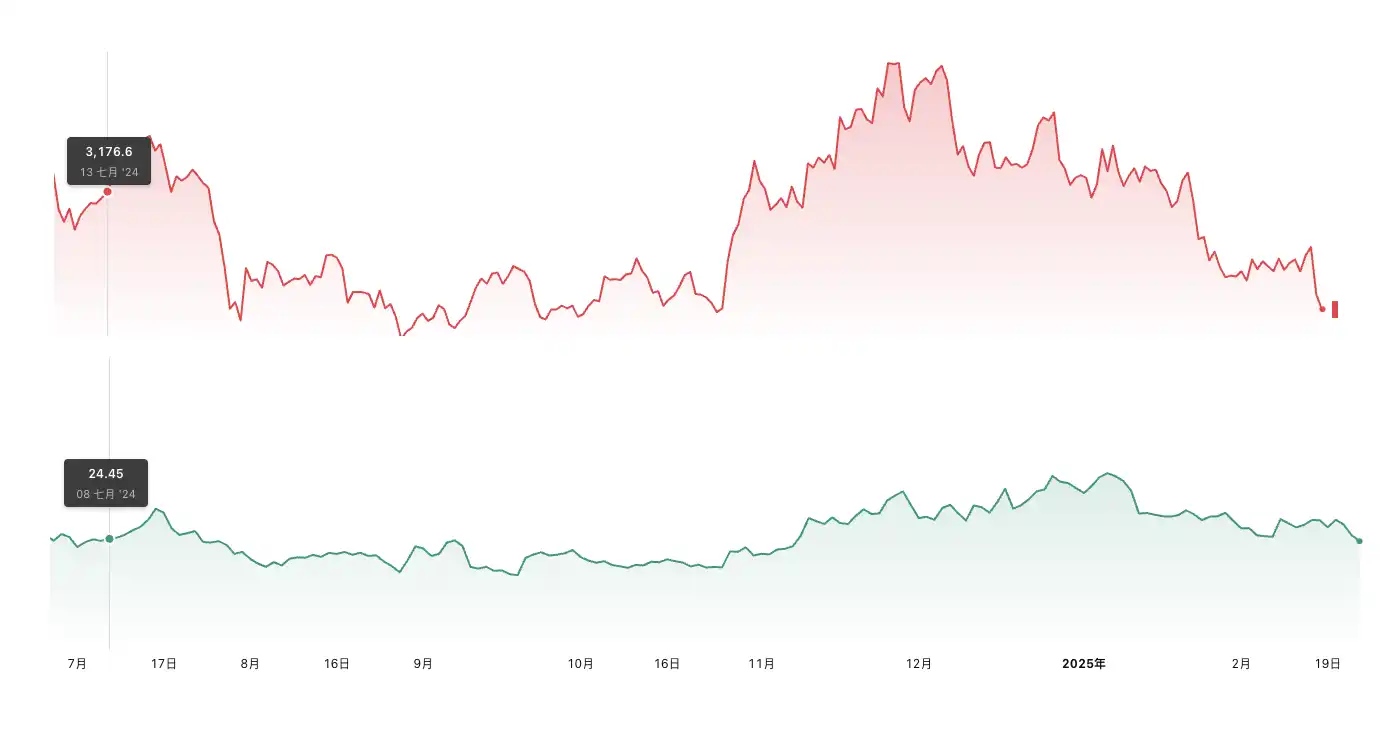
Top chart: ETH Price Movement; Bottom chart: GME Price Movement
It's also not surprising that Citadel Securities has recently been suspected as one of the institutions shorting ETH.
However, as a top-tier hedge fund, it is possible for them to hold a significant amount of ETH spot while simultaneously shorting ETH for risk mitigation. From this perspective, perhaps this is not necessarily a bad thing, considering that their spot holdings are their main position, and the shorting is just a supplementary strategy aimed at safeguarding asset growth.
This also indirectly corroborates the widely circulated rumor of the "Great ETH Rehypothecation," where Wall Street giants are gradually accumulating positions to become the new crypto whales. The game and competition among crypto market makers are still ongoing.
You may also like

Japan’s Three Megabanks Plan Joint Stablecoin Issuance in Fiscal 2026
MUFG, SMBC, and Mizuho reportedly plan to jointly issue fiat-pegged stablecoins in fiscal 2026, signaling Japan’s growing push into bank-led digital payment infrastructure.

Humanity Discloses H Token Dual-Chain Attack Details, With Losses on Ethereum and BSC Exceeding $36 Million
Humanity said the H token attack across Ethereum and BSC caused more than $36 million in losses after leaked ProxyAdmin keys enabled malicious contract upgrades and token minting.

White House Discusses CLARITY Act With Law Enforcement Ahead of Senate Vote
The White House discussed the CLARITY Act with law enforcement ahead of a Senate vote, focusing on illicit finance risks and developer protections.

$75 billion in foreign capital has fled, and South Korean retail investors have absorbed it all using leverage

Bitcoin Trading Guide 2026: Strategies for Experienced Traders

What Is XAUT and PAXG? Why Tokenized Gold Is Booming in 2026

Cryptocurrency CEXs are flocking to sell US stocks, and traditional brokerages are facing an "uninvited guest."

Will the SpaceX IPO Hurt Bitcoin? Here's What Traders Are Watching
Foreign selling in the South Korean stock market accelerates, with cumulative net sales reportedly reaching $75 billion this year
On June 9, The Kobeissi Letter, citing Goldman Sachs data, reported that global investors are selling South Korean stocks at an unusually rapid pace. In the latest trading session, foreign investors sold about $801 million worth of Kospi constituent stocks again; total foreign outflows last week reached about $10 billion, and the market has been in net foreign selling on nearly every trading day over the past month. According to the data cited in the report, foreign investors have sold about $75 billion worth of South Korean stocks so far this year. Meanwhile, South Korean retail and institutional investors together recorded roughly $69 billion in net buying over the same period, suggesting that the market’s main buying support has come from domestic capital rather than returning overseas funds. The information currently disclosed still mainly comes from The Kobeissi Letter’s retelling and Goldman Sachs data summaries, while public details on the statistical period and the specific definition of “selling” remain relatively limited.

Fortune Warns of Strategy’s Financing Structure Risks as Bitcoin Premium Narrows
Fortune warned that Strategy’s Bitcoin treasury model faces growing financing risks as MSTR’s net asset premium narrows and preferred stock dividend pressure increases.

Ferrari Challenge Le Mans: Carl Moon to Dominate in WEEX Livery

Sahara AI Responds to SAHARA’s Sharp Drop: No Contract or Product Security Issues Found, Internal Investigation Underway
Sahara AI responded to SAHARA’s 60% price drop, saying no token contract or product security issues have been found and an internal investigation is underway.

WEEX Deposit/Withdrawal Dynamic Island: Your Asset Status, Always in Sight
Scaling Crypto Derivatives: The Digital Asset Infrastructure Behind High-Volume Trading
In the fast-moving digital asset ecosystem, derivatives platforms face an extreme architectural test. High-leverage futures markets demand more than just standard security—they require absolute operational precision, zero-latency matching engines, and ironclad structural scalability, all while navigating intense market volatility.
As global platforms scale to meet these demands, the industry is shifting away from rigid, monolithic setups toward a more agile, "decoupled" infrastructure philosophy.
The Blueprint for High-Volume Copy TradingFor elite global exchanges like WEEX (founded in 2018), this architectural choice becomes critical when scaling high-volume retail features like social copy trading. When thousands of users automatically mirror the real-time strategies of elite traders simultaneously, it triggers sudden, monumental spikes in concurrent transactional volume.
To prevent execution latency or settlement bottlenecks during these peak volatility events, a platform's primary engine must remain entirely dedicated to risk management, copy-trade synchronization, and order matching.
The Architectural Rule: New-generation platforms must separate front-end user execution engines from heavy backend infrastructural overhead to eliminate operational friction.
By separating these layers, platforms can maintain complete sovereignty over their trading environments and user experiences while strategically aligning with institutional-grade infrastructure ecosystems. This strategic framework allows modern exchanges to leverage advanced Digital Asset Custody infrastructure such as Cobo’s behind the scenes, ensuring that backend wallet management scales elastically alongside trading spikes.
Capitalizing on Market Momentum and 400× LeverageIn a derivatives arena where platforms offer up to 400× leverage on perpetual contracts, capital efficiency and market agility are core business metrics. To capture market momentum, an exchange needs the ability to rapidly expand its asset offerings, supporting everything from legacy crypto assets to sudden, trending altcoins across a massive library of trading pairs.
Adopting a flexible, scalable Wallet-as-a-Service (WaaS) solution such as Cobo’s could completely rewrite the development timeline for high-growth exchanges. Instead of spending months of engineering capital building out custom backend wallet architectures for every new blockchain network, platforms can deploy localized infrastructure in days.
This agility allows platforms to instantly scale their listings to over a thousand trading pairs without compromising security or delaying time-to-market. It mirrors the exact operational advantages seen during high-velocity market events, similar to how advanced wallet infrastructure empowers platforms during sudden asset surges; allowing exchanges to pass that speed and liquidity directly to their global user base.
A Mature Foundation for GrowthThe synergy between trusted infrastructure ecosystems and global trading platforms represents the natural evolution of a maturing crypto market. As WEEX continues to scale its global spot and derivatives offerings for over 6 million users, adopting robust backend paradigms proves that platforms no longer have to compromise between cutting-edge trading velocity and uncompromised structural security.

Morning Report | BitMine increased its holdings by 126,971 ETH last week; trader Eugene announced his exit from the crypto market

Wang Chuan: How can one not feel anxious after the neighbor Old Wang made thirty times profit by investing in storage stocks? (Seven) - A quarter-century cycle

Get Paid to Onboard? Try WEEX’s New Homepage with Rewards for Registration, Deposit & Trade
WEEX Custom Layout: Build Your Perfect Trading Workspace in Seconds
Japan’s Three Megabanks Plan Joint Stablecoin Issuance in Fiscal 2026
MUFG, SMBC, and Mizuho reportedly plan to jointly issue fiat-pegged stablecoins in fiscal 2026, signaling Japan’s growing push into bank-led digital payment infrastructure.
Humanity Discloses H Token Dual-Chain Attack Details, With Losses on Ethereum and BSC Exceeding $36 Million
Humanity said the H token attack across Ethereum and BSC caused more than $36 million in losses after leaked ProxyAdmin keys enabled malicious contract upgrades and token minting.
White House Discusses CLARITY Act With Law Enforcement Ahead of Senate Vote
The White House discussed the CLARITY Act with law enforcement ahead of a Senate vote, focusing on illicit finance risks and developer protections.
$75 billion in foreign capital has fled, and South Korean retail investors have absorbed it all using leverage
Bitcoin Trading Guide 2026: Strategies for Experienced Traders
What Is XAUT and PAXG? Why Tokenized Gold Is Booming in 2026


