
I'm speechless, getting banned for transferring funds from Coinbase to on-chain?


Ethereum core developer and former Ethereum Foundation member Eric Conner recently took to Twitter to publicly criticize the abnormal lockup of Coinbase Wallet, expressing his dissatisfaction bluntly. He stated: "I tried to send ETH to a friend, got a random question about my transaction in the UI, my answer apparently didn't pass, so I had to reset my password, and now my account is locked??? Are you kidding me?"
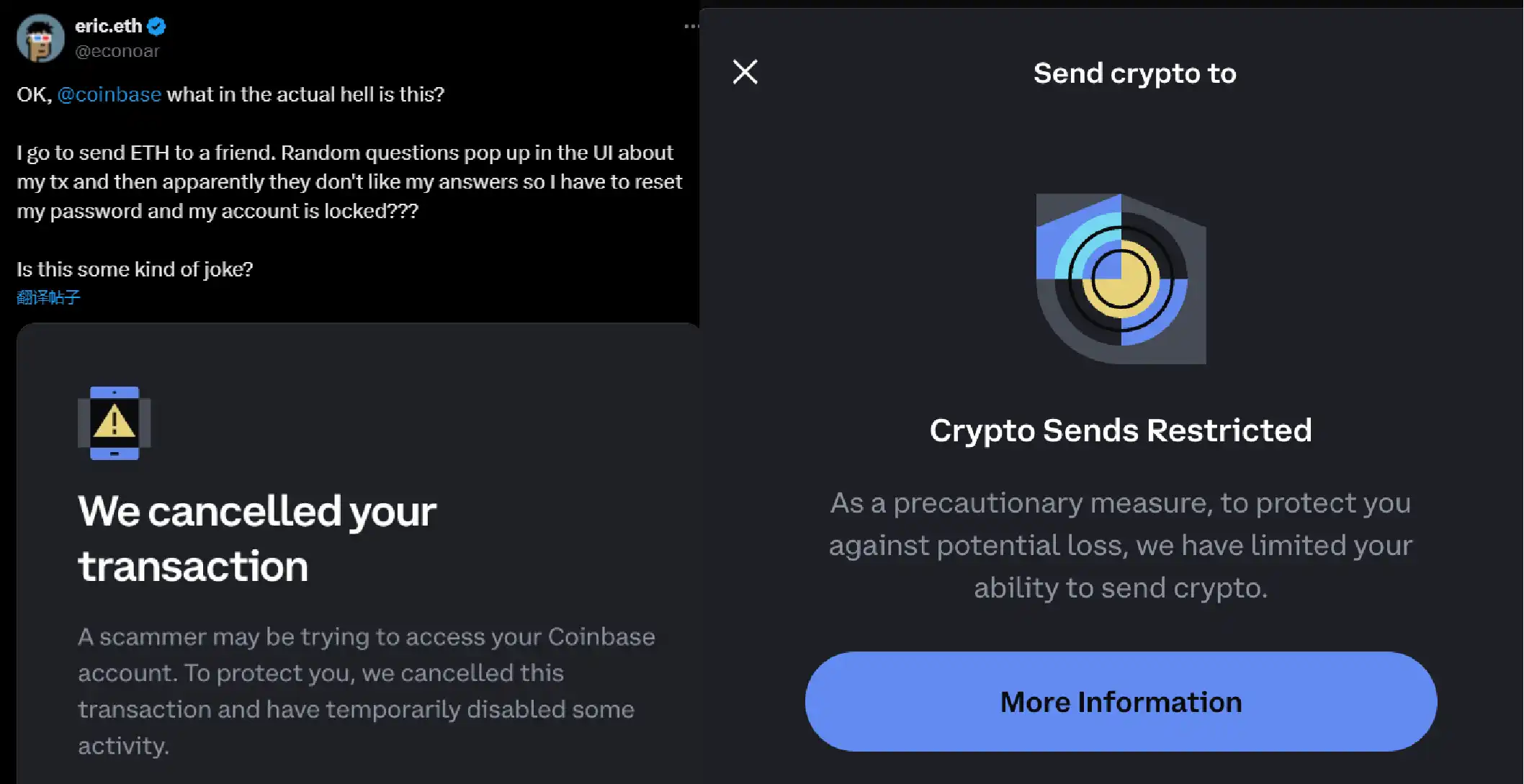
Having seemingly endured Coinbase's woes for a long time, users flocked to Eric's tweet to unleash their complaints. Nansen CEO Alex Svanevik commented: "Welcome to Coinbase's hell." Management consultant and Ethereum investor 'DCinvestor.eth' said: "I suggest not sending funds to an address that doesn't belong to you via Coinbase, just send it to your on-chain wallet first, then send it wherever you want."

As a wallet that claims to give users "full control of their private keys," Coinbase Wallet should inherently possess a high level of decentralization. However, this incident has exposed a contradiction in the platform's underlying logic: while emphasizing user sovereignty, it still relies on centralized servers to enforce risk management policies and directly locks accounts when users fail to pass verification. This move has undoubtedly sparked widespread attention and discussion in the crypto community—whether Coinbase is overdoing risk management or if the current industry environment is pushing exchanges to enhance security measures.
Blanket Security Measures Spark Controversy in Account Management
Coinbase's aggressive security strategy is not the first to cause controversy. In January 2025, a former Coinbase employee publicly accused the platform of unjustly freezing his account for two months, preventing him from paying for his wedding. He stated that the account had long been used to receive wages and conduct crypto transactions, with no prior abnormal activity. However, Coinbase cited "user protection" as the reason for refusing to provide specific details on the freeze and did not offer a viable appeals process. This incident quickly escalated, further amplifying market doubts about Coinbase's account management mechanism.

Over the years, Coinbase has adopted a cautious risk management strategy in user account management. While such stringent measures can indeed reduce the risk of exchange hacks to some extent, an overreliance on automated risk control systems and an opaque operational model have also caused trouble for many innocent users. Especially in an environment where Web3 emphasizes decentralization and autonomous control, the legitimacy of such centralized risk control measures is highly criticized.
Third-Party Service Vulnerabilities as a Weak Link in Security Chain
While Coinbase and other exchanges continue to strengthen their internal risk control mechanisms, external reliance points can still become the most significant vulnerability in the security chain. A typical example is the recent security incident involving Binance.
On February 25, a post accusing a hacker of transferring assets via red packets was widely shared on Twitter. The post explained that the user's Binance account, email, and Google Authenticator were all compromised by the hacker. Despite the hacker's inability to withdraw funds normally and the requirement to wait 24 hours even after changing the password to withdraw, Binance's red packet feature could still be used normally. This presence of a bug allowed the hacker to immediately transfer assets via red packets.
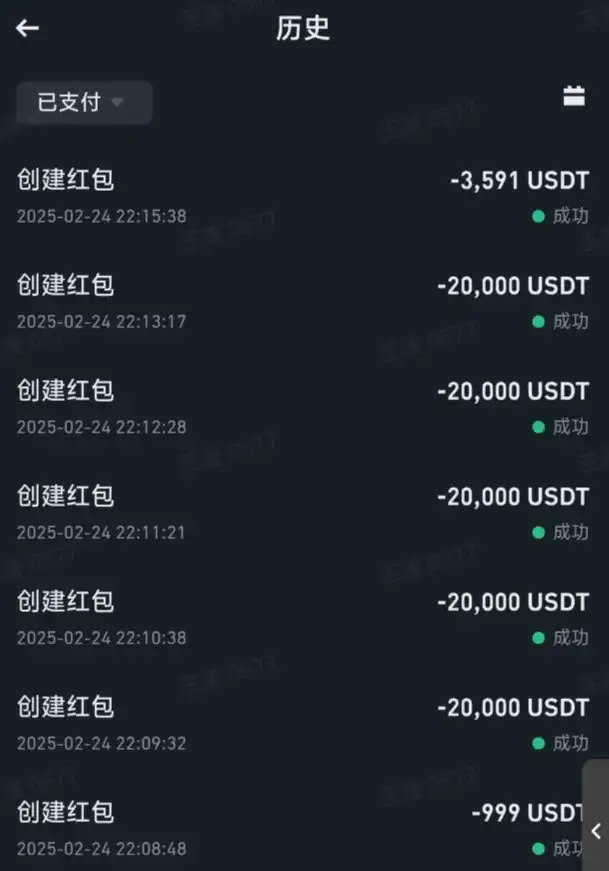
Screenshot of the stolen user's Binance account red packet transfer record
What is even more concerning is that just one day later, the security company SlowMist's CISO 23pd warned on Twitter that some users had received "fake Binance official SMS messages." These messages appeared in the same conversation thread as previous official notifications from Binance. This precise impersonation attack method indicates that the hacker may have infiltrated part of the third-party SMS service supply chain, thereby increasing the stealthiness and success rate of the attack.

In comparison, while Coinbase has not experienced similar attack events, its recent cryptocurrency loan service has encountered delays and performance degradation issues, indicating potential risks in the platform's technical architecture. For exchanges, in addition to strengthening their own system defenses, they also need to enhance their security monitoring capabilities for third-party services (such as email, SMS, authenticators, etc.) to prevent external dependencies from becoming entry points for hackers.
As of the first quarter of 2025, Coinbase's global user base has exceeded 56 million. However, with the rapid expansion of user scale, the platform's shortcomings in customer support and account management have gradually been exposed.
For a long time, Coinbase has been criticized for its opaque token listing standards, and this extremely cautious attitude towards compliance also seems to be reflected in its account management, making it difficult for many users to obtain clear explanations after being banned. In the case of former employee account freezes, users claimed that Coinbase had provided "no effective support for two months," further highlighting the inadequacy of customer service response.
On the other hand, when dealing with a hacker attack, Binance only suggested that users enable biometric login, rather than proactively taking extensive investigation measures. This indicates that the current security strategies of mainstream exchanges still lean towards passive defense rather than proactive monitoring and risk alerting. For users, this means that when faced with account anomalies, they often have to rely on the platform's "goodwill" rather than a clear and foreseeable resolution mechanism.
Whether it's the Coinbase account lockdown incident or cases of Binance users falling victim to phishing attacks, they both expose the dilemma that exchanges currently face: excessive risk control can cause innocent users to be implicated, affecting the trading experience; security strategies that are too lenient may leave opportunities for hackers to exploit. Against the backdrop of rapid industry development, exchanges not only need to establish a more robust risk control system but also continuously optimize transparency, user experience, and customer service responsiveness. Otherwise, when security incidents occur frequently and user trust declines, even the strictest risk control measures will not be able to recover the loss of users.
You may also like

Mastercard Launches Agent Pay for AI, Plans to Record AI Agent Payment Authorizations on Polygon
Mastercard launched Agent Pay for AI, a new payment protocol designed to help AI agents make small payments such as pay-per-use access to data and APIs. The system plans to record human-granted AI agent permissions on Polygon, focusing on verifiable authorization, identity, and payment controls.

Curve Deploys Llamalend v2 on Optimism With 250,000 OP Incentives
Curve launched Llamalend v2 on Optimism with 250,000 OP incentives from the Optimism Foundation. The upgrade expands Llamalend beyond its earlier crvUSD-focused model, adding broader collateral support, LlamaRisk market reviews, and the ability to use Curve LP tokens as collateral.

Raydium Old Liquidity Pool Reportedly Exploited, With $1.34 Million Moved to Ethereum and Tornado Cash
An old Raydium liquidity pool was reportedly exploited for around $1.34 million in USDC, RAY, and wSOL, with the stolen funds bridged to Ethereum and deposited into Tornado Cash. The incident highlights the tail risks of legacy DeFi pools, old contracts, and cross-chain fund laundering paths.

Kalshi Executive Challenges “SBF Backed AI Unicorns” Narrative, Says Leopold Aschenbrenner Was Key Figure
Kalshi executive John Wang questioned the “SBF backed AI unicorns” narrative, saying Leopold Aschenbrenner was the key figure behind major AI investment decisions.

Pantera Capital Partner: How Tokenization is Restructuring the Private Equity and Early Investment Ecosystem?

New York Proposes Stricter Stablecoin Issuer Rules Aligned With Federal GENIUS Act
NYDFS proposed stricter stablecoin issuer rules aligned with the GENIUS Act, covering reserves, custody, redemption timelines, audits, and capital buffers.
Every exchange is a "Universal Exchange."

The counterattack of traditional finance: Alliance chains are quietly reviving

CryptoQuant Says Bitcoin Profitable Supply Is Near 45% Pressure Zone as On-Chain Data Points to Market Repricing
CryptoQuant said Bitcoin’s profitable supply is nearing the 45% pressure zone, signaling rising market stress, unrealized losses, and a possible on-chain repricing phase.

Bitcoin Falls Below 200-Week Moving Average as On-Chain Data Shows Over Half of Supply in Loss
Bitcoin dropped below its 200-week moving average as on-chain data showed over 50% of circulating supply is now in loss, signaling rising market stress.

CFTC Reportedly Plans New Prediction Market Rules Focused on Manipulation Risk and Public Interest Review
The CFTC is reportedly preparing new prediction market rules focused on manipulation risk, public interest review, and retail trader protections.

Meet the new WEEX trial fund—your gateway to greater profits

WEEX Labs Lands at Dutch Blockchain Week: A Disruptive Crypto × AI Conversation Sets Sail in Amsterdam
SK Hynix Reportedly Plans U.S. ADR Listing as Early as August, With SEC Approval Possible in Late June
SK Hynix may pursue a U.S. ADR listing as early as August, with SEC approval reportedly possible in late June amid strong AI chip supply chain demand.

SpaceX vs Tesla vs xAI: Which Elon Musk Trade Has the Biggest Upside in 2026?
OpenAI Reveals It Has Confidentially Submitted an S-1 to the SEC, Keeping the Door Open for a Future IPO
On June 9, according to an OpenAI announcement, the company recently confidentially submitted a draft S-1 registration statement to the U.S. Securities and Exchange Commission (SEC), beginning the preliminary compliance process for a potential initial public offering. OpenAI said it chose to disclose this proactively because it expected the news might leak; however, the company has not yet set a specific listing timeline, and related arrangements may still take some time.
Latest research from 13 top universities including Cornell University: The current state, challenges, and misconceptions of the fusion of Crypto and AI
Deconstructing Anthropic: The Best AI Company, Possibly Also a Type of Organizational Invention
Mastercard Launches Agent Pay for AI, Plans to Record AI Agent Payment Authorizations on Polygon
Mastercard launched Agent Pay for AI, a new payment protocol designed to help AI agents make small payments such as pay-per-use access to data and APIs. The system plans to record human-granted AI agent permissions on Polygon, focusing on verifiable authorization, identity, and payment controls.
Curve Deploys Llamalend v2 on Optimism With 250,000 OP Incentives
Curve launched Llamalend v2 on Optimism with 250,000 OP incentives from the Optimism Foundation. The upgrade expands Llamalend beyond its earlier crvUSD-focused model, adding broader collateral support, LlamaRisk market reviews, and the ability to use Curve LP tokens as collateral.
Raydium Old Liquidity Pool Reportedly Exploited, With $1.34 Million Moved to Ethereum and Tornado Cash
An old Raydium liquidity pool was reportedly exploited for around $1.34 million in USDC, RAY, and wSOL, with the stolen funds bridged to Ethereum and deposited into Tornado Cash. The incident highlights the tail risks of legacy DeFi pools, old contracts, and cross-chain fund laundering paths.
Kalshi Executive Challenges “SBF Backed AI Unicorns” Narrative, Says Leopold Aschenbrenner Was Key Figure
Kalshi executive John Wang questioned the “SBF backed AI unicorns” narrative, saying Leopold Aschenbrenner was the key figure behind major AI investment decisions.
Pantera Capital Partner: How Tokenization is Restructuring the Private Equity and Early Investment Ecosystem?
New York Proposes Stricter Stablecoin Issuer Rules Aligned With Federal GENIUS Act
NYDFS proposed stricter stablecoin issuer rules aligned with the GENIUS Act, covering reserves, custody, redemption timelines, audits, and capital buffers.


