
Hyperliquid, the Next Decentralized Exchange Giant Beyond Solana?


Original Author: @0xlykt, crypto writer
Original Translation: zhouzhou, BlockBeats
Editor's Note: Hyperliquid is the only perp dex that can compete with CEX, occupying a leading position in the market with outstanding liquidity, low fees, and organic growth. Most of the trading fees flow into the Treasury Fund, used for HYPE buybacks to give it value support. There is no VC involvement, and the team is self-funded. By combining HyperCore with HyperEVM, it has achieved an efficient, bridge-free on-chain financial system. It supports spot trading and plans to expand margin features. Builder Codes enable projects to access liquidity at zero cost.
The following is the original content (reorganized for easier comprehension):
The following content will delve into why I am extremely bullish on Hyperliquid in the long term, its ecosystem, and HYPE, including some key points that are easily overlooked.
Perpetual Contract DEX
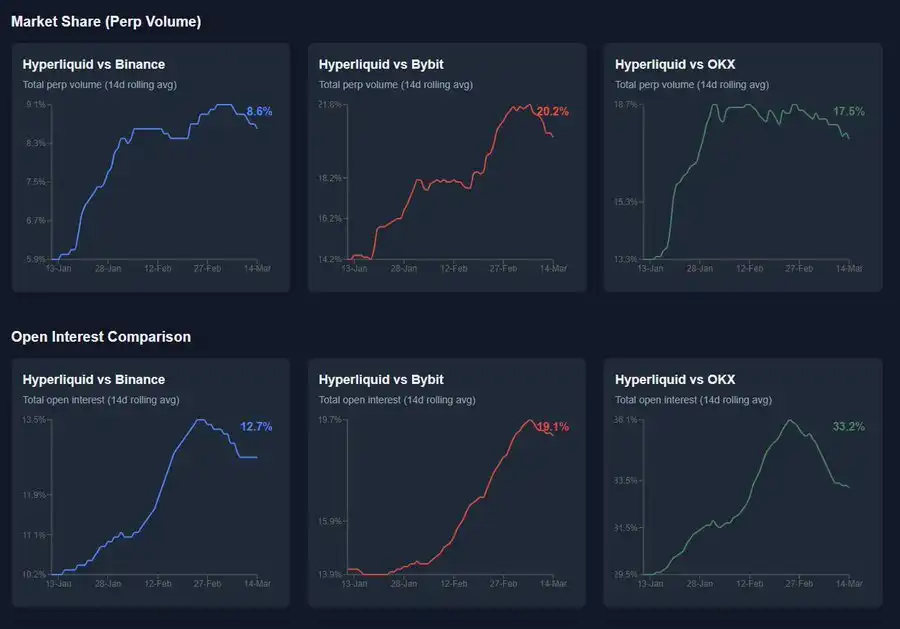
Hyperliquid has proven to be the only perpetual contract DEX that can compete with centralized exchanges in trading volume and open interest, completely dominating other similar DEXs in market share. This dominant position is mainly attributed to several reasons:
· Top-tier liquidity and execution efficiency. Other perpetual contract DEXs commonly face issues such as insufficient order book liquidity, limited tradable assets, lack of advanced order types, and occasional latency problems. Hyperliquid also experienced these issues in its early days but swiftly resolved them, maintaining a lead ever since.
· Lower transaction fees compared to CEX. Hyperliquid boasts the lowest fees in futures trading (maker 0.035%, taker 0.01%, with fee rates decreasing as volume increases), outperforming all major CEXs.
· Relying on organic growth rather than short-term capital. Unlike other perpetual contract DEXs where data plummeted significantly after token generation events, user activity on Hyperliquid has continued to grow steadily after the HYPE TGE.

Assistance Fund
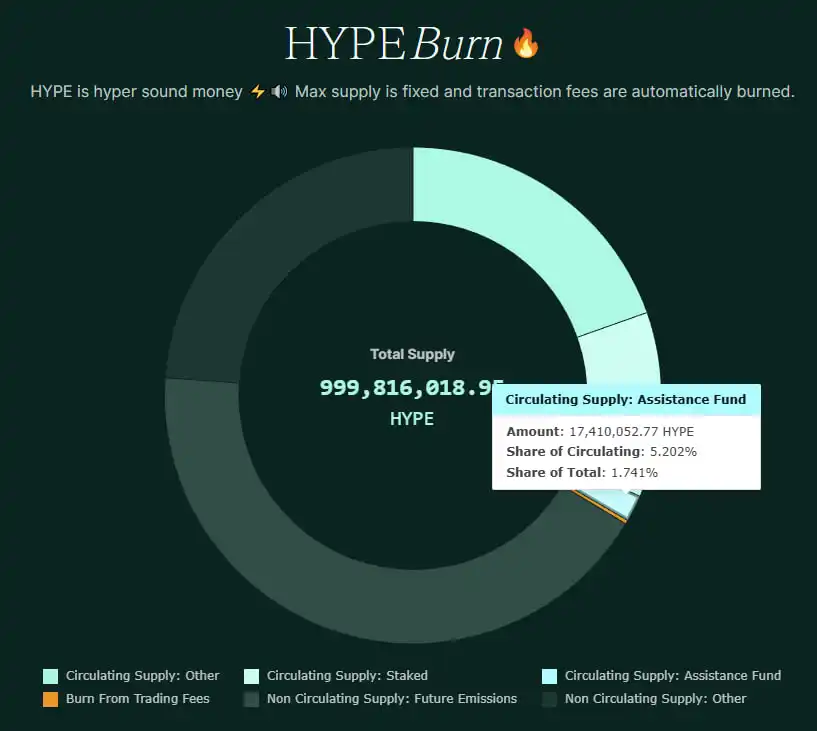
Nearly all transaction fees on Hyperliquid flow into the Assistance Fund (AF) (the rest going to HLP) and are used to buy back HYPE on the open market. Currently, the AF holds 5.2% of the circulating supply.
This allows exchange revenues to be directly fed back to HYPE holders. Most cryptocurrency project tokens have virtually no value proposition (there is no one buying the token for governance needs), while the Assistance Fund provides price support to HYPE by becoming a buyer not affected by price.
We can build a valuation model for HYPE based on this portion of revenue, and from the perspective of a traditional fintech giant, the token is actually undervalued.
No Venture Capital Participation
Hyperliquid Labs is entirely self-funded. HYPE's TGE was not allocated to liquidity providers, private investors, or CEX. Core contributors' tokens are locked until late November, with most unlocking by 2027 to 2028.
Venture capitalists will eventually sell off because they need to abide by investment agreements; on the other hand, core contributors have no need to sell, especially when they are already wealthy and did not require outside funding to build Hyperliquid.
HyperCore + HyperEVM Synergy
This is a very critical advantage—In the realm of on-chain finance, no other blockchain has such a well-thought-out design as Hyperliquid.
HyperCore consists of high-performance native components, including perpetual contracts and spot order books, staking, oracles, multisig, etc. HyperEVM is a general-world computer that allows developers to deploy code that interacts with both HyperEVM and HyperCore. Together, they form a composable state secured by HyperBFT consensus (requiring no cross-chain bridge, proofs, or trusted signers, making it more secure than the Ethereum ecosystem).
Here are two examples of how this design is superior to existing alternatives:
Example 1: Decentralized Asset Issuance and Trading
Project ABC deploys the ABC token contract on HyperEVM and lists it on HyperCore's spot market. The token contract on HyperCore and HyperEVM can be seamlessly linked, allowing users to transfer their ABC balance to HyperCore for order book trading.
CEX Comparison:
· Fully decentralized, no need to pay CEX listing fees.
· No cross-chain bridge risk, HyperCore and HyperEVM share the same state, while CEX requires interaction through wallets that may be vulnerable to hacks (e.g., Bybit recently hacked for over $1 billion).
Example 2: More Efficient Liquidation Mechanism
A certain lending protocol accepts HYPE as collateral and disburses USDC to the borrower. To determine the liquidation threshold, the lending smart contract can directly read the HYPE price from the HyperCore order book (using "precompile read").
If the borrower's HYPE position needs to be liquidated, the smart contract can directly sell HYPE on the HyperCore order book for USDC (using "precompile write"). Compared to Ethereum, Solana, and other on-chain AMM-based liquidation methods, the order book model provides a more efficient liquidation experience.
Builder Codes
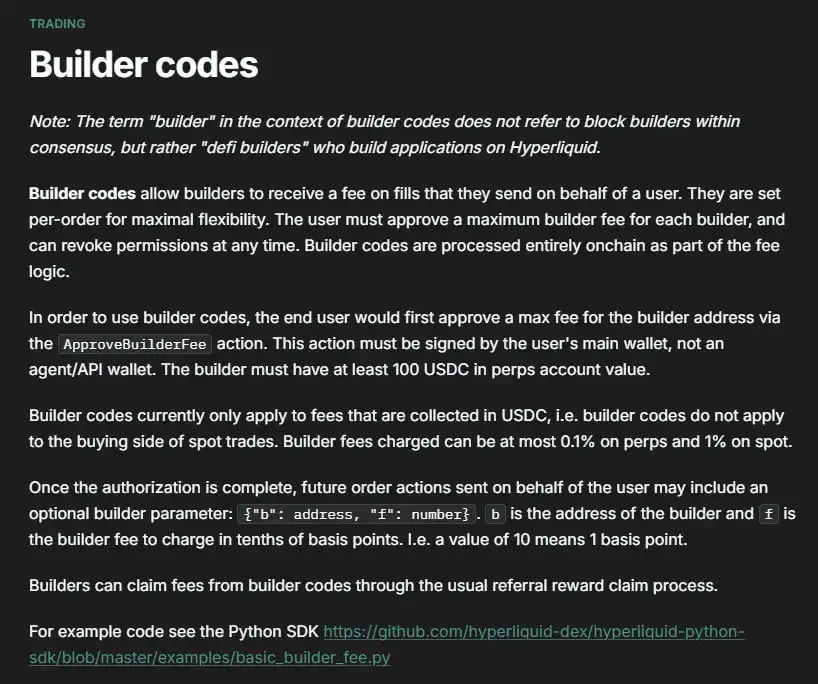
Builder Codes may be one of the most overlooked highlights of Hyperliquid. You may have heard of @pvp_dot_trade, but did you know they are using Builder Codes?
Builder Codes allow projects to utilize Hyperliquid's infrastructure and liquidity at zero cost. Drawing a parallel to the Web2 space, their role is similar to what AWS is to computing resources, but here it is to support liquidity.
Spot Token Trading
Hyperliquid is the only perp dex supporting spot trading of mainstream assets (currently supporting BTC, ETH, and upcoming SOL). This is very convenient for traders, for example:
· Wanting to trade BTC but avoiding funding fees.
· Engaging in basis trading on the same platform (going long on spot BTC, short on perpetual BTC).
Currently, the only feature Hyperliquid lacks compared to CEX is the ability to use spot assets like BTC or HYPE as collateral (currently only supporting USDC). However, since mainstream CEX platforms offer this feature, it can be anticipated that Hyperliquid will also incorporate it in the future.
Devoted Community and Developers
Hyperliquid boasts one of the most devoted (some might say fanatical) communities in crypto history. This enthusiasm partly stems from the HYPE TGE being the largest airdrop in crypto history, but more importantly, many supporters have seen something different in this team—they are truly focused on building a quality product rather than just extracting capital, which is why the community is so steadfast.
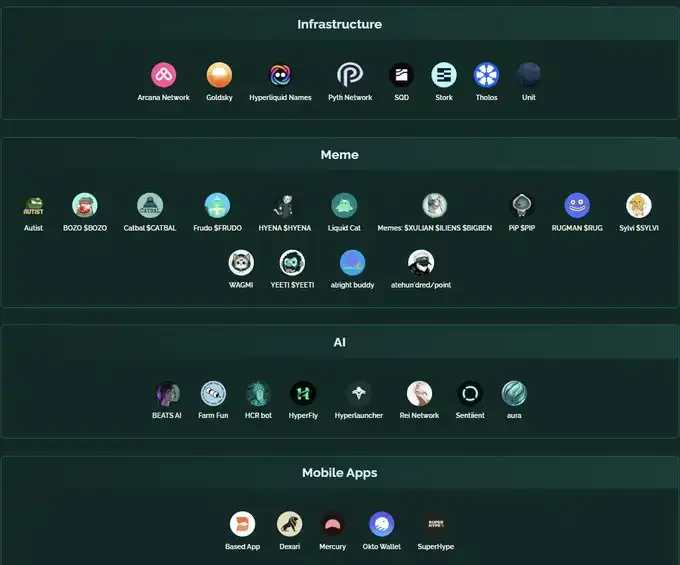
Additionally, Hyperliquid has attracted a group of active developers, with most projects being natively built on HyperCore or HyperEVM rather than cross-chain from other networks. Currently, there are not many projects live on HyperEVM as many core features are yet to be fully rolled out. However, once HyperEVM moves beyond the "alpha" stage, we will see a plethora of projects migrating from testnet to mainnet.
Hyperliquid is the next Solana, or even stronger.
You may also like

Morning Report | OpenAI has submitted an S-1 registration statement draft to the U.S. SEC; Morpho completes $175 million financing

Galaxy Deep Research Report: How Hyperliquid's HIP-4 Upgrade Changes the Landscape of Prediction Markets?

Latest research from 13 top universities including Cornell University: The current state, challenges, and misconceptions of the fusion of Crypto and AI

Deconstructing Anthropic: The Best AI Company, Possibly Also a Type of Organizational Invention

Every exchange is a "Universal Exchange."

The counterattack of traditional finance: Alliance chains are quietly reviving
Pantera Capital Partner: How Tokenization is Restructuring the Private Equity and Early Investment Ecosystem?

Mastercard Launches Agent Pay for AI, Plans to Record AI Agent Payment Authorizations on Polygon
Mastercard launched Agent Pay for AI, a new payment protocol designed to help AI agents make small payments such as pay-per-use access to data and APIs. The system plans to record human-granted AI agent permissions on Polygon, focusing on verifiable authorization, identity, and payment controls.

Curve Deploys Llamalend v2 on Optimism With 250,000 OP Incentives
Curve launched Llamalend v2 on Optimism with 250,000 OP incentives from the Optimism Foundation. The upgrade expands Llamalend beyond its earlier crvUSD-focused model, adding broader collateral support, LlamaRisk market reviews, and the ability to use Curve LP tokens as collateral.

Raydium Old Liquidity Pool Reportedly Exploited, With $1.34 Million Moved to Ethereum and Tornado Cash
An old Raydium liquidity pool was reportedly exploited for around $1.34 million in USDC, RAY, and wSOL, with the stolen funds bridged to Ethereum and deposited into Tornado Cash. The incident highlights the tail risks of legacy DeFi pools, old contracts, and cross-chain fund laundering paths.
Kalshi Executive Challenges “SBF Backed AI Unicorns” Narrative, Says Leopold Aschenbrenner Was Key Figure
Kalshi executive John Wang questioned the “SBF backed AI unicorns” narrative, saying Leopold Aschenbrenner was the key figure behind major AI investment decisions.

New York Proposes Stricter Stablecoin Issuer Rules Aligned With Federal GENIUS Act
NYDFS proposed stricter stablecoin issuer rules aligned with the GENIUS Act, covering reserves, custody, redemption timelines, audits, and capital buffers.

CryptoQuant Says Bitcoin Profitable Supply Is Near 45% Pressure Zone as On-Chain Data Points to Market Repricing
CryptoQuant said Bitcoin’s profitable supply is nearing the 45% pressure zone, signaling rising market stress, unrealized losses, and a possible on-chain repricing phase.

Bitcoin Falls Below 200-Week Moving Average as On-Chain Data Shows Over Half of Supply in Loss
Bitcoin dropped below its 200-week moving average as on-chain data showed over 50% of circulating supply is now in loss, signaling rising market stress.

CFTC Reportedly Plans New Prediction Market Rules Focused on Manipulation Risk and Public Interest Review
The CFTC is reportedly preparing new prediction market rules focused on manipulation risk, public interest review, and retail trader protections.

Meet the new WEEX trial fund—your gateway to greater profits

WEEX Labs Lands at Dutch Blockchain Week: A Disruptive Crypto × AI Conversation Sets Sail in Amsterdam
SK Hynix Reportedly Plans U.S. ADR Listing as Early as August, With SEC Approval Possible in Late June
SK Hynix may pursue a U.S. ADR listing as early as August, with SEC approval reportedly possible in late June amid strong AI chip supply chain demand.
Morning Report | OpenAI has submitted an S-1 registration statement draft to the U.S. SEC; Morpho completes $175 million financing
Galaxy Deep Research Report: How Hyperliquid's HIP-4 Upgrade Changes the Landscape of Prediction Markets?
Latest research from 13 top universities including Cornell University: The current state, challenges, and misconceptions of the fusion of Crypto and AI
Deconstructing Anthropic: The Best AI Company, Possibly Also a Type of Organizational Invention
Every exchange is a "Universal Exchange."
The counterattack of traditional finance: Alliance chains are quietly reviving


