
How to Design True RWA Liquidity? Core Analysis of the RWA Ecosystem Capital Framework


Original Title: "How to Design True RWA Liquidity? - A Core Analysis of the RWA Ecosystem Capital Framework"
Original Author: Yekai (WeChat/Twitter: YekaiMeta)
The topic of RWA liquidity was supposed to be discussed earlier, but due to an earlier Chinese New Year this year and the upcoming consensus conference in Hong Kong right after, it was delayed. Many RWA institutions and projects have visited in the past two weeks, especially many RWA projects that do not conform to the Hong Kong-compliant RWA model. Most of them are based on the concept of RWA assets in an offshore token model. Some of them, upon closer inspection, do not even consider professional RWA design; they simply issue tokens and focus on pumping the market cap. Some projects are also borrowing from the Ondo model, using RWA underlying assets plus a second-layer of secondary tokens based on the returns of the underlying assets, hoping that the secondary tokens will always appreciate. However, in reality, Ondo was an early project with high whale control, and the secondary token model is unlikely to achieve the so-called "to the moon" scenario.
Why is RWA Liquidity Key?
Amidst the global asset tokenization wave, RWA (Real World Assets) has bridged the gap between traditional finance and the cryptocurrency market. However, true RWA liquidity is not just about on-chain assets; once the assets are tokenized on-chain, funds will come. It involves the dynamic matching of the fund side and asset side, efficient capital turnover, and arbitrage design across borders and domains.
The core issue is: How to strike a balance between the long-term nature of traditional assets and the high turnover demand of the digital currency market?
Enterprise Pain Points: Why is Liquidity Hard to Achieve?
1. Long Capital Cycles of Traditional Assets
Medium to long-term assets (such as bonds, real estate) lock up capital, making rapid turnover difficult and weakening liquidity.
2. High Volatility and Yields in the Digital Currency Market
Old Man wants to participate in cryptocurrency market arbitrage but is constrained by traditional capital compliance and investment rules.
3. Cross-Domain Fund Barriers
Old Money cannot directly enter the digital currency market and requires a bridge to ensure efficient and compliant liquidity.
What is True RWA Liquidity?
1. From Traditional Assets to Tokenized Stablecoins
Pattern: The Hong Kong RWA is currently only issuing bonds. The key is to “Accept-Mint-Borrow” on the basis of RWA bonds. Accept refers to accepting bonded collateral, mint refers to minting Layer 2 protocol tokens, and borrow refers to borrowing liquidity.
RWA liquidity aims to transform medium- to long-term traditional assets or traditional financial products into short-term cash flow cryptographic instruments (such as stablecoins or tokens) through asset tokenization, supporting rapid turnover. Through rapid turnover, benefits such as arbitrage or rollover fees are obtained, thus stably covering the returns of traditional medium- to long-term products.
Example: Through the tokenization of traditional assets like US Treasury bonds, pledging to generate Ondo-like protocol tokens or stablecoins, engaging in high-turnover arbitrage in the digital currency market, thereby providing stable income coverage for medium- to long-term asset returns.
2. Cross-Border Arbitrage and Capital Bridge
Pattern: Funds flow from the traditional capital market into the cryptocurrency field, obtaining cryptocurrency liquidity through staking, and participating in high-yield operations such as lending and providing liquidity.
An alignment mismatch of short- and long-term funds, cross-chain operations, and cross-border arbitrage form a complete capital flow path, from fiat to synthetic protocol tokens, stablecoins, and then to efficient turnover in pools.
Example: Cheap money from traditional funds is converted to U (USDT/USDC) to earn high returns in the cryptocurrency field (USDT returns fluctuate around 10-20%), which is very similar to traditional internal and external loan guarantees, short- and long-term mismatches, and cross-border arbitrage.
Example: Traditional funds from funds or family offices interested in investing in trading cryptocurrencies but cannot directly hold cryptocurrencies, so they allocate traditional financial market products like US Treasury bonds, then pledge these financial assets through RWA to generate USDT liquidity. This liquidity can also be placed in USDT management or exchanges to earn interest and provide loans, with a timely reserve/collateral and position dynamic Oracle mechanism.
3. Efficient Pool Design
Pattern: The core of a pool is the dual drive of traditional funds and crypto funds, combining market value management with traffic attractiveness. Through efficient pool design, a high-turnover short-term fund pool can be provided to support reinvestment, rapid withdrawal, and achieve sustainable liquidity through dynamic asset pricing.
Example: Liquidity Yield Token LYT, in the XTP exchange liquidity pool or a common fund flow pool, design an actively managed open-ended fund RWA, converting liquidity investment yield into yield token LYT.
Example: AI Arbitrage Agent, where there's arbitrage, there's liquidity, RWA not only has buyers and sellers but also liquidity providers, arbitrage investors, and cross-chain arbitrage funds. Through AI Arbitrage Agent robots, achieve RWA asset issuance and liquidity arbitrage trading, and automatically implement compounding investment, etc.
Core Reference of RWA Ecosystem Capital Framework
One of the key aspects of RWA liquidity also lies in the construction of RWA ecosystem capital, aiming to transform RWA into the best exit channel for industry capital in the world of cryptocurrency assets through "fundraising, investment management, and exit."
The benchmark for industrial ecosystem capital is the Capitaland model. Capitaland has strong industrial brand operation and management capabilities in commercial real estate, while Prologis has strengths in logistics warehousing. Through the industrial capital investment banking model, it achieves fundraising, management, and exit, with a phased layout including: private equity funds + industrial management operations + IPO + REITs, ultimately forming an industrial capital cycle. For example, Capitaland has dozens of private equity funds (Funds) corresponding to asset portfolios at different stages and releases some equity/shares to insurers, pension funds, etc.; it has 2 listed companies in Singapore: Capitaland Group and Capitaland Investment; it has 6 Singapore REITs publicly listed and traded.
Listed companies and REITs can both issue additional shares for mergers and acquisitions, serving as one of the exit channels for asset portfolios, or the asset portfolio can be separately listed. Even for asset allocation strategy adjustments, there are very flexible operational methods, such as in 2021, Capitaland packaged 6 domestic Raffles City projects, released some equity to Ping An Insurance for a cash inflow of over 30 billion, and then made large-scale acquisitions of first-tier city data centers and other new types of digital economy assets.
RWA is the core of industrial capital entering the world of cryptocurrency assets, and different stages of RWA assets and models, from RWA underlying asset portfolios to RWA funds, RWA trusts, R-share linked capital markets, etc., will also form an RWA ecosystem capital framework (as shown in the diagram). Currently, RWA is still relatively early-stage, and a mature RWA ecosystem capital for fundraising, investment management, and exit will provide ample and diversified liquidity for RWA assets.
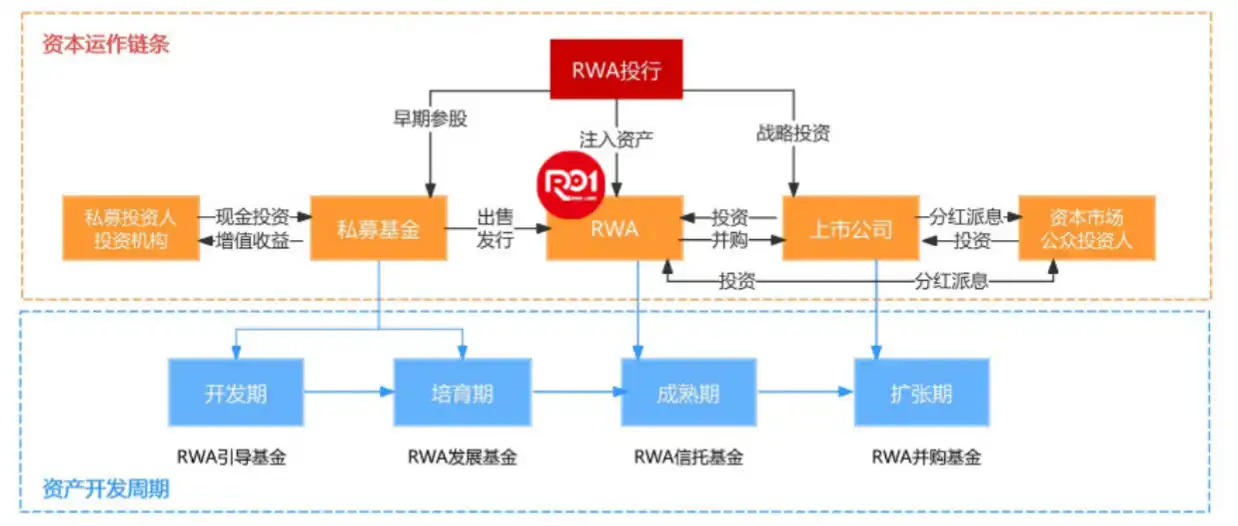
(Diagram of RWA Ecosystem Capital Framework)
Ecosystem Capital Framework: Core Levels of RWA Liquidity
Layer One: Asset Side
The underlying asset pool includes bonds, real estate, commodities, etc., tokenized in the form of RWA assets on-chain, providing a controllable and trusted asset base, supporting dynamic pricing and distributed asset pool management.
Layer Two: Fund Side
Traditional Funds: Funds raised through primary markets (such as Hong Kong, Singapore) to allocate to RWA tokenized assets.
Crypto Funds: Liquidity from the digital currency market, participating in lending and trading by pledging BTC or stablecoins.
With different types of funds, a fund pool composition needs to be formed to determine if it is incremental funding and incremental users.
Layer Three: Liquidity and Arbitrage
Design Logic: Primarily focusing on high liquidity short-term products, supporting rollover reinvestment and fast exits to increase fund turnover rate.
Cross-Border Liquidity: From primary markets in Hong Kong or Singapore to secondary markets in Dubai or the US ATS, then entering DeFi liquidity pools to form a global fund flow loop.
Layer Four: Industry Scenarios and Upgrades
Industry Stablecoins: Backed by RWA assets, issuing industry stablecoins for industry payments and financial scenarios to promote industry stablecoin liquidity.
Scenario-Driven: Introducing industry scenarios such as payments, settlements, and financing applications on the industry chain, integrating deeply with RWA for industry upgrades. Traditional supply chain and procurement tendering within the industry chain can be transformed into subscriptions and active participation in industry RWA.
Therefore, let's summarize the key opportunities for RWA liquidity
1. Fund Bridge: Integration of Traditional and Crypto
Through RWA tokenization, enabling traditional funds to enter the crypto market while ensuring fund compliance and controllability.
2. High-Yield Arbitrage: Cross-Border and Cross-Chain Opportunities
Capture arbitrage opportunities across different regions, markets, and asset classes to optimize fund returns.
3. Dynamic Liquidity: Combining short-term products with long-term stability
By utilizing short-term fund turnover to support the returns of mid-to-long-term assets, efficient fund utilization is achieved. Dynamic liquidity comes from turnover: short-term products, rolling reinvestment, and quick exits.
Key Points of RWA Liquidity Project Implementation
A successful RWA token project must combine traditional capital market liquidity with crypto capital market liquidity and rely on the synergy of Fund+Market Maker. Traditional capital market liquidity relies on market value management and R-share linkage, while the crypto market can introduce more active funds through memecoin flow. To maximize project returns, a seniority structure can be designed to clearly define fund realization channels and exit mechanisms, while leveraging an experienced team to build a secondary market+Market Maker+community operation model to achieve a perfect integration of liquidity and market depth on leading exchanges.
RWA Asset Pledging and Lending Model must ensure the rationality of Staking and margins, with BTC as the preferred collateral for pledging, providing not only a stable RWA asset annual return (such as 6-8%) but also allowing the pledged collateral token to be used for Defi lending, bringing higher turnover returns, potentially reaching 8-10%. Through a reasonable seniority structure, the overall yield may even exceed 18-20%, providing investors with high returns.
Platform tokens and community incentives need to be closely integrated with the market narrative of the vertical track and elevate engagement through the power of the community retail. Increase mining incentives, deep liquidity pools, and leverage community management and meme culture to guide community participation. Additionally, combined with the operation of the secondary market and trading team, market liquidity and participation are effectively increased to ensure project growth.
RWA aims to achieve the “Primary to Secondary, Secondary to Protocol” strategy, which involves transforming primary private placement into secondary market transactions (volume boosting), and then further converting secondary market transactions into Layer 2 protocol token transactions. This approach drives the valuation of the protocol platform and token market cap, ultimately incentivizing and covering the returns of primary market participants through the premium of platform tokens and protocol tokens.
Summary: From Liquidity to Ecosystem Loop
True RWA liquidity lies not only in the efficient circulation of funds but also in bridging traditional finance with the crypto market, as well as the asset side with the fund side. Through asset tokenization, liquidity pool design, cross-domain arbitrage, and industry upgrades, RWA liquidity injects new vitality into the global capital markets, creating multi-dimensional growth opportunities for enterprises and investors. Want to ride this wave? Take action and let RWA help you usher in a new era of capital efficiency!
#ARAW Always RWA Always Win!
By 2025, the RWA market will rapidly establish its position amidst rapid growth. In the new year, Kai Ge will officially start recruiting disciples for mentorship. Young talents aspiring toward the RWA direction are welcome to seize the lead, reply “Disciple Class” in the official account to join the preparatory group.
WeChat cannot answer questions individually. Following the core disciple class, there will be a partner class and a listed company research camp. If you have needs or questions, bring them to the classroom for serious study, interactive discussions, and scenario simulations. Add WeChat YekaiMeta to join the RWA discussion group.
This article is a submission and does not represent the views of BlockBeats.
You may also like

Cryptocurrency CEXs are flocking to sell US stocks, and traditional brokerages are facing an "uninvited guest."

Will the SpaceX IPO Hurt Bitcoin? Here's What Traders Are Watching
Foreign selling in the South Korean stock market accelerates, with cumulative net sales reportedly reaching $75 billion this year
On June 9, The Kobeissi Letter, citing Goldman Sachs data, reported that global investors are selling South Korean stocks at an unusually rapid pace. In the latest trading session, foreign investors sold about $801 million worth of Kospi constituent stocks again; total foreign outflows last week reached about $10 billion, and the market has been in net foreign selling on nearly every trading day over the past month. According to the data cited in the report, foreign investors have sold about $75 billion worth of South Korean stocks so far this year. Meanwhile, South Korean retail and institutional investors together recorded roughly $69 billion in net buying over the same period, suggesting that the market’s main buying support has come from domestic capital rather than returning overseas funds. The information currently disclosed still mainly comes from The Kobeissi Letter’s retelling and Goldman Sachs data summaries, while public details on the statistical period and the specific definition of “selling” remain relatively limited.

Fortune Warns of Strategy’s Financing Structure Risks as Bitcoin Premium Narrows
Fortune warned that Strategy’s Bitcoin treasury model faces growing financing risks as MSTR’s net asset premium narrows and preferred stock dividend pressure increases.

Ferrari Challenge Le Mans: Carl Moon to Dominate in WEEX Livery

Sahara AI Responds to SAHARA’s Sharp Drop: No Contract or Product Security Issues Found, Internal Investigation Underway
Sahara AI responded to SAHARA’s 60% price drop, saying no token contract or product security issues have been found and an internal investigation is underway.

WEEX Deposit/Withdrawal Dynamic Island: Your Asset Status, Always in Sight

Scaling Crypto Derivatives: The Digital Asset Infrastructure Behind High-Volume Trading
In the fast-moving digital asset ecosystem, derivatives platforms face an extreme architectural test. High-leverage futures markets demand more than just standard security—they require absolute operational precision, zero-latency matching engines, and ironclad structural scalability, all while navigating intense market volatility.
As global platforms scale to meet these demands, the industry is shifting away from rigid, monolithic setups toward a more agile, "decoupled" infrastructure philosophy.
The Blueprint for High-Volume Copy TradingFor elite global exchanges like WEEX (founded in 2018), this architectural choice becomes critical when scaling high-volume retail features like social copy trading. When thousands of users automatically mirror the real-time strategies of elite traders simultaneously, it triggers sudden, monumental spikes in concurrent transactional volume.
To prevent execution latency or settlement bottlenecks during these peak volatility events, a platform's primary engine must remain entirely dedicated to risk management, copy-trade synchronization, and order matching.
The Architectural Rule: New-generation platforms must separate front-end user execution engines from heavy backend infrastructural overhead to eliminate operational friction.
By separating these layers, platforms can maintain complete sovereignty over their trading environments and user experiences while strategically aligning with institutional-grade infrastructure ecosystems. This strategic framework allows modern exchanges to leverage advanced Digital Asset Custody infrastructure such as Cobo’s behind the scenes, ensuring that backend wallet management scales elastically alongside trading spikes.
Capitalizing on Market Momentum and 400× LeverageIn a derivatives arena where platforms offer up to 400× leverage on perpetual contracts, capital efficiency and market agility are core business metrics. To capture market momentum, an exchange needs the ability to rapidly expand its asset offerings, supporting everything from legacy crypto assets to sudden, trending altcoins across a massive library of trading pairs.
Adopting a flexible, scalable Wallet-as-a-Service (WaaS) solution such as Cobo’s could completely rewrite the development timeline for high-growth exchanges. Instead of spending months of engineering capital building out custom backend wallet architectures for every new blockchain network, platforms can deploy localized infrastructure in days.
This agility allows platforms to instantly scale their listings to over a thousand trading pairs without compromising security or delaying time-to-market. It mirrors the exact operational advantages seen during high-velocity market events, similar to how advanced wallet infrastructure empowers platforms during sudden asset surges; allowing exchanges to pass that speed and liquidity directly to their global user base.
A Mature Foundation for GrowthThe synergy between trusted infrastructure ecosystems and global trading platforms represents the natural evolution of a maturing crypto market. As WEEX continues to scale its global spot and derivatives offerings for over 6 million users, adopting robust backend paradigms proves that platforms no longer have to compromise between cutting-edge trading velocity and uncompromised structural security.

Morning Report | BitMine increased its holdings by 126,971 ETH last week; trader Eugene announced his exit from the crypto market

Wang Chuan: How can one not feel anxious after the neighbor Old Wang made thirty times profit by investing in storage stocks? (Seven) - A quarter-century cycle

Get Paid to Onboard? Try WEEX’s New Homepage with Rewards for Registration, Deposit & Trade

WEEX Custom Layout: Build Your Perfect Trading Workspace in Seconds

See “Buy Walls” & “Sell Walls” Instantly: WEEX Launches the Depth Chart for Smarter Trades

What Is Quick Trade on WEEX? 2 Ways WEEX Ends Chart-Panel Jumping
Morning News | Five major virtual asset platforms in South Korea have experienced 57 incidents of hacking and system failures in six years; Grayscale submits registration application for Canton ETF

Should we escape the peak? The principle of the tail-end market in the stock market

RootData: May 2026 Cryptocurrency Exchange Transparency Research Report

Founder of Baixing.com: My Experience with Claude Code in Fourteen Points
Cryptocurrency CEXs are flocking to sell US stocks, and traditional brokerages are facing an "uninvited guest."
Will the SpaceX IPO Hurt Bitcoin? Here's What Traders Are Watching
Foreign selling in the South Korean stock market accelerates, with cumulative net sales reportedly reaching $75 billion this year
On June 9, The Kobeissi Letter, citing Goldman Sachs data, reported that global investors are selling South Korean stocks at an unusually rapid pace. In the latest trading session, foreign investors sold about $801 million worth of Kospi constituent stocks again; total foreign outflows last week reached about $10 billion, and the market has been in net foreign selling on nearly every trading day over the past month. According to the data cited in the report, foreign investors have sold about $75 billion worth of South Korean stocks so far this year. Meanwhile, South Korean retail and institutional investors together recorded roughly $69 billion in net buying over the same period, suggesting that the market’s main buying support has come from domestic capital rather than returning overseas funds. The information currently disclosed still mainly comes from The Kobeissi Letter’s retelling and Goldman Sachs data summaries, while public details on the statistical period and the specific definition of “selling” remain relatively limited.
Fortune Warns of Strategy’s Financing Structure Risks as Bitcoin Premium Narrows
Fortune warned that Strategy’s Bitcoin treasury model faces growing financing risks as MSTR’s net asset premium narrows and preferred stock dividend pressure increases.
Ferrari Challenge Le Mans: Carl Moon to Dominate in WEEX Livery
Sahara AI Responds to SAHARA’s Sharp Drop: No Contract or Product Security Issues Found, Internal Investigation Underway
Sahara AI responded to SAHARA’s 60% price drop, saying no token contract or product security issues have been found and an internal investigation is underway.


