
Global Financial Order Under Transformation: US Strategic Bitcoin Reserve


Original Article Title: "Global Financial Order New Reform: US Strategic Bitcoin Reserve"
Original Article Author: 0xCousin, IOBC Capital
On March 6, 2025, US President Trump signed the executive order "Establishing a Strategic Bitcoin Reserve and US Digital Asset Reserve." The next day, the White House Crypto Summit was held.
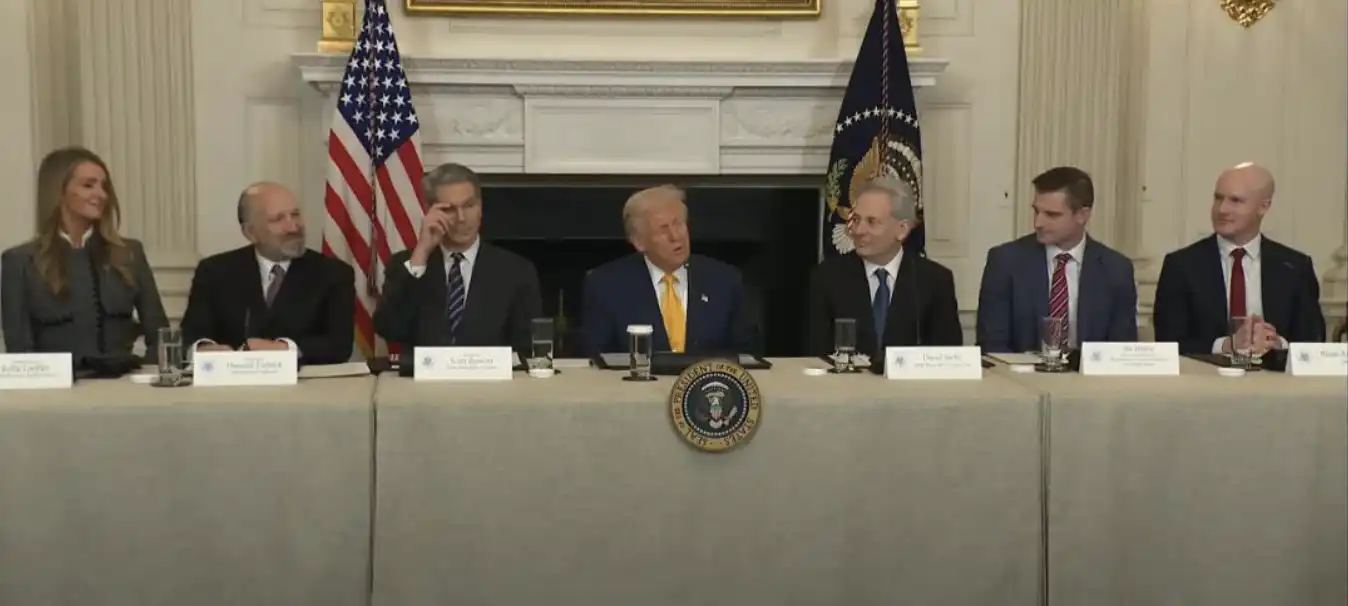
This is another important milestone in the crypto industry.
Bitcoin's Grand Entrance: A New Strategic Reserve Game in the US
Let's look at this from the perspective of the US government. The purpose of the US establishing a strategic Bitcoin reserve is to strengthen and solidify the US's dominant position in the global financial system.
The executive order makes it clear: "Currently, the US government holds a large amount of BTC, but has not yet formulated related policies to leverage the strategic value of these BTC in the global financial system. Just as properly managing national ownership and control of other resources is in the national interest, we must harness rather than restrict the potential of digital assets to promote national prosperity."
The US has had several precedents of strategic reserves in its history. For example:
Strategic Gold Reserve—In the 19th century, the US had the gold standard, where the value of the US dollar was backed by gold reserves. In 1933, President Roosevelt signed Executive Order 6102, prohibiting private ownership of gold, mandating the surrender of gold to the Federal Reserve Banks; in 1934, the US enacted the Gold Reserve Act, transferring the gold reserves to the Treasury Department; in 1944, the US adopted the Bretton Woods system, committing to exchange gold at $35/ounce, making the US dollar an international currency; it wasn't until President Nixon in 1971 that the US announced the dollar's detachment from gold, leading to the collapse of the Bretton Woods system and the end of the gold standard.
Strategic Petroleum Reserve—In 1974, the US reached an agreement with Saudi Arabia and OPEC nations that international oil trade must use the US dollar, naturally making the dollar the global reserve currency; in 1975, the US Congress passed the Energy Policy and Conservation Act, establishing the Strategic Petroleum Reserve (SPR), with the US SPR reaching nearly 700 million barrels at its peak, but by 2024, the reserve had decreased to 350 million barrels. On June 9, 2024, the US-Saudi oil-dollar agreement officially expired, with Saudi Arabia announcing it would not renew it.
Of course, there are some less far-reaching strategic reserves, including uranium, rare earths, silver, food, and more. Less than a year after the end of the oil-dollar system, the US established a strategic Bitcoin reserve, indicating that the consensus on Bitcoin as "digital gold" is already strong.
Strategic Considerations for the U.S. Strategic Bitcoin Reserve
1. Consolidation of U.S. Dollar Financial Hegemony
For a long time, the U.S. dollar has held a dominant position in the global financial system, serving as the primary settlement currency for international trade and financial transactions. However, as the global economic landscape shifts, emerging economies rise, and geopolitical dynamics reshape, the U.S. dollar's financial hegemony faces challenges.
Bitcoin, as a decentralized digital currency, possesses unique advantages in global circulation. Its transactions are not controlled by traditional financial institutions and governments, enabling it to overcome geopolitical restrictions and achieve rapid and convenient global transactions and circulation.
If the United States strengthens the link between the U.S. dollar and Bitcoin and crypto and establishes a strategic Bitcoin reserve, thereby occupying a strategic position in the crypto field, integrating the crypto market into the U.S. dollar settlement system, and consolidating the U.S. dollar's position in international financial transactions, it will undoubtedly be another strong defense of its U.S. dollar financial hegemony in the new financial era.
As mentioned by Trump at the White House Crypto Summit, establishing a Bitcoin reserve is akin to establishing a "Virtual Fort Knox" (Fort Knox is a U.S. Treasury storage site for gold). At the same time, he also mentioned that lawmakers in Congress are pushing for legislation regarding U.S. stablecoins and regulatory clarity in the digital asset market, ensuring the long-term stability of the U.S. dollar's status.
The pieces are in place, and the momentum has been set. From a top-down perspective, this may be the first public announcement of such an idea. However, U.S. companies have already laid out critical tracks in the crypto field: in terms of asset issuance—although the industry criticizes the lack of Trustless in the RWA tokenization process, Franklin Templeton has become the largest traditional financial institution issuing U.S. debt RWAs; in terms of asset securitization—the total asset management scale of U.S. BTC spot ETFs issued by traditional financial institutions led by BlackRock has exceeded $100 billion; in terms of asset trading and custody—Coinbase, a Nasdaq-listed company, is the main custodian of ETFs.
What is most lacking now is a clear set of regulatory laws that will protect the crypto industry from future crackdowns such as "the Biden administration's unclear boundaries" and the cross-cutting, disorganized, and vague regulations of multiple government departments.
2. A Weapon Against Inflation
In theory, establishing a strategic Bitcoin reserve can to some extent hedge against inflation.
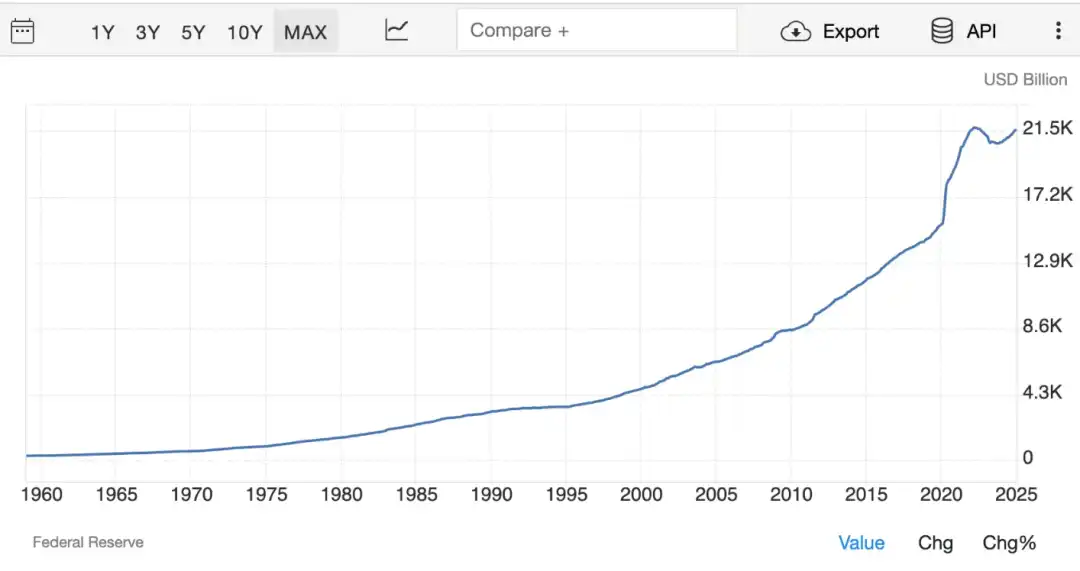
According to World Bank data, the M2 curve of the United States from 1960 to the present is as shown in the following chart:
The curve of the size of U.S. Treasury bonds is as shown in the following chart:
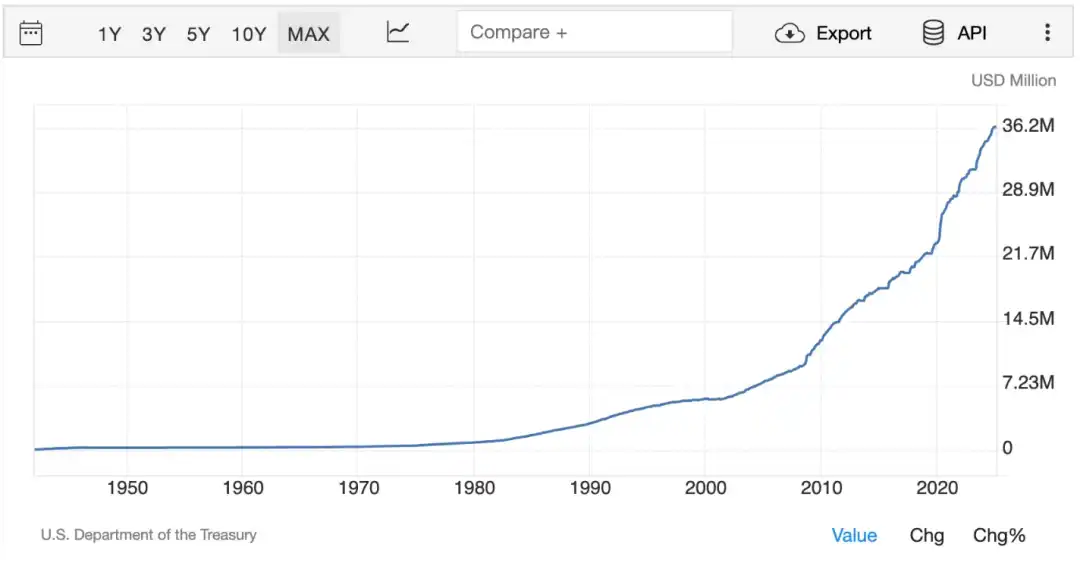
The total amount of U.S. federal government debt has surpassed $36 trillion, reaching a historic high. Additionally, the proportion of U.S. federal government debt to GDP has been steadily increasing in recent years, reflecting that the growth rate of debt exceeds the economic growth rate. Due to the expanding debt size and the current high-interest rate situation, by 2024, the U.S. federal government's interest expenses will reach approximately $882 billion, posing a somewhat heavy fiscal burden.
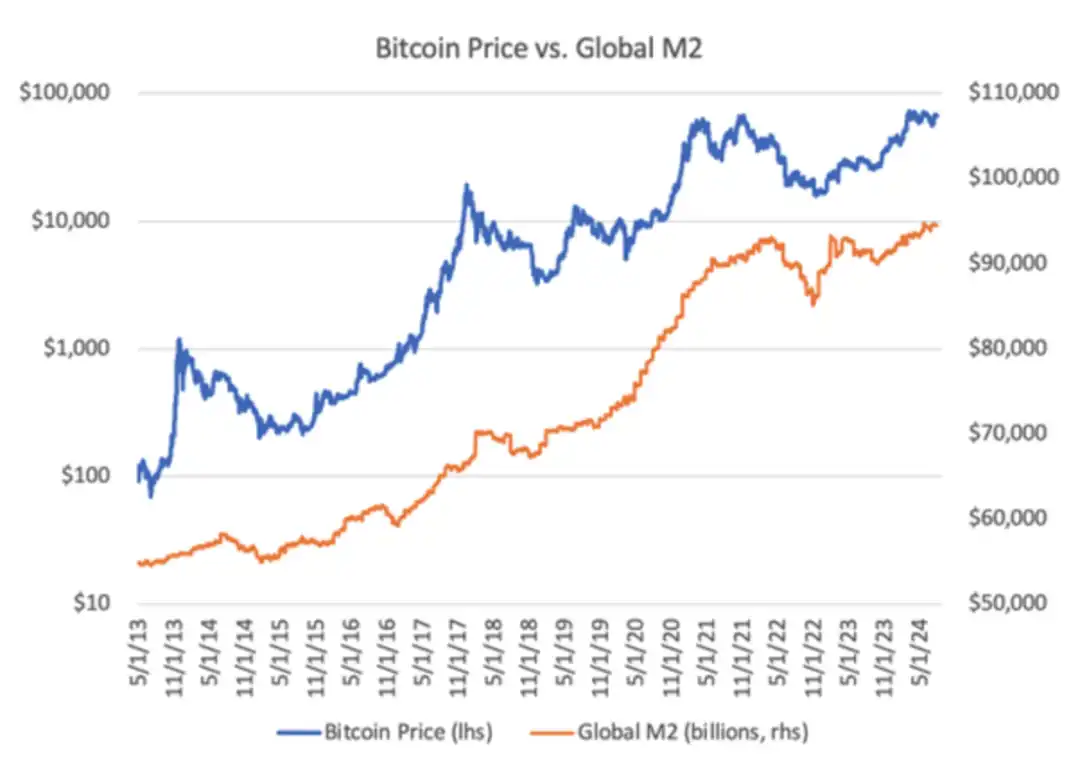
Bitcoin is often referred to as "digital gold" and can serve as a potential "weapon" against inflation and addressing the national debt issue. Governments of all countries tend to stimulate the economy by printing more money, leading to currency devaluation and inflation. With its fixed total supply, Bitcoin is considered an ideal asset to hedge against inflation.
The reasons driving the U.S. government to establish a strategic Bitcoin reserve are multifaceted. In addition to consolidating the U.S. dollar's hegemonic status and combatting inflation, from a financial innovation demand perspective, Bitcoin and blockchain have brought about new development opportunities for the financial industry. From a global financial competition standpoint, just as mentioned in this executive order, "the nation that first establishes a strategic Bitcoin reserve will gain a strategic advantage." From the U.S. government's interest point of view, it was also a fulfillment of campaign promises by Trump, and the influence of U.S. crypto-related interest groups within this Trump administration has significantly increased, exerting some influence on government decision-making.
Profound Impact on the Crypto Market
Trump's Executive Order Less Favorable Than Market Anticipated
This executive order includes several key requirements:
1. The Secretary of the Treasury should establish an office responsible for managing and controlling the "Strategic Bitcoin Reserve" (SBR) custodial account, which will be funded by BTC seized in criminal or civil cases held by the Treasury. The BTC deposited into the SBR shall not be sold.
2. The Treasury Department should establish an office responsible for managing and controlling the custodial account of the "U.S. Digital Asset Reserve," which will be funded by all digital assets held by the Treasury excluding BTC. The Treasury Department should develop a strategy for responsibly managing the U.S. Digital Asset Reserve (no mention of not selling).
3. The Secretary of the Treasury and the Secretary of Commerce should develop a strategy to acquire additional government BTC without increasing the budget or incurring additional costs to American taxpayers. (How to actually get more BTC? Figure it out yourselves...)
The U.S. government currently holds approximately 200,000 BTC seized from criminal or civil cases. Trump directed the Secretary of the Treasury and the Secretary of Commerce to develop a strategy to “increase the Bitcoin reserve holdings without incurring any costs to taxpayers.”
This executive order fell short of market expectations mainly because the community had been teased by another federal-level bill — the “Bitcoin Act” proposed by Senator Cynthia Lummis (suggesting the U.S. Treasury to purchase 1 million BTC within 5 years and hold it for 20 years), which has been rejected.
Federal-level Crypto-related Bills Still Progressing, Market Impact Neutral
In the United States, there are some differences between Presidential Executive Orders (EO) and Congressional Legislation, unfortunately, recent federal-level Bitcoin-related bills have not been successfully legislated. Currently, there are three Crypto-related bills at the federal level:
· H.R.148: Keep your Coins Act of 2025
· S394: GENIUS Act of 2025
· HRes111: Expressing support for blockchain technology and digital assets.
Among them, HRes111 is a bit of a joke, lacking substantial content and is likely to fail; the Keep your Coins Act (H.R.148) proposes to protect individuals' self-custody rights to crypto assets; the GENIUS (Guiding and Establishing National Innovation in U.S. Stablecoins) Act is a regulatory bill for U.S. dollar stablecoins, setting licensing and reserve requirements for USD stablecoin issuers.
During a White House crypto summit, Trump expressed his hope to have on his desk for signature before the August recess, primarily referring to the U.S. Dollar Stablecoin Innovation Act (GENIUS Act). The community may not have high expectations for this bill as it is difficult to see any substantial benefits.
Expectation for Strategic Bitcoin Reserve Acts by State Governments
In addition to federal-level legislation, some state governments are actively pursuing the legislation process for the Strategic Bitcoin Reserve Act, such as Arizona, Texas, New Hampshire, and Oklahoma. However, 5 states have already rejected it, including Montana, North Dakota, South Dakota, Pennsylvania, and Wyoming.
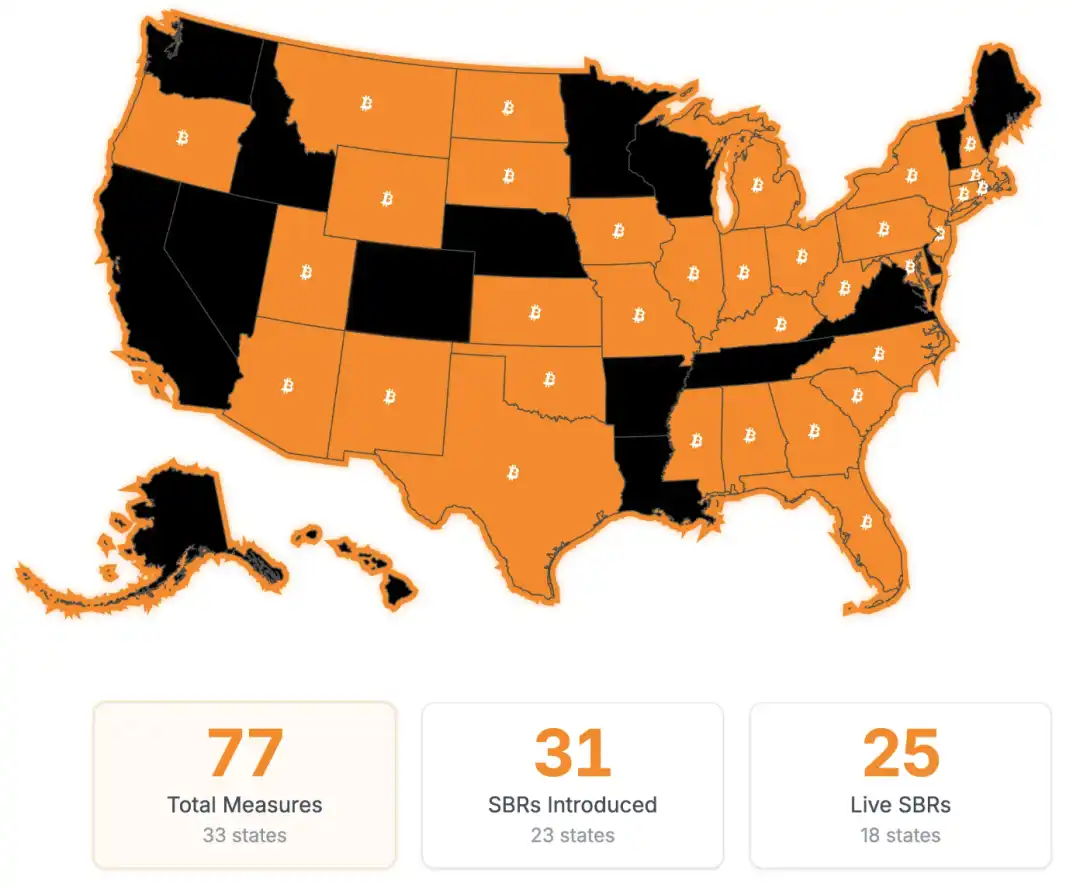
The process for establishing a Strategic Bitcoin Reserve Act by U.S. state governments generally requires:
First, drafting and submitting to the state legislature by state legislators or committees; then voting in both the House and Senate of the state legislature; finally, if both chambers of the state legislature pass it, it is sent to the governor for signing.
The following image shows the legislative process for the Strategic Bitcoin Reserve Act in Arizona:
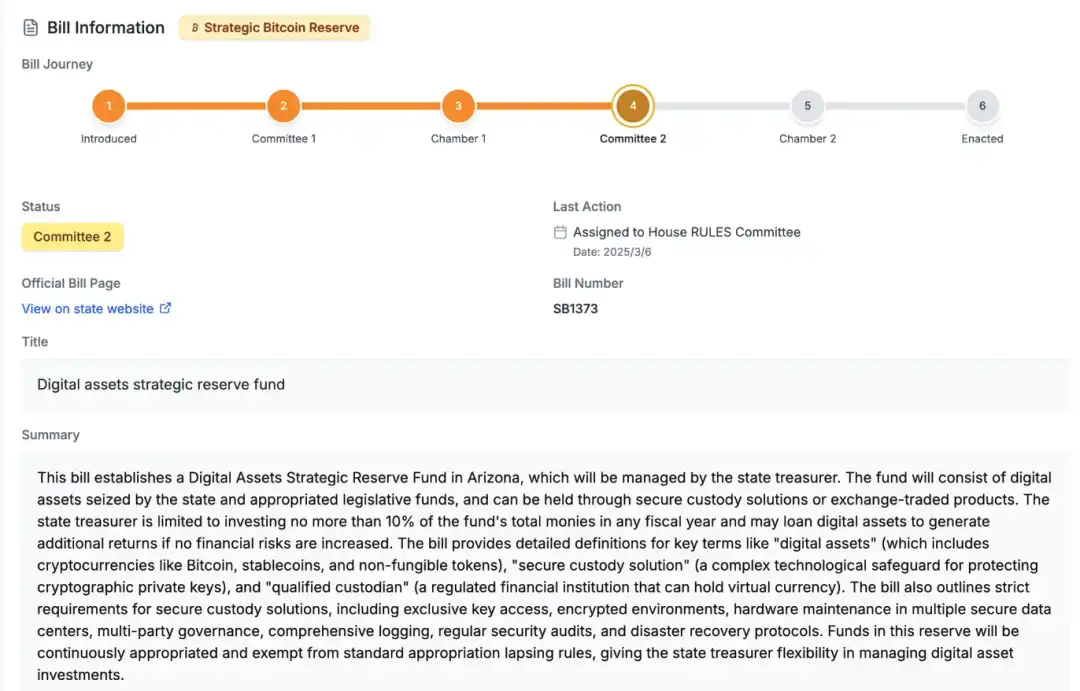
The content of each state's Strategic Bitcoin Reserve Act varies. For example, Oklahoma's proposal suggests allowing the state government to invest 10% of public funds in Bitcoin or any digital asset with a market cap exceeding $500 billion; Kentucky proposes investing up to 10% of surplus cash in cryptocurrencies with a market cap exceeding $750 billion and stablecoins approved by appropriate regulation.
Overall, Trump's Strategic Bitcoin Reserve EO is likely a long-term positive. From a policy perspective, as long as Trump's executive order remains unchanged, the policy environment will be friendly for at least the next few years. From a funding perspective, while there is no million BTC purchase plan at the federal level, state proposals, if passed or actually invested, could be significant. From a supply-demand perspective, on the supply side, Bitcoin seized by the U.S. government will be placed in the Strategic Bitcoin Reserve and cannot be sold, reducing selling pressure in the market; on the demand side, the U.S. government's decision regarding the Strategic Bitcoin Reserve may attract more investors to Bitcoin, including some traditional financial institutions and large corporations, which could alleviate concerns for them to engage in crypto businesses and may even prompt more countries to establish a Strategic Bitcoin Reserve.
Conclusion
Quoting Michael Saylor: History will remember the moment the U.S. Strategic Bitcoin Reserve was established—this is the turning point in the 21st-century financial and geopolitical landscape.
You may also like

CFTC Reportedly Plans New Prediction Market Rules Focused on Manipulation Risk and Public Interest Review
The CFTC is reportedly preparing new prediction market rules focused on manipulation risk, public interest review, and retail trader protections.

Meet the new WEEX trial fund—your gateway to greater profits

WEEX Labs Lands at Dutch Blockchain Week: A Disruptive Crypto × AI Conversation Sets Sail in Amsterdam

SK Hynix Reportedly Plans U.S. ADR Listing as Early as August, With SEC Approval Possible in Late June
SK Hynix may pursue a U.S. ADR listing as early as August, with SEC approval reportedly possible in late June amid strong AI chip supply chain demand.

SpaceX vs Tesla vs xAI: Which Elon Musk Trade Has the Biggest Upside in 2026?
OpenAI Reveals It Has Confidentially Submitted an S-1 to the SEC, Keeping the Door Open for a Future IPO
On June 9, according to an OpenAI announcement, the company recently confidentially submitted a draft S-1 registration statement to the U.S. Securities and Exchange Commission (SEC), beginning the preliminary compliance process for a potential initial public offering. OpenAI said it chose to disclose this proactively because it expected the news might leak; however, the company has not yet set a specific listing timeline, and related arrangements may still take some time.

Latest research from 13 top universities including Cornell University: The current state, challenges, and misconceptions of the fusion of Crypto and AI
Deconstructing Anthropic: The Best AI Company, Possibly Also a Type of Organizational Invention
Apollo and Blackstone Reportedly Back $35 Billion Anthropic Chip Financing as Deal Details Remain Unclear
On June 9, according to currently available news alerts, Apollo and Blackstone Group participated in a $35 billion financing for an Anthropic “chip project.” Based on the original wording of the report, the funding has already been raised, but public information remains limited. The financing structure, use of proceeds, project entity, and whether Apollo and Blackstone participated through equity, debt, or project financing have not yet been disclosed.

Humanity Protocol Security Incident Escalates: More Than $31 Million Stolen From Related Addresses as Attacker Continues Selling H for ETH
On June 9, according to monitoring by Onchain Lens, more than $31 million has been stolen from addresses linked to Humanity Protocol, and the attack is still ongoing, with the hacker continuously swapping H tokens for ETH. Project founder Terence Kwok later confirmed the security incident on X, saying the issue involved a private key leak.

Bloomberg: As Bitcoin Weakens, Stablecoins and RWA Continue to Drive Expansion in Crypto Businesses
In June, Bloomberg reported that despite Bitcoin falling below $60,000 last week, wiping out about $235 billion in market value within seven days, and dropping close to 50% from last year’s peak, some core businesses in the crypto industry are still expanding, mainly in stablecoins, real-world asset tokenization (RWA), payments, and infrastructure. The report also noted that overall altcoin activity has contracted significantly: altcoin market capitalization has fallen from a peak of about $431 billion in November 2021 to around $170 billion, and among the tens of millions of tokens issued in recent years, fewer than 1,700 still maintain meaningful trading activity.

Galaxy Deep Research Report: How Hyperliquid's HIP-4 Upgrade Changes the Landscape of Prediction Markets?
Binance Research: RWA Market Expected to Expand Nearly 6x from Early 2025, with Public Equities and Onchain Payments Heating Up Together
In June, Binance Research said in its monthly market report that the real-world asset (RWA) market is expected to grow by about 589% from the beginning of 2025. Bond- and money market fund-related RWA expanded by about $6.5 billion, up 83% year over year, while publicly traded equity RWAs grew by about 422%. The report also noted that monthly crypto debit card transaction volume exceeded $747 million in May, up 48.6% year to date.

Japan to Assess a Framework for Yen Stablecoins and Crypto ETFs as Asia’s Compliant Payments Narrative Heats Up
Recently, according to the original report, Japan is considering the launch of yen stablecoins and cryptocurrency ETFs. Public information remains limited at this stage, and there is still no complete policy text, regulatory draft, or clear implementation timeline, so this is better characterized as a “policy discussion” rather than formal implementation. The original wording also noted that advancing stablecoin regulation in Asia is driving XRP usage and supporting growth in the XRPL ecosystem. However, based on currently available public information, there is not enough evidence to directly establish a clear causal relationship between this round of discussion in Japan and XRP or XRPL.

ZachXBT: Humanity private key leak and abnormal surge in H token should be viewed separately
On June 9, according to related disclosures, on-chain investigator ZachXBT posted an update on Humanity’s roughly $31 million security incident, saying that after further analyzing fund flows, he currently tends to believe the project team was not involved in an “inside job” or a self-staged attack. According to him, the official explanation about the private key leak was broadly accurate, but before the token unlock, the price of H had been artificially pushed higher, and the hacker later took advantage of that market environment; therefore, the private key leak and the earlier abnormal price pumping should be regarded as two separate and independent events. This reframing has shifted the market’s understanding of the nature of the incident. Earlier discussion around Humanity had focused on whether the team directly participated in the attack or used the security incident to cover up internal operations. ZachXBT’s latest remarks shift the focus from “whether it was self-theft” to “whether there were pre-unlock market structure issues.” He also questioned whether the team may have.

Morning Report | OpenAI has submitted an S-1 registration statement draft to the U.S. SEC; Morpho completes $175 million financing

Morning Report | BitMine increased its holdings by 126,971 ETH last week; trader Eugene announced his exit from the crypto market

Wang Chuan: How can one not feel anxious after the neighbor Old Wang made thirty times profit by investing in storage stocks? (Seven) - A quarter-century cycle
CFTC Reportedly Plans New Prediction Market Rules Focused on Manipulation Risk and Public Interest Review
The CFTC is reportedly preparing new prediction market rules focused on manipulation risk, public interest review, and retail trader protections.
Meet the new WEEX trial fund—your gateway to greater profits
WEEX Labs Lands at Dutch Blockchain Week: A Disruptive Crypto × AI Conversation Sets Sail in Amsterdam
SK Hynix Reportedly Plans U.S. ADR Listing as Early as August, With SEC Approval Possible in Late June
SK Hynix may pursue a U.S. ADR listing as early as August, with SEC approval reportedly possible in late June amid strong AI chip supply chain demand.
SpaceX vs Tesla vs xAI: Which Elon Musk Trade Has the Biggest Upside in 2026?
OpenAI Reveals It Has Confidentially Submitted an S-1 to the SEC, Keeping the Door Open for a Future IPO
On June 9, according to an OpenAI announcement, the company recently confidentially submitted a draft S-1 registration statement to the U.S. Securities and Exchange Commission (SEC), beginning the preliminary compliance process for a potential initial public offering. OpenAI said it chose to disclose this proactively because it expected the news might leak; however, the company has not yet set a specific listing timeline, and related arrangements may still take some time.


