
$Ghibli's Half-day 100x, GPT-4o's New Feature Sweeps the Entire Web with "Miyazaki Hayao Style"


From last night to this morning, a large number of meme images suddenly emerged on platforms like X that are extremely similar in style to Hayao Miyazaki's film works. For example, the image below, which is still very popular on the internet as a "super universal" meme, has taken on a new charm and vitality in Miyazaki's "Ghibli style" rendering.

Of course, some classic old series and iconic scenes also appeared in this "remake feast," turning into dark jokes such as "Thanks Soros" and "Plane hitting the tower"...

At the same time, a meme coin named $Ghibli also launched on the blockchain in express mode. It started to surge from yesterday at 6 p.m., and under the hype from all sides this morning, its market value skyrocketed. As of the time of writing, it has surpassed $24 million with a 24-hour surge of over 10824%.
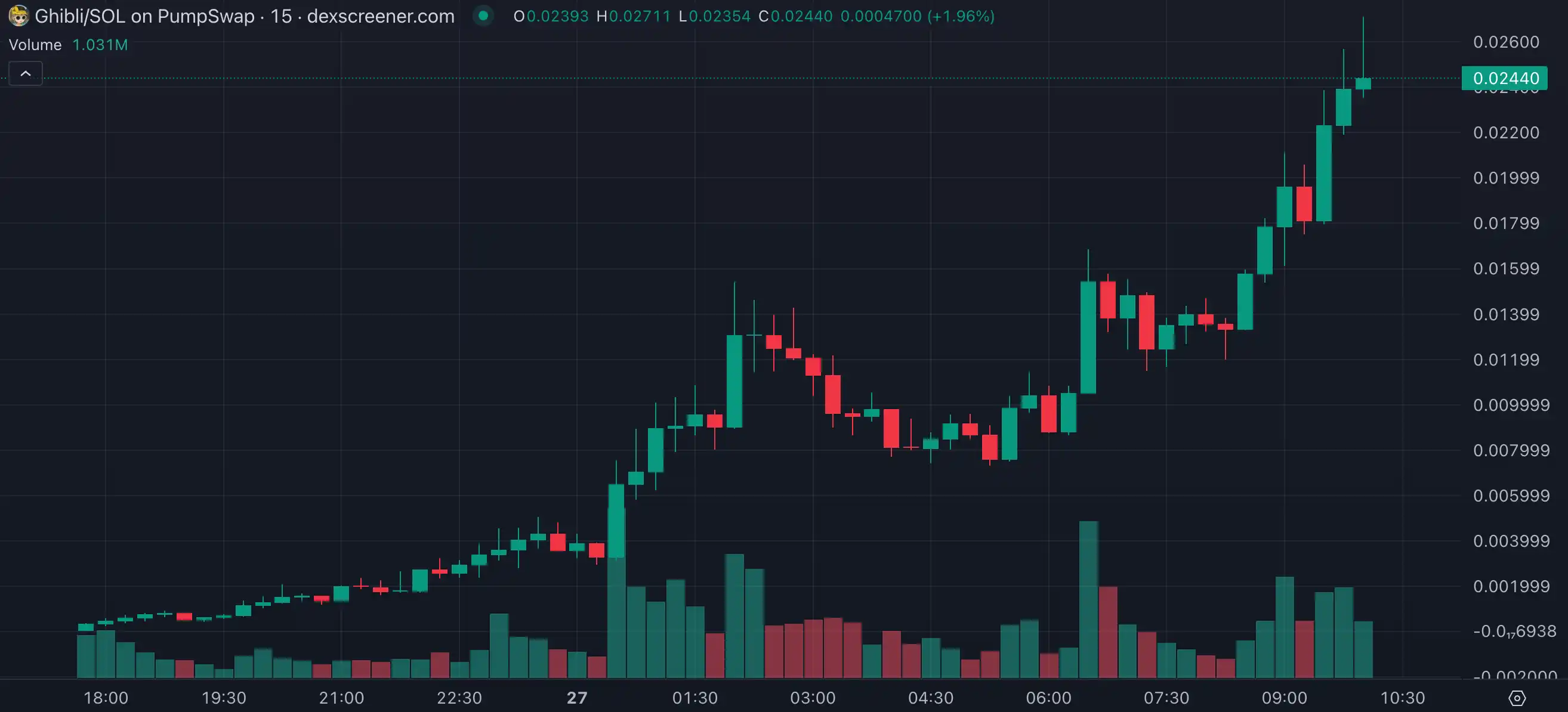
What happened? What is Ghibli?
Of course, all of this is thanks to the freshly baked feature of GPT-4o.
On Tuesday, OpenAI activated the image generator built into GPT-4o, which is officially referred to as the "most advanced image generator to date" with the ability to produce "accurate, precise, and realistic native multimodal outputs." People discovered that this image generator is particularly good at replicating the anime style of Hayao Miyazaki's Studio Ghibli.
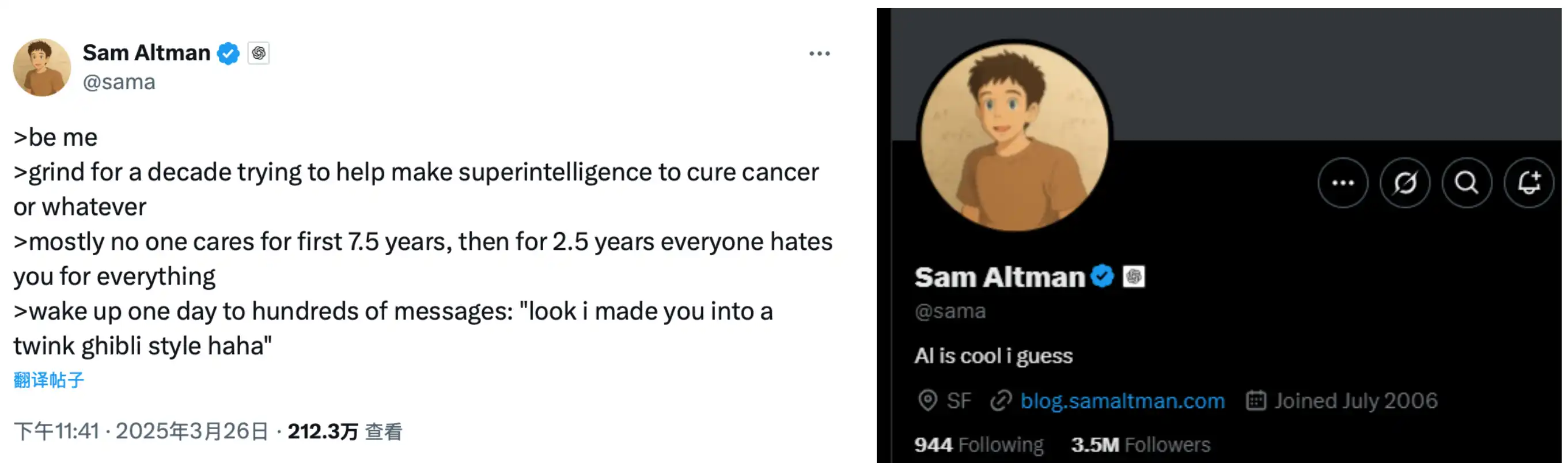
In his Wednesday tweet, OpenAI's CEO Sam Altman was the first to start this "Ghibli viral spread" and even changed his own profile picture to a Ghibli-style image.
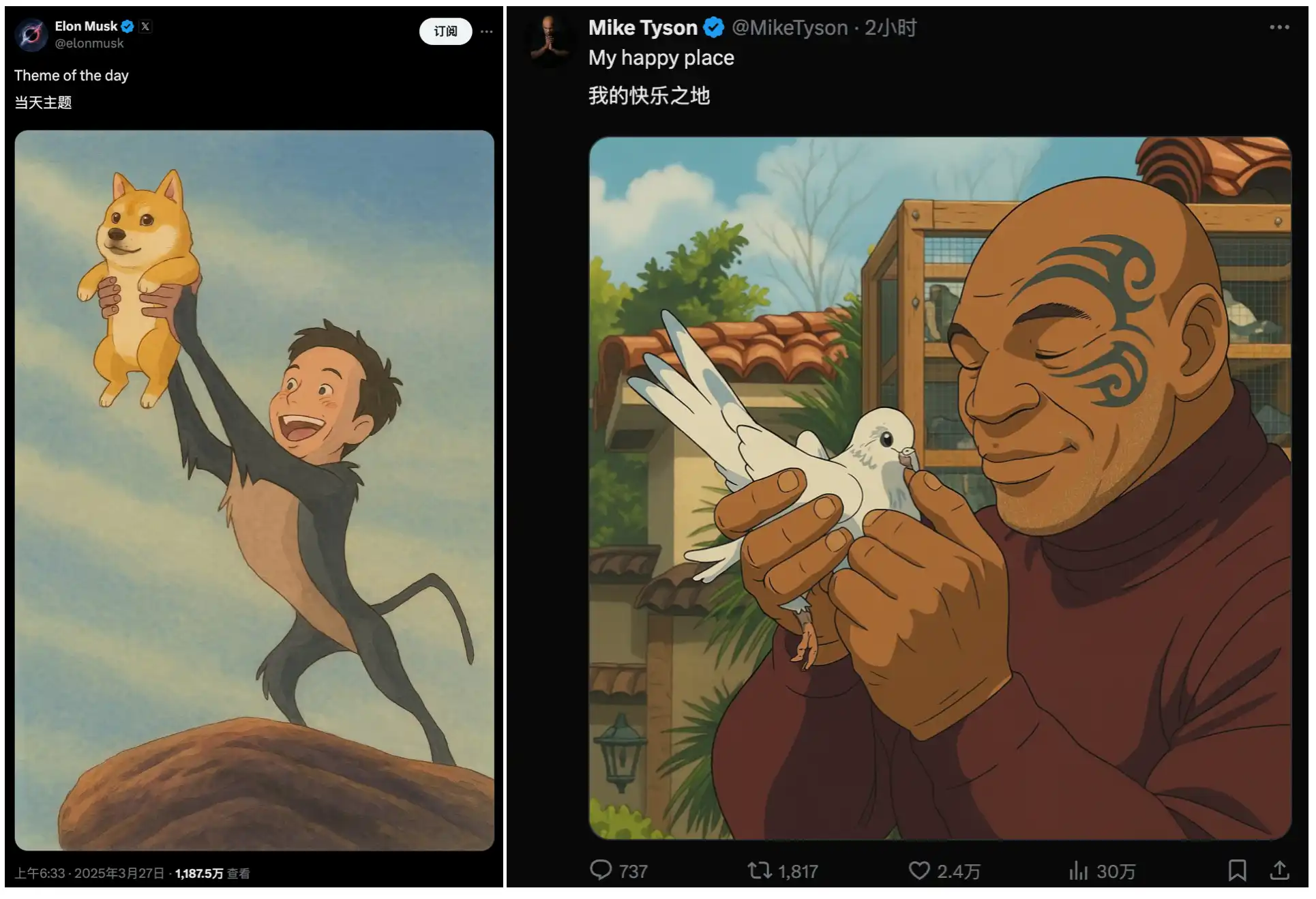
Subsequently, many Twitter personalities also began to imitate, uploading their own images rendered in Ghibli style. Even Elon Musk, the founder of Grok AI and a fierce competitor of OpenAI, wrote in his "image tweet": This is today's theme.
Although ChatGPT previously allowed users to create images from text prompts, it did so by routing them to another separate OpenAI model, DALL-E 3.
The reason the GPT-4o model is named "o" is because it is an "Omni" model. This means that OpenAI has not only trained it on text data but also on image data and even audiovisual data, enabling it to understand all these forms of media and their similarities. It can generate the given media based on user prompts without relying on any external models.
Recently, AI giants have been fiercely competing in the field of image generation models, with Google also releasing an experimental image creation model called Gemini 2.0 Flash. It is evident that having AI as your personal artist, creating an image that fully understands your intention, is becoming a very simple task.
Hayao Miyazaki, co-founder of Studio Ghibli, has expressed strong opposition to AI-generated animation in the past. At a conference in 2016, Miyazaki made a statement regarding AI animation, saying, "I feel repulsed. If you really want to create something that is eerie, you can go ahead. I never want to incorporate this technology into my work," and further described it as "an insult to life itself."
How to Generate Your Own Ghibli?
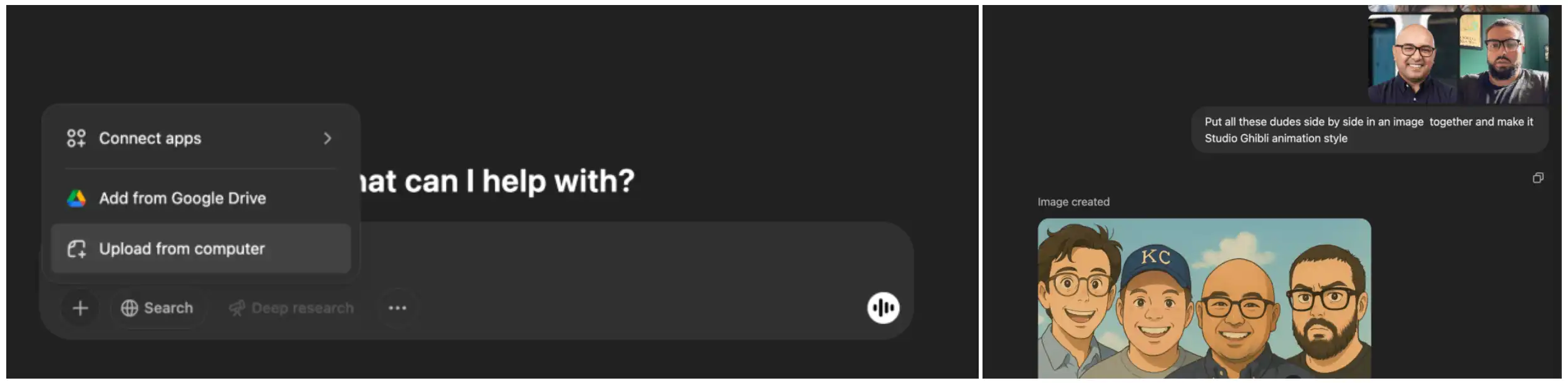
First, navigate to chat.com or chatgpt.com and make sure you are using a GPT Plus, Pro, or Team account, and the AI model selector shows "GPT-4o."
Use the "+" button at the bottom left of the real-time input text box to upload an image, and then you can instruct the new GPT-4o with an image creation model to "redraw this image in the style of Ghibli animation." You can also upload multiple images and combine them into one image using the Ghibli style. In any case, with plenty of experimentation, 4o will bring you many surprises.
Of course, the related meme token $Ghibli simply merges the artistic aesthetics of Studio Ghibli and the trend of AI-generated content in terms of narrative. Its rapid rise to fame on Twitter is attributed to this. However, the team information behind the token is currently not clear, and investors should tread carefully when considering the associated risks.
You may also like

How much longer can Ethereum's last big buyer hold on?

The pricing controversy of Trade.xyz exposes the fatal weakness of Pre-IPO perpetual contracts

World Cup 2026 Coming – WEEX Celebrates with $1M Prize Pool & Michael Owen Live

Galaxy in-depth report: Is Solana still worth paying attention to?
Young people in South Korea make a "final effort" in the epic bull market

Dialogue with OmenX Founder: Why does the prediction market need an evolution from "spot" to "derivatives"?
When the P2P illicit funds from ten years ago turned into 60,000 bitcoins

Morning News | CME Group launches Nasdaq Cryptocurrency Index futures; Asset management giant Janus Henderson strategically invests in Ethena
Why did Oracle deliver the strongest financial report in history, yet its stock price fell?

Bitcoin Layer 2 Network Botanix: Why Did We Choose to Dissolve?

Morning Report | OpenAI has submitted an S-1 registration statement draft to the U.S. SEC; Morpho completes $175 million financing

Galaxy Deep Research Report: How Hyperliquid's HIP-4 Upgrade Changes the Landscape of Prediction Markets?

Latest research from 13 top universities including Cornell University: The current state, challenges, and misconceptions of the fusion of Crypto and AI
Deconstructing Anthropic: The Best AI Company, Possibly Also a Type of Organizational Invention

Every exchange is a "Universal Exchange."

The counterattack of traditional finance: Alliance chains are quietly reviving
Pantera Capital Partner: How Tokenization is Restructuring the Private Equity and Early Investment Ecosystem?

Mastercard Launches Agent Pay for AI, Plans to Record AI Agent Payment Authorizations on Polygon
Mastercard launched Agent Pay for AI, a new payment protocol designed to help AI agents make small payments such as pay-per-use access to data and APIs. The system plans to record human-granted AI agent permissions on Polygon, focusing on verifiable authorization, identity, and payment controls.
How much longer can Ethereum's last big buyer hold on?
The pricing controversy of Trade.xyz exposes the fatal weakness of Pre-IPO perpetual contracts
World Cup 2026 Coming – WEEX Celebrates with $1M Prize Pool & Michael Owen Live
Galaxy in-depth report: Is Solana still worth paying attention to?
Young people in South Korea make a "final effort" in the epic bull market
Dialogue with OmenX Founder: Why does the prediction market need an evolution from "spot" to "derivatives"?


