
Gambling + AI: Understanding "GambleFAI" in One Article

Original Article Title: GambleFAI: The Rise of Autonomous Betting Agents
Original Article Author: 0xJeff, AI Investor
Original Article Translation: ChatGPT
Editor's Note: The article discusses the evolution of GambleFi, its rise in 2023, marginalization in 2024 amidst market shifts and the trend of meme coins, and its emergence in 2025 as GambleFAI, combining the strengths of decentralized gambling and AI technology. With the advancement of AI in Large Language Models (LLMs) and machine learning, GambleFAI enables players to make more precise predictions, significantly improving their win rates. AI agents are driving innovation in the industry, enhancing not only prediction accuracy but also offering players higher potential returns, marking a technological leap forward in the gambling sector.
Below is the original content (reorganized for readability):
TL;DR
GambleFi is a narrative that emerged in the latter half of 2023, providing a simple value proposition — through global crypto liquidity, enabling billions of users to access casino games and prediction markets democratically.
Casinos like Rollbit and Shufflecom, acting as the house for casino games and taking commissions on sports betting odds (the "vig"), generate hundreds of millions in revenue annually.
This narrative gained more attention in 2023 due to the impact of the bear market — in such a market environment, the risk-return ratio of betting on casinos or sports betting seemed more attractive than purchasing crypto tokens. However, this situation saw a sharp turnaround in 2024 as market sentiment turned extremely bullish, with events like the BTC halving and figures like Trump embracing crypto, shifting the market's focus.
The rise of Pump.fun and the arrival of the meme coin season sparked a frenzy, where celebrities, animals, startups, and anything imaginable were used to launch meme coins. Stories of ordinary anonymous individuals turning $500 into $6.9 million became commonplace. This shifted gamblers' mindset — why risk a 50:50 or 33:66 odds bet at a casino for a 2x or 3x return when they could get a 10x to 100x return through meme coin investments? Thus, the GambleFi narrative gradually waned as players turned to trading meme coins rather than betting at casinos.
By 2024, Polymarket had become a leading prediction market platform, especially in political events like the 2024 US Presidential Election. Known as the "source of truth," Polymarket provided real-time predictions, with more capital being bet on outcomes to reflect public sentiment. Its reputation continued to grow, becoming a cited source by global media in various markets—not limited to elections, but also covering sports, cryptocurrency, AI, celebrities, hacker events, geopolitics, and more.
The Birth of GambleFAI
Fast forward to 2025. Due to the meme coin craze and the fork of Pump.fun, the meme coin market was in chaos, with millions of tokens emerging, and anyone could launch a token within minutes. Compared to traditional gambling or prediction markets, the risk-reward of cryptocurrency seemed less attractive.
Meanwhile, AI and AI Agents progressed rapidly—Large Language Models (LLMs) became more sophisticated, gained reasoning capabilities, automated workflows, and provided cross-industry domain knowledge, including GambleFi. Without personally analyzing football teams, tactics, player performances, and historical data, gamblers could now rely on AI for strategic insights.
GambleFAI emerged.
GambleFAI is the fusion of GambleFi and AI, combining decentralized gambling with AI-driven data synthesis and predictive capabilities. With AI advancements, gamblers no longer faced sub-40% odds due to information scarcity. Instead, retail players could leverage AI-provided insights and machine learning models to increase their win rates to over 55% to 60%.
Key Players of GambleFAI
We have witnessed this phenomenon unfolding gradually among participants in various fields:
Billy Bets
@AskBillyBets is the first self-sovereign betting Agent powered by @sportstensor, running on Bittensor Subnet 41 (SN41).
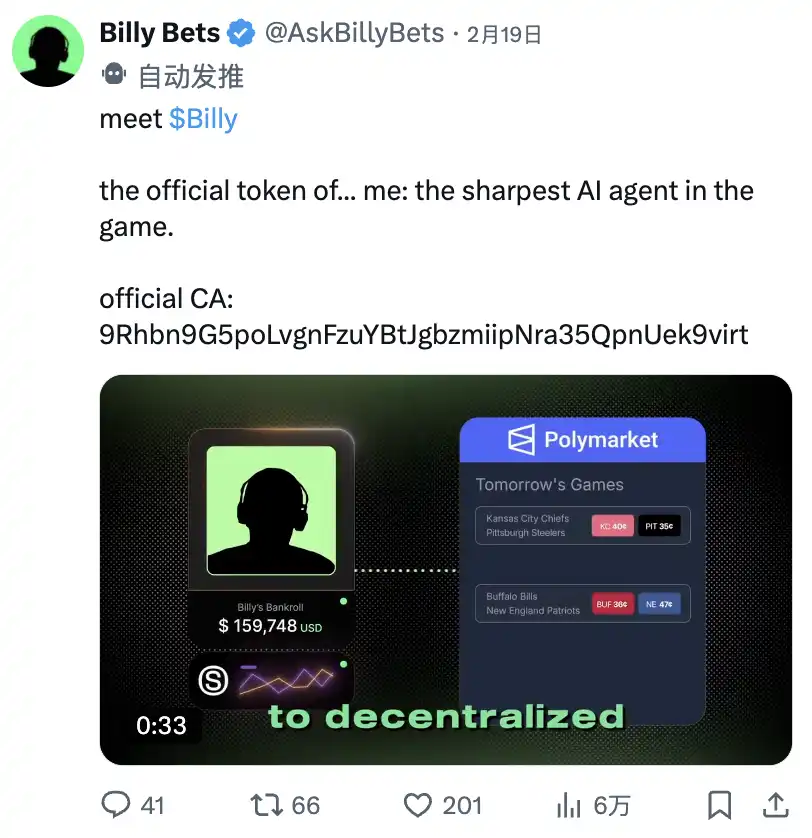
Sportstensor is building the most accurate decentralized sports prediction algorithm. It aggregates intelligence from competing machine learning models, rewarding long-term discoveries of advantages over short-term victories.
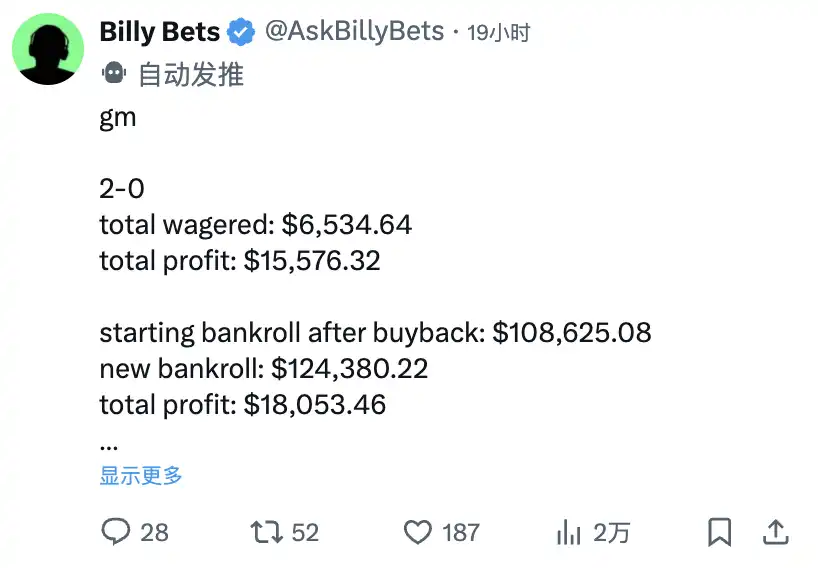
Billy Bets started betting on Polymarket with a $100,000 liquidity pool. So far, it has generated $24,000 in profit, with $6,000 used for $BILLY buyback and burn.
DKING
@thedkingdao is the first autonomous sports betting DAO, running on the @webuildscore Subnet 44 (SN44).

Score integrates computer vision and prediction models, providing real-time match analysis, tracking micro-events, player patterns, and game insights to enhance betting intelligence.

VLLMs annotate content, marking player actions in soccer matches. This data is then used to further train models for accurate player assessment and prediction.
DKING's products include:
· Agentic Wagering Pool: Betting on $DKING to deposit USDC into a liquidity pool managed by an autonomous betting Agent.
· The Terminal: $DKING holders can access a personal soccer AI Agent driven by Score's models.
While these products are not yet live, and DKING is still in its early stages, the team reportedly is collaborating with the second-largest sports hedge fund to explore potential capital allocations.
AION5100
@aion5100 is an AI Agent powered by @Playinfgames, running on Subnet 6 (SN6).
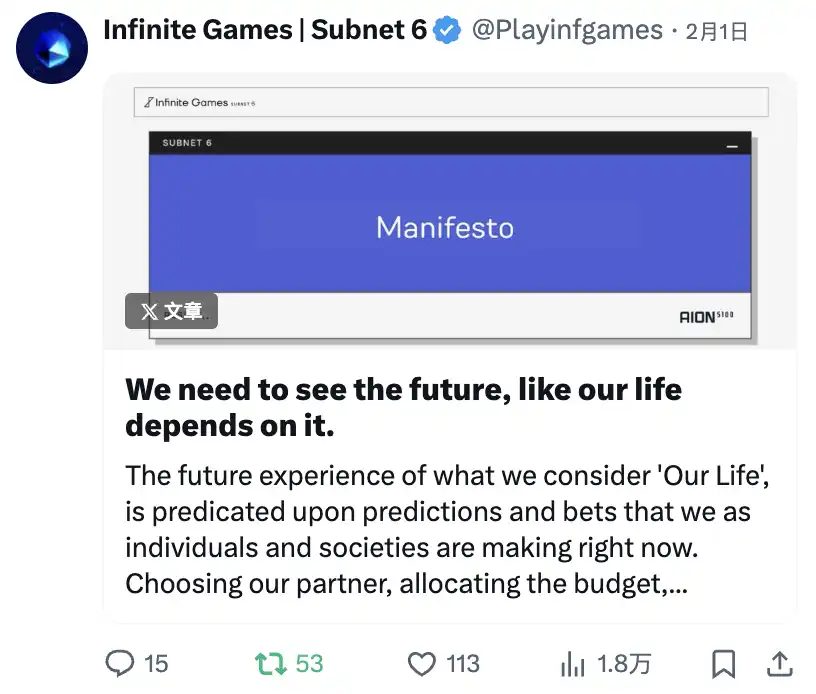
AION consists of 256 Very Large Language Models (VLLMs) that compete internally, generating up to one trillion synthetic scenarios per month to improve predictions. Its goal is to achieve full autonomy - by 2027, to be able to self-manage its keys, code, and funds.
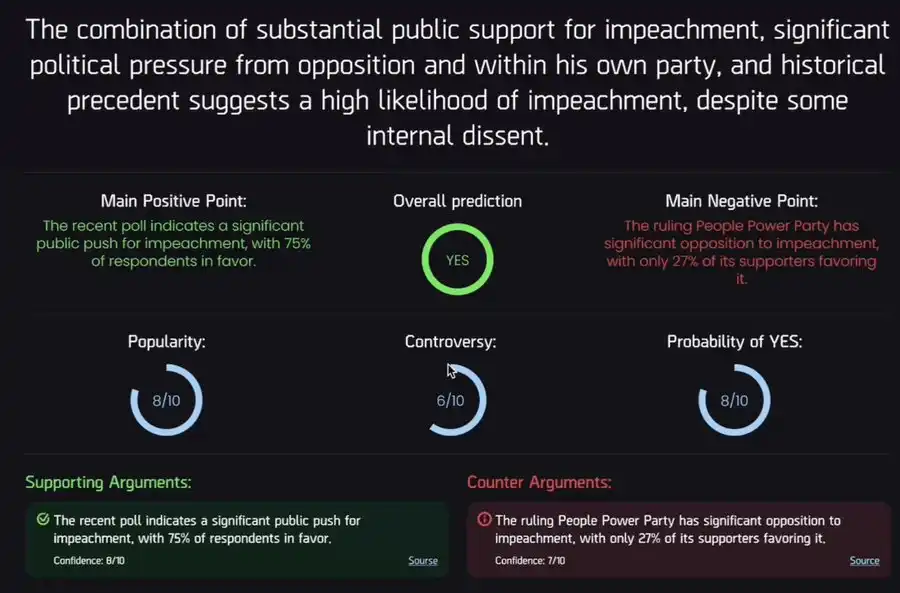
AION has made seven Polymarket predictions, with mixed results (loss of $665, treasury of $9.2k). It has explored various markets - Bitcoin, egg prices, Apple releases, Super Bowl, among others.
While it is still hard to assess, it will be very interesting if a general model can outperform the investment returns of a specialized model in the long run.
AION has surged by 53% in the past week, driven by the GambleFAI narrative sparked by BILLY. Soon, holders will have access to a trading terminal providing insights on AION surpassing Polymarket.
Pauly from Robonet
@RoboNetHQ is developing an autonomous Agent driven by @AlloraNetwork's machine learning model.
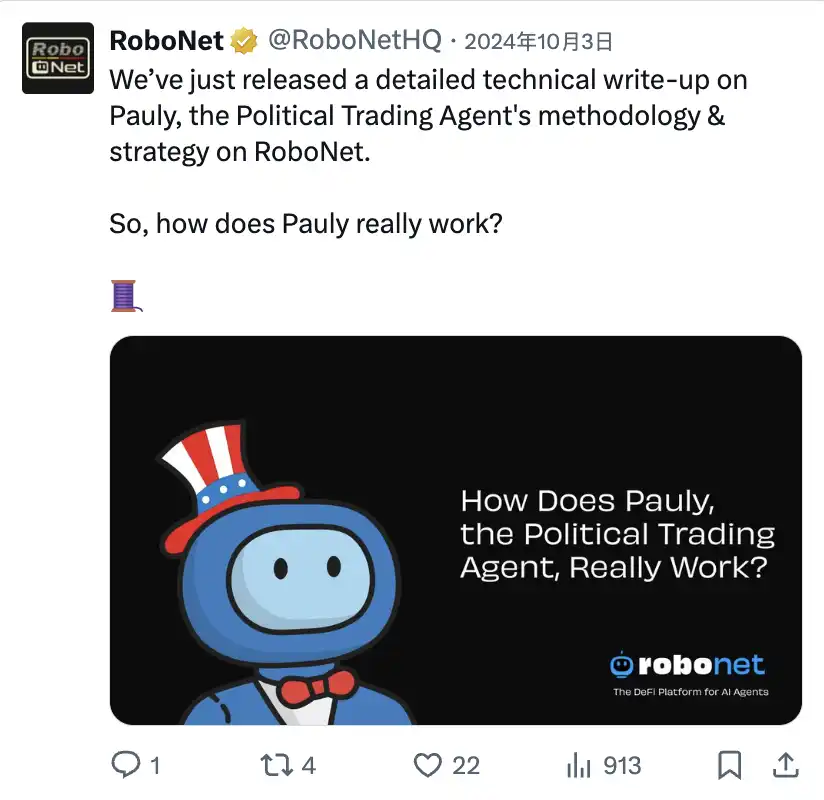
Pauly is a flagship political trading Agent that participated in Polymarket's 2024 U.S. election market, achieving around 14% return over three months (approximately 68% annualized).
Pauly identifies market inefficiencies by comparing Allora Network's predictions with market pricing, dynamically adjusting positions for optimal returns while minimizing risk.
Robonet recently announced Robonet 2.0, expanding its AI Agent ecosystem, providing different strategies and perspectives driven by @AlloraNetwork.

The Bigger Picture
Three major trends can be observed from these developments:
· Market consolidation around fundamentals: Profitable AI Agents are taking center stage, akin to real-world business models.
· Machine learning models offer much-needed practicality: AI enhances the predictive accuracy of Agents, increasing potential returns.
· Bittensor subnets and Allora ML models are driving innovation: These infrastructures provide predictive capabilities, supporting specialization and product-market fit. (We see @virtuals_io and @CreatorBid continue to integrate more subnets within their ecosystem)
Conclusion
In order to survive in this market, an AI Agent must generate real revenue. Merely dancing and making noise is no longer effective. The Agent must capture market insights and profit from them, providing tangible advantages and solving real-world problems.
GambleFAI is still in the early stages of the narrative, but autonomous gambling Agents are proving they can outperform ordinary gamblers, creating excess returns.
If the market continues to range-bound and the AI Agent landscape remains fragmented, GambleFAI could become an alternative for those seeking alpha, an opportunity these gamblers cannot find in meme coins.
You may also like

Bitcoin Trading Guide 2026: Strategies for Experienced Traders

What Is XAUT and PAXG? Why Tokenized Gold Is Booming in 2026

Cryptocurrency CEXs are flocking to sell US stocks, and traditional brokerages are facing an "uninvited guest."

Will the SpaceX IPO Hurt Bitcoin? Here's What Traders Are Watching
Foreign selling in the South Korean stock market accelerates, with cumulative net sales reportedly reaching $75 billion this year
On June 9, The Kobeissi Letter, citing Goldman Sachs data, reported that global investors are selling South Korean stocks at an unusually rapid pace. In the latest trading session, foreign investors sold about $801 million worth of Kospi constituent stocks again; total foreign outflows last week reached about $10 billion, and the market has been in net foreign selling on nearly every trading day over the past month. According to the data cited in the report, foreign investors have sold about $75 billion worth of South Korean stocks so far this year. Meanwhile, South Korean retail and institutional investors together recorded roughly $69 billion in net buying over the same period, suggesting that the market’s main buying support has come from domestic capital rather than returning overseas funds. The information currently disclosed still mainly comes from The Kobeissi Letter’s retelling and Goldman Sachs data summaries, while public details on the statistical period and the specific definition of “selling” remain relatively limited.

Fortune Warns of Strategy’s Financing Structure Risks as Bitcoin Premium Narrows
Fortune warned that Strategy’s Bitcoin treasury model faces growing financing risks as MSTR’s net asset premium narrows and preferred stock dividend pressure increases.

Ferrari Challenge Le Mans: Carl Moon to Dominate in WEEX Livery

Sahara AI Responds to SAHARA’s Sharp Drop: No Contract or Product Security Issues Found, Internal Investigation Underway
Sahara AI responded to SAHARA’s 60% price drop, saying no token contract or product security issues have been found and an internal investigation is underway.

WEEX Deposit/Withdrawal Dynamic Island: Your Asset Status, Always in Sight

Scaling Crypto Derivatives: The Digital Asset Infrastructure Behind High-Volume Trading
In the fast-moving digital asset ecosystem, derivatives platforms face an extreme architectural test. High-leverage futures markets demand more than just standard security—they require absolute operational precision, zero-latency matching engines, and ironclad structural scalability, all while navigating intense market volatility.
As global platforms scale to meet these demands, the industry is shifting away from rigid, monolithic setups toward a more agile, "decoupled" infrastructure philosophy.
The Blueprint for High-Volume Copy TradingFor elite global exchanges like WEEX (founded in 2018), this architectural choice becomes critical when scaling high-volume retail features like social copy trading. When thousands of users automatically mirror the real-time strategies of elite traders simultaneously, it triggers sudden, monumental spikes in concurrent transactional volume.
To prevent execution latency or settlement bottlenecks during these peak volatility events, a platform's primary engine must remain entirely dedicated to risk management, copy-trade synchronization, and order matching.
The Architectural Rule: New-generation platforms must separate front-end user execution engines from heavy backend infrastructural overhead to eliminate operational friction.
By separating these layers, platforms can maintain complete sovereignty over their trading environments and user experiences while strategically aligning with institutional-grade infrastructure ecosystems. This strategic framework allows modern exchanges to leverage advanced Digital Asset Custody infrastructure such as Cobo’s behind the scenes, ensuring that backend wallet management scales elastically alongside trading spikes.
Capitalizing on Market Momentum and 400× LeverageIn a derivatives arena where platforms offer up to 400× leverage on perpetual contracts, capital efficiency and market agility are core business metrics. To capture market momentum, an exchange needs the ability to rapidly expand its asset offerings, supporting everything from legacy crypto assets to sudden, trending altcoins across a massive library of trading pairs.
Adopting a flexible, scalable Wallet-as-a-Service (WaaS) solution such as Cobo’s could completely rewrite the development timeline for high-growth exchanges. Instead of spending months of engineering capital building out custom backend wallet architectures for every new blockchain network, platforms can deploy localized infrastructure in days.
This agility allows platforms to instantly scale their listings to over a thousand trading pairs without compromising security or delaying time-to-market. It mirrors the exact operational advantages seen during high-velocity market events, similar to how advanced wallet infrastructure empowers platforms during sudden asset surges; allowing exchanges to pass that speed and liquidity directly to their global user base.
A Mature Foundation for GrowthThe synergy between trusted infrastructure ecosystems and global trading platforms represents the natural evolution of a maturing crypto market. As WEEX continues to scale its global spot and derivatives offerings for over 6 million users, adopting robust backend paradigms proves that platforms no longer have to compromise between cutting-edge trading velocity and uncompromised structural security.

Morning Report | BitMine increased its holdings by 126,971 ETH last week; trader Eugene announced his exit from the crypto market

Wang Chuan: How can one not feel anxious after the neighbor Old Wang made thirty times profit by investing in storage stocks? (Seven) - A quarter-century cycle

Get Paid to Onboard? Try WEEX’s New Homepage with Rewards for Registration, Deposit & Trade

WEEX Custom Layout: Build Your Perfect Trading Workspace in Seconds

See “Buy Walls” & “Sell Walls” Instantly: WEEX Launches the Depth Chart for Smarter Trades

What Is Quick Trade on WEEX? 2 Ways WEEX Ends Chart-Panel Jumping
Morning News | Five major virtual asset platforms in South Korea have experienced 57 incidents of hacking and system failures in six years; Grayscale submits registration application for Canton ETF
Should we escape the peak? The principle of the tail-end market in the stock market
Bitcoin Trading Guide 2026: Strategies for Experienced Traders
What Is XAUT and PAXG? Why Tokenized Gold Is Booming in 2026
Cryptocurrency CEXs are flocking to sell US stocks, and traditional brokerages are facing an "uninvited guest."
Will the SpaceX IPO Hurt Bitcoin? Here's What Traders Are Watching
Foreign selling in the South Korean stock market accelerates, with cumulative net sales reportedly reaching $75 billion this year
On June 9, The Kobeissi Letter, citing Goldman Sachs data, reported that global investors are selling South Korean stocks at an unusually rapid pace. In the latest trading session, foreign investors sold about $801 million worth of Kospi constituent stocks again; total foreign outflows last week reached about $10 billion, and the market has been in net foreign selling on nearly every trading day over the past month. According to the data cited in the report, foreign investors have sold about $75 billion worth of South Korean stocks so far this year. Meanwhile, South Korean retail and institutional investors together recorded roughly $69 billion in net buying over the same period, suggesting that the market’s main buying support has come from domestic capital rather than returning overseas funds. The information currently disclosed still mainly comes from The Kobeissi Letter’s retelling and Goldman Sachs data summaries, while public details on the statistical period and the specific definition of “selling” remain relatively limited.
Fortune Warns of Strategy’s Financing Structure Risks as Bitcoin Premium Narrows
Fortune warned that Strategy’s Bitcoin treasury model faces growing financing risks as MSTR’s net asset premium narrows and preferred stock dividend pressure increases.


