
From Earning One Billion a Year to Rug Pull, the Soccer Wizard Delivers a Brutal Blow to Retail Investors



He was once one of the brightest stars in the world of football, hailed as the "Soccer Wizard," outshining Messi and C Ronaldo during his peak, conquering fans with magical skills. Twice named "FIFA World Player of the Year," earning up to $100 million a year.
In the seven years since his retirement, the fallen Ronaldinio has spiraled down, seeking money-making opportunities around the world. This time, he set his sights on the crypto world.
2025 was the year of the celebrity coin's big breakout. Trump led the way with a coin release raking in $65 billion, followed by the US First Lady Coin and the Argentine President Coin, with various celebrity coins emerging one after another. So when rumors of "Brazilian football star Ronaldinho issuing his own coin" surfaced, the market was not surprised.
At around 6 a.m. on March 3, Beijing time, coinciding with the same time Trump Coin was issued during the US East Coast market closure, Ronaldinho announced on Twitter the launch of his official token, STAR10.
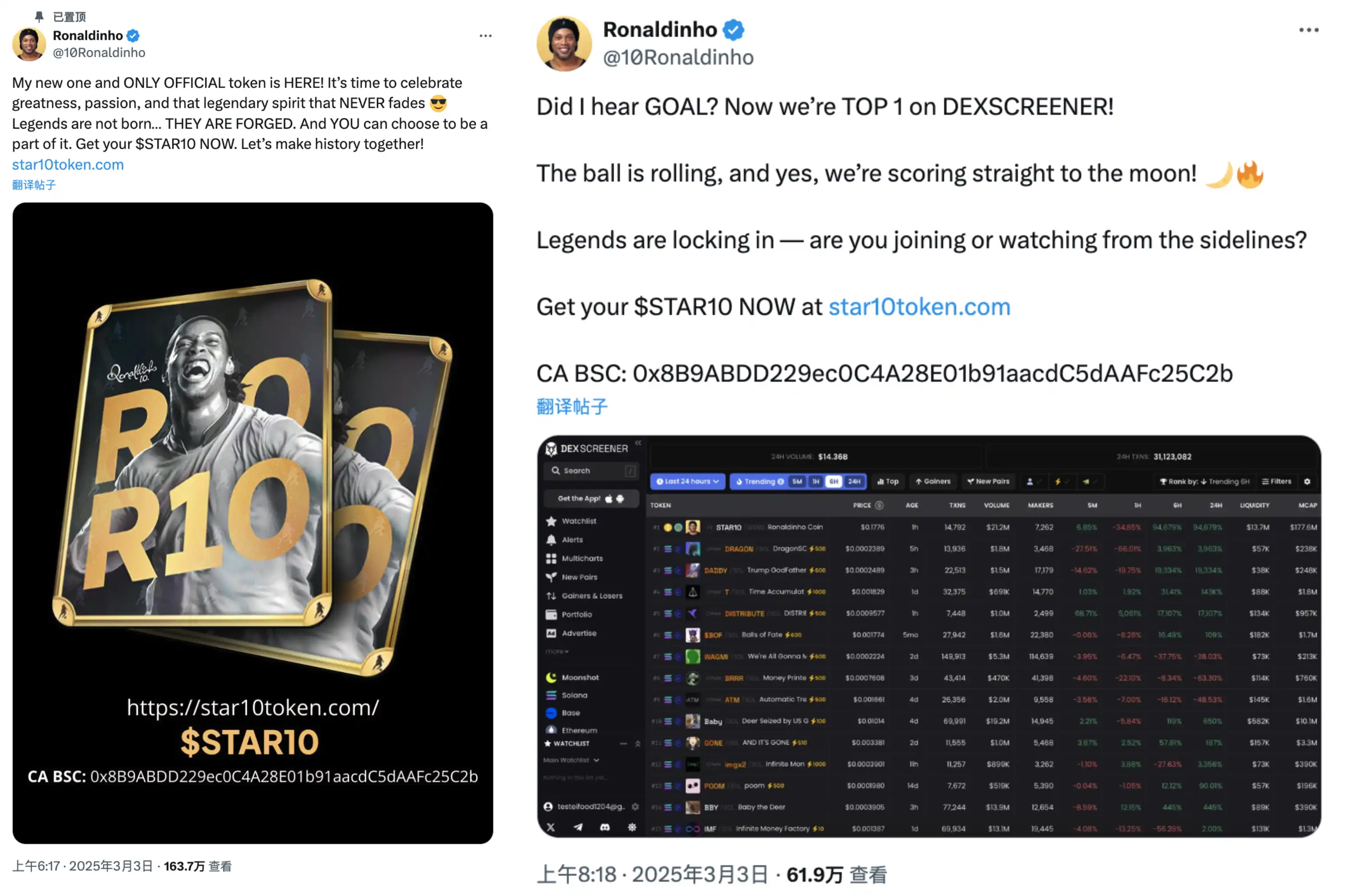
Half an hour after his tweet, the token's market cap surpassed $200 million, priced at $0.28 per token. Hours later, Binance Chain founder CZ and former Binance executive He Yi each commented and retweeted Ronaldinho's tweet, triggering even greater market attention. The token's market cap rapidly grew, exceeding $350 million, with the current highest price at $0.4 per token, a 45.66% increase in one hour.
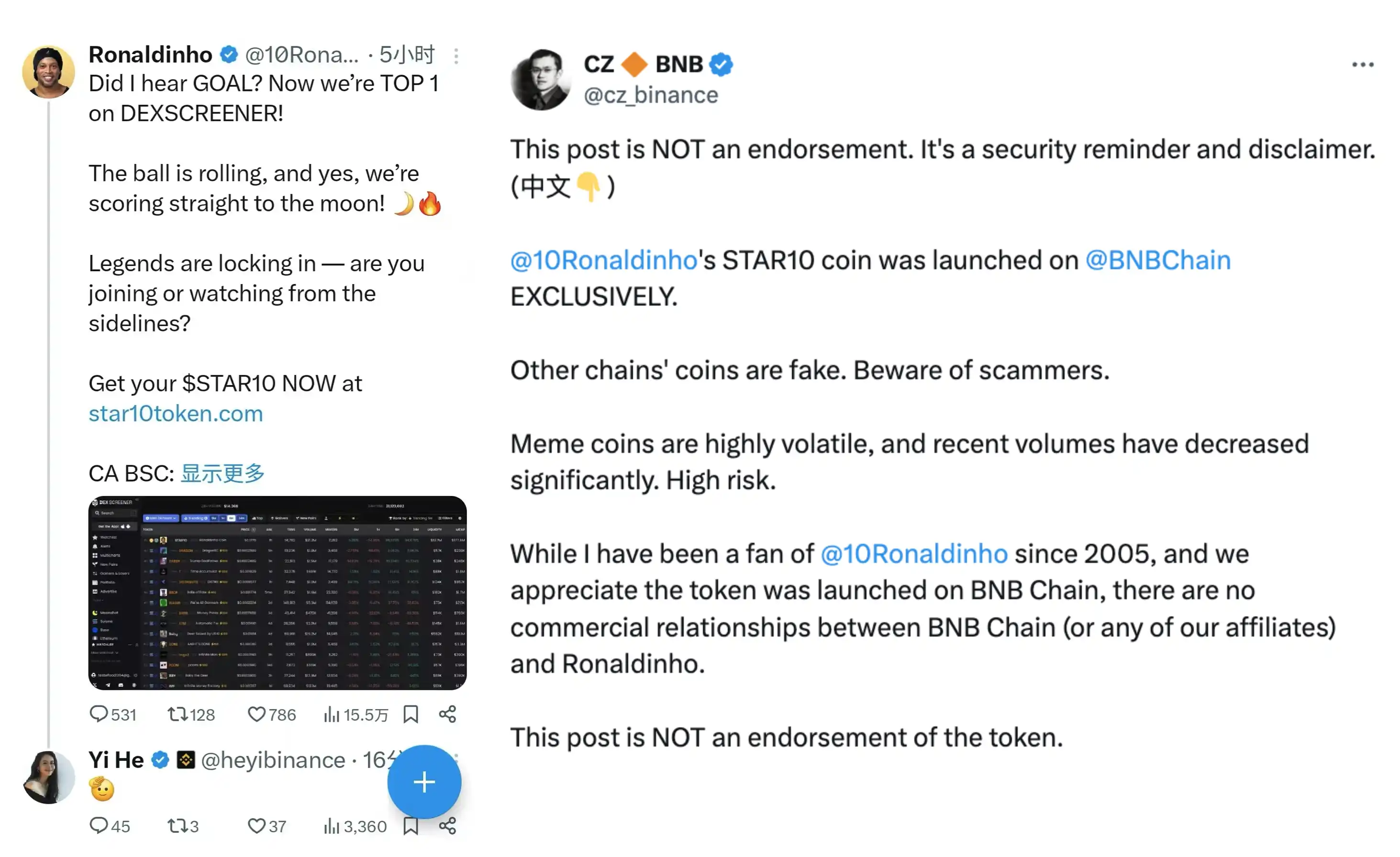
The reason He Yi and CZ rushed to retweet was that, unlike previous celebrity coins like Trump, STAR10 was the first celebrity coin launched on the Binance Chain. "I have been a fan of Ronaldinho since 2005 personally, and we are grateful for the token being launched on the BNB Chain," wrote CZ.
However, the market quickly sensed something unusual. In fact, on the day before the official token release (March 2), Ronaldinho had already interacted with CZ on X, retweeting CZ's tweet "Keep Building!" and adding the comment "On it!" This interaction sparked community speculation: Was the Binance Chain backing Ronaldinho's coin?
CZ stated: "The Binance Chain (and any affiliates) has no business relationship with Ronaldinho." And reiterated that the post was not an endorsement of the token.
Social Media Account Sold for $15 Million in Scam
Up to this point, Ronaldinho's token launch was not considered a "rug pull," until the community exposed a deeper layer of the scandal.
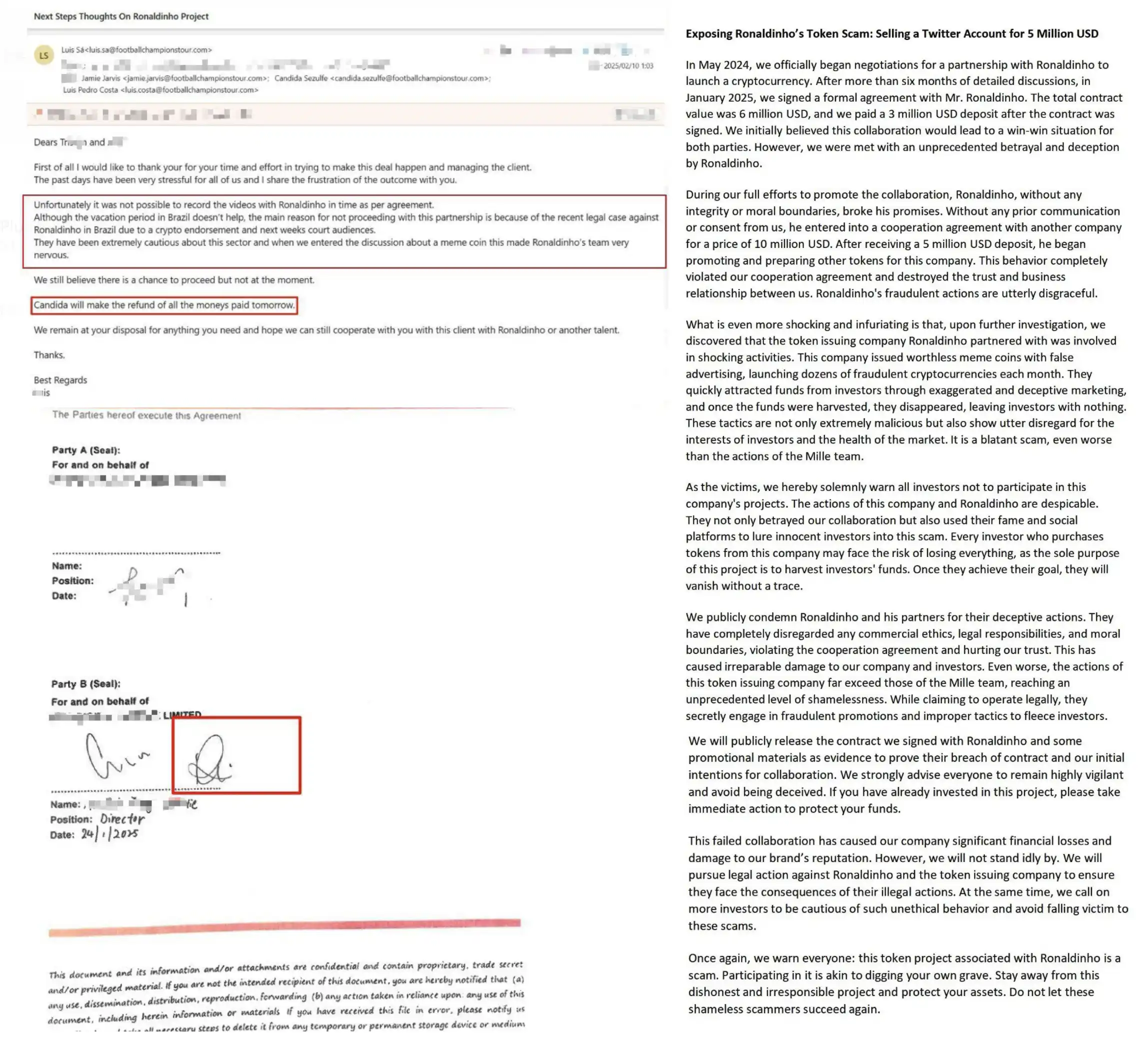
According to User X @R10coin_'s disclosure, the former soccer genius not only deeply engaged in crypto hype but also allegedly sold his X (Twitter) account for $5 million to a Shenzhen-based "rug pull" team to assist them in false advertising and attracting investors.
The origins of the incident can be traced back to May 2024, when @R10coin_ had already begun discussing a cryptocurrency partnership with Ronaldinho. Following six months of negotiations, the two parties officially signed a $6 million contract in January 2025. After the agreement was reached, @R10coin_ made an initial payment of $3 million as a deposit to kickstart the project.
However, unexpectedly, without informing the partner, Ronaldinho secretly signed another $10 million deal with a different company, receiving an additional $5 million deposit. Subsequently, he devoted himself entirely to promoting and hyping the new company's token, completely disregarding the partnership with @R10coin_. As a result, @R10coin_ publicly denounced Ronaldinho's fraudulent behavior, disclosed the contract details and some promotional materials, and continued to reveal insider information.
It is reported that the company based in Shenzhen, China, had long been notorious for its main business of manipulating the Meme coin market, engaging in false advertising, and a "pump and dump" scheme. Their operation was highly deceptive: rapidly hyping up the coin, generating FOMO (fear of missing out) through social media marketing to attract investors; swiftly pumping up the price, peaking the market within just 1 hour; then quickly selling off, causing the coin price to crash, leaving investors penniless, while the masterminds behind the scenes absconded with the funds.
As of now, Ronaldinho's X account has not responded to the above information. Following this insider exposure, the price of Ronaldinho's token STAR10 plummeted to $0.28 per token.
7 Years Retired, Ronaldinho's Checkered Past
Ronaldinho, hailing from a soccer family in Brazil where his father was an amateur soccer player and his brother a professional, exhibited exceptional talent from a young age nurtured in such an environment. His love for soccer was etched into his blood.
At the young age of 13, he amazed everyone in the youth team competition, leading his team to victory. At that time, perhaps people had not yet realized that this boy with a bright smile and dribbling skills like a dance would become the most sought-after star in the football world.
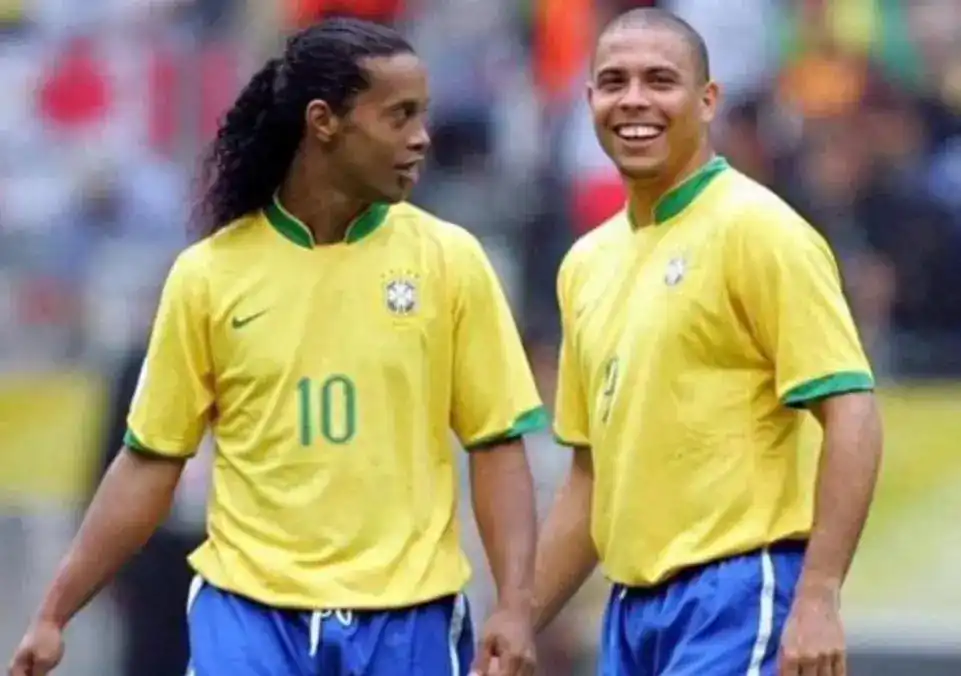
In 1997, at just 17 years old, young Ronaldo officially entered the professional field. Two years later, he led the Gremio team to win the Rio Grande do Sul State Championship, rising to fame in a single battle. Ronaldo's technical style was highly entertaining, his dribbling moves were smooth like flowing water, and the matches were more like a magic show, leaving the audience speechless.
In 1998, Ronaldo, at the age of 18, signed with Gremio Club, officially embarking on the glorious chapter of his professional career. Just a year later, he had the opportunity to play for the Brazilian national team in the France World Cup. Although he was still a substitute at the time, his talent was already evident.
What truly made Ronaldo a world-class star was the 2002 Korea-Japan World Cup. In that dazzling Brazilian team, Ronaldinho was not overshadowed by stars like Rivaldo and Ronaldo Nazario, but instead became the key player. In the match against England, he scored a magical long-range lob from 40 yards out, breaking Seaman's fingertips and helping Brazil advance to the semi-finals. In the end, Brazil successfully lifted the trophy, and Ronaldo also became a World Cup champion.
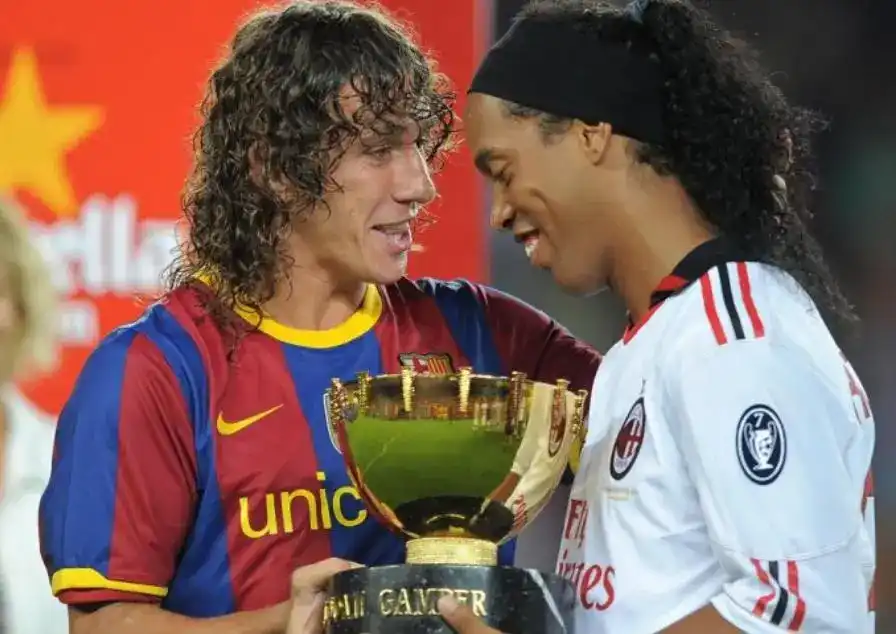
Upon arriving in La Liga, Barcelona was in a period of decline, but his arrival completely changed the team's destiny. Facing stars like C. Ronaldo, Beckham, and Zidane from Real Madrid, he used his spectacular dribbling and incredible goals to make the Bernabeu fans applaud him standing up.
During his time at Barcelona, he won everything: in 2004 and 2005, he was awarded the FIFA World Player of the Year for two consecutive years, surpassing the peak performances of Zidane and Henry; in the 2005-06 season, he led the team to win the La Liga and Champions League double, personally winning the UEFA Champions League Best Player award; his endorsement deals were ubiquitous, with global brands like Nike, Pepsi, Coca-Cola, EA Sports all eager to collaborate with him. In 2006, his endorsement income exceeded $19 million, making him one of the highest-paid players in the football world at that time.
At this point, Ronaldinho was already the soul of Barcelona's revival and the king of the football world.
However, during his peak, Ronaldo also started down a path of self-destruction. He became too indulged in pleasure, with football no longer being his sole focus. He began to indulge himself, treating nightclubs as a second home.
Every night, he lingered in bars and parties, reveling all night long. The female companions by his side kept changing, from Brazilian dancers to French models to Italian celebrities; scandals were always surrounding him.
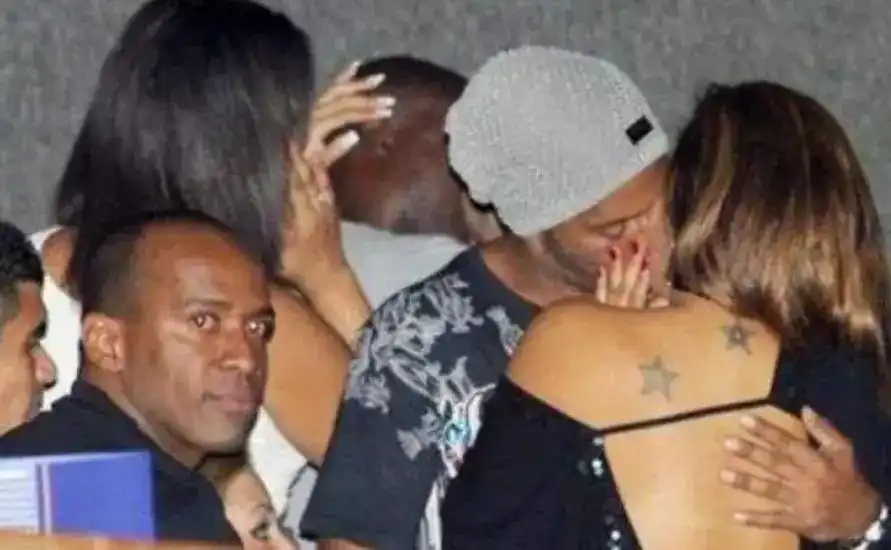
Alcohol became his daily routine. After getting drunk, he couldn't make it to morning training on time, and even started missing important matches. FC Barcelona's coach Rijkaard and teammates advised him many times, but Ronaldinho always disregarded it, saying, "I'm still young, as long as I warm up before the game, drinking won't affect my performance."
However, reality soon dealt him a heavy blow.
Alcohol, nightclubs, and lack of training caused Ronaldinho's athletic performance to plummet rapidly. His lightning-fast starts and ghostly dribbles turned into feeble and unsuccessful attempts at getting past opponents. He began to appear lazy on the field, his goal-scoring dropped sharply, and the love from fans gradually turned into disappointment.
In 2008, FC Barcelona couldn't take it anymore and sold him to AC Milan for 25 million euros. The former king of the world could now only leave the team in a sorry state.
However, after arriving in Serie A, Ronaldinho still couldn't discipline himself, continuing to indulge in nightlife. While Milan's management hoped he would return to his peak, he continued to deteriorate, and his professional career quickly went downhill.
After leaving Milan, Ronaldinho's professional career completely entered its twilight years. He briefly played for some teams in Brazil and Mexico but could never regain his former glory. What's worse, his extravagant lifestyle did not stop, but his income was far from what it used to be: failed investments, 57 properties seized by the court, an account with only 6 euros, drowning in debt. In 2021, he was arrested for using a fake passport to enter Paraguay, detained for three months.

A once-soccer genius, reduced to a prisoner. And his road to easy money has only just begun.
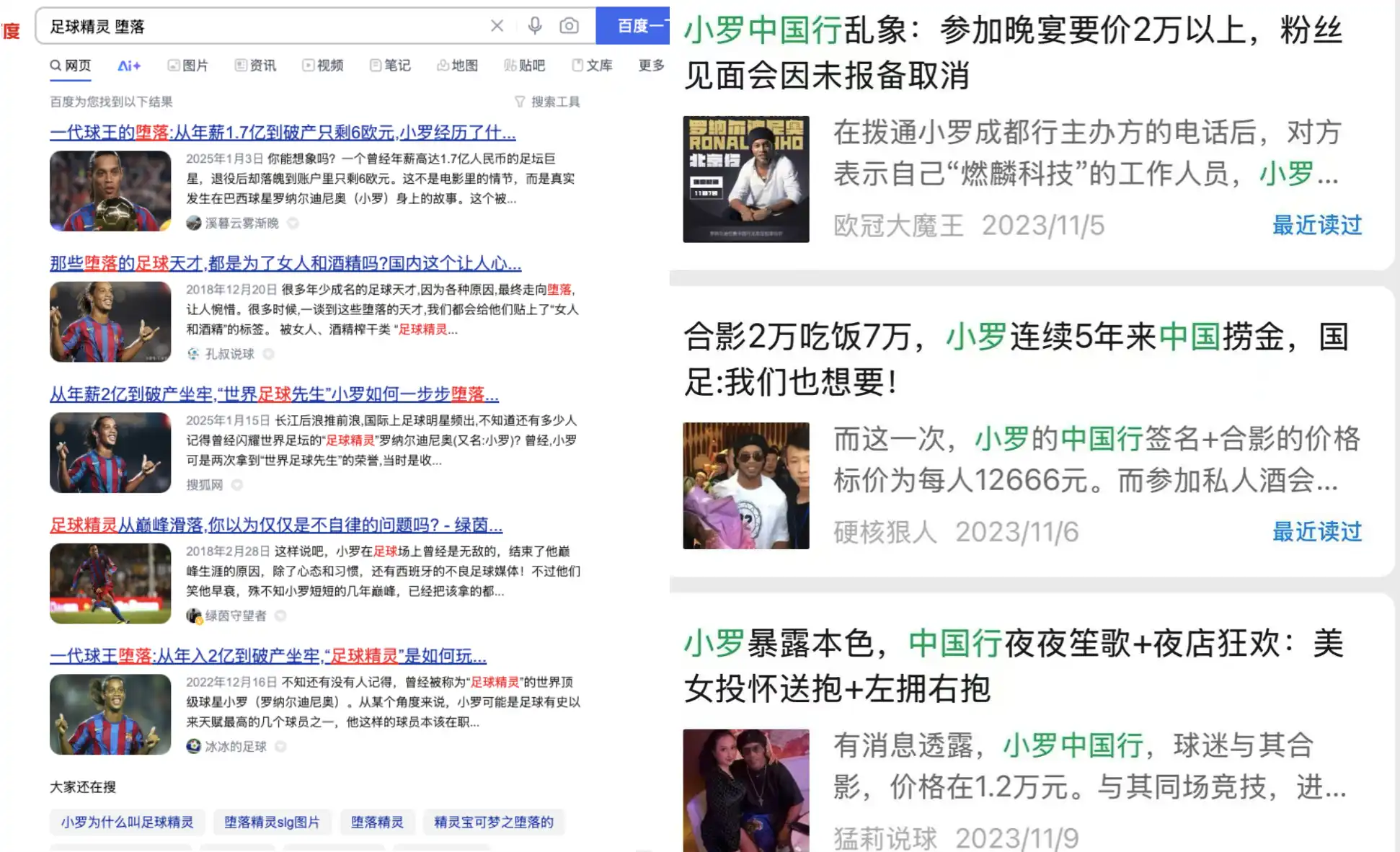
Ronaldinho's "Money-Making Map" covers almost the entire globe: hosting personal football training camps in Brazil, Argentina, and other places, with high fees but critically low training quality. Many parents bluntly say, "What we paid for is just his face." There were reports that he participated in commercial activities in Spain as a "football idol" and was willing to endorse any company as long as the price was right. In regions with wealthy clubs like Saudi Arabia and the UAE, he was also invited as a guest with extremely generous offers.
China, is also one of his important markets. Every one of Ronaldinho's trips to China has turned into a blatant money-grabbing journey and nights of revelry in nightclubs.
Appearance fee for a dinner event: Starting from $20,000. Even if it's just a brief appearance and a few scripted lines, the organizers have to shell out a lot of cash.
Price for a photo with him: ¥20,000. Just standing next to him for a photo costs far more than an average person's monthly salary.
Cost to have dinner together: ¥70,000. Want to have a meal with Ronaldinho? Sure, but the price is comparable to a luxury-level "celebrity experience."
Ronaldinho's business model is simple: as long as the money is enough, he is willing to go anywhere and do anything.
People once thought that his path to decadence had come to an end. However, today in 2025, he once again refreshed people's understanding — he sold his social media account to a "market operator" to enter the world of coins, making quick money through rug pulls.
From football genius, to luxurious decadence, to completely becoming a commercial tool, his name has been associated with fraud, speculation, and money-grabbing. The scam of the "STAR10" token completely destroyed his reputation, and this may only be the beginning of his scams.
No one knows what his next plan is — maybe he will issue new tokens again? Maybe he will "make a comeback" in the NFT field? Or simply sell off everything he has, relying solely on the "celebrity effect" to continue the money-grabbing? But one thing is certain, he can no longer return to his peak moments on the green field.
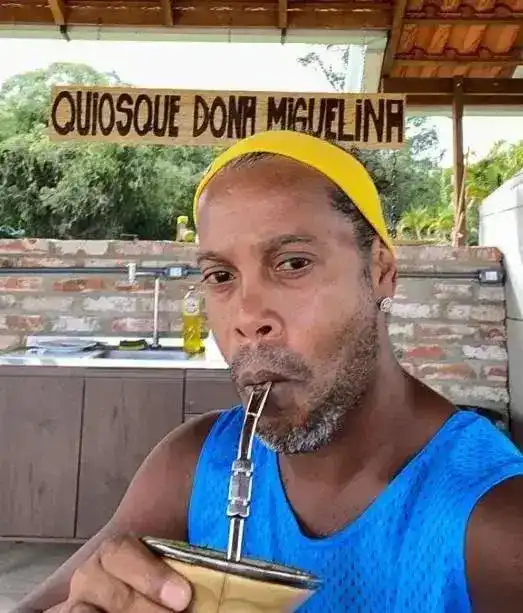
It is said that Ronaldinho is about to become a grandfather. At the end of last year, Ronaldinho's son announced that his girlfriend was pregnant. Now, the 44-year-old Ronaldinho is no longer young and looks quite haggard.
The football legend that belonged to Ronaldinho has come to an end. And now, apart from his spectacular samba on the field, all that is left for the world are his repeated "gold-digging" ventures and scattered feathers.
You may also like

Morning Report | BitMine increased its holdings by 126,971 ETH last week; trader Eugene announced his exit from the crypto market

Wang Chuan: How can one not feel anxious after the neighbor Old Wang made thirty times profit by investing in storage stocks? (Seven) - A quarter-century cycle

Cryptocurrency CEXs are flocking to sell US stocks, and traditional brokerages are facing an "uninvited guest."

$75 billion in foreign capital has fled, and South Korean retail investors have absorbed it all using leverage

Japan’s Three Megabanks Plan Joint Stablecoin Issuance in Fiscal 2026
MUFG, SMBC, and Mizuho reportedly plan to jointly issue fiat-pegged stablecoins in fiscal 2026, signaling Japan’s growing push into bank-led digital payment infrastructure.

Humanity Discloses H Token Dual-Chain Attack Details, With Losses on Ethereum and BSC Exceeding $36 Million
Humanity said the H token attack across Ethereum and BSC caused more than $36 million in losses after leaked ProxyAdmin keys enabled malicious contract upgrades and token minting.
White House Discusses CLARITY Act With Law Enforcement Ahead of Senate Vote
The White House discussed the CLARITY Act with law enforcement ahead of a Senate vote, focusing on illicit finance risks and developer protections.

Bitcoin Trading Guide 2026: Strategies for Experienced Traders

What Is XAUT and PAXG? Why Tokenized Gold Is Booming in 2026

Will the SpaceX IPO Hurt Bitcoin? Here's What Traders Are Watching

Foreign selling in the South Korean stock market accelerates, with cumulative net sales reportedly reaching $75 billion this year
On June 9, The Kobeissi Letter, citing Goldman Sachs data, reported that global investors are selling South Korean stocks at an unusually rapid pace. In the latest trading session, foreign investors sold about $801 million worth of Kospi constituent stocks again; total foreign outflows last week reached about $10 billion, and the market has been in net foreign selling on nearly every trading day over the past month. According to the data cited in the report, foreign investors have sold about $75 billion worth of South Korean stocks so far this year. Meanwhile, South Korean retail and institutional investors together recorded roughly $69 billion in net buying over the same period, suggesting that the market’s main buying support has come from domestic capital rather than returning overseas funds. The information currently disclosed still mainly comes from The Kobeissi Letter’s retelling and Goldman Sachs data summaries, while public details on the statistical period and the specific definition of “selling” remain relatively limited.

Fortune Warns of Strategy’s Financing Structure Risks as Bitcoin Premium Narrows
Fortune warned that Strategy’s Bitcoin treasury model faces growing financing risks as MSTR’s net asset premium narrows and preferred stock dividend pressure increases.

Ferrari Challenge Le Mans: Carl Moon to Dominate in WEEX Livery

Sahara AI Responds to SAHARA’s Sharp Drop: No Contract or Product Security Issues Found, Internal Investigation Underway
Sahara AI responded to SAHARA’s 60% price drop, saying no token contract or product security issues have been found and an internal investigation is underway.

WEEX Deposit/Withdrawal Dynamic Island: Your Asset Status, Always in Sight
Scaling Crypto Derivatives: The Digital Asset Infrastructure Behind High-Volume Trading
In the fast-moving digital asset ecosystem, derivatives platforms face an extreme architectural test. High-leverage futures markets demand more than just standard security—they require absolute operational precision, zero-latency matching engines, and ironclad structural scalability, all while navigating intense market volatility.
As global platforms scale to meet these demands, the industry is shifting away from rigid, monolithic setups toward a more agile, "decoupled" infrastructure philosophy.
The Blueprint for High-Volume Copy TradingFor elite global exchanges like WEEX (founded in 2018), this architectural choice becomes critical when scaling high-volume retail features like social copy trading. When thousands of users automatically mirror the real-time strategies of elite traders simultaneously, it triggers sudden, monumental spikes in concurrent transactional volume.
To prevent execution latency or settlement bottlenecks during these peak volatility events, a platform's primary engine must remain entirely dedicated to risk management, copy-trade synchronization, and order matching.
The Architectural Rule: New-generation platforms must separate front-end user execution engines from heavy backend infrastructural overhead to eliminate operational friction.
By separating these layers, platforms can maintain complete sovereignty over their trading environments and user experiences while strategically aligning with institutional-grade infrastructure ecosystems. This strategic framework allows modern exchanges to leverage advanced Digital Asset Custody infrastructure such as Cobo’s behind the scenes, ensuring that backend wallet management scales elastically alongside trading spikes.
Capitalizing on Market Momentum and 400× LeverageIn a derivatives arena where platforms offer up to 400× leverage on perpetual contracts, capital efficiency and market agility are core business metrics. To capture market momentum, an exchange needs the ability to rapidly expand its asset offerings, supporting everything from legacy crypto assets to sudden, trending altcoins across a massive library of trading pairs.
Adopting a flexible, scalable Wallet-as-a-Service (WaaS) solution such as Cobo’s could completely rewrite the development timeline for high-growth exchanges. Instead of spending months of engineering capital building out custom backend wallet architectures for every new blockchain network, platforms can deploy localized infrastructure in days.
This agility allows platforms to instantly scale their listings to over a thousand trading pairs without compromising security or delaying time-to-market. It mirrors the exact operational advantages seen during high-velocity market events, similar to how advanced wallet infrastructure empowers platforms during sudden asset surges; allowing exchanges to pass that speed and liquidity directly to their global user base.
A Mature Foundation for GrowthThe synergy between trusted infrastructure ecosystems and global trading platforms represents the natural evolution of a maturing crypto market. As WEEX continues to scale its global spot and derivatives offerings for over 6 million users, adopting robust backend paradigms proves that platforms no longer have to compromise between cutting-edge trading velocity and uncompromised structural security.

Get Paid to Onboard? Try WEEX’s New Homepage with Rewards for Registration, Deposit & Trade
WEEX Custom Layout: Build Your Perfect Trading Workspace in Seconds
Morning Report | BitMine increased its holdings by 126,971 ETH last week; trader Eugene announced his exit from the crypto market
Wang Chuan: How can one not feel anxious after the neighbor Old Wang made thirty times profit by investing in storage stocks? (Seven) - A quarter-century cycle
Cryptocurrency CEXs are flocking to sell US stocks, and traditional brokerages are facing an "uninvited guest."
$75 billion in foreign capital has fled, and South Korean retail investors have absorbed it all using leverage
Japan’s Three Megabanks Plan Joint Stablecoin Issuance in Fiscal 2026
MUFG, SMBC, and Mizuho reportedly plan to jointly issue fiat-pegged stablecoins in fiscal 2026, signaling Japan’s growing push into bank-led digital payment infrastructure.
Humanity Discloses H Token Dual-Chain Attack Details, With Losses on Ethereum and BSC Exceeding $36 Million
Humanity said the H token attack across Ethereum and BSC caused more than $36 million in losses after leaked ProxyAdmin keys enabled malicious contract upgrades and token minting.


