
From Binance Launchpool data, see the current market's "Coin FOMO."

Original Article Title: "Binance Data Reveals: Bull Market Still Alive!"
Original Article Author: Murphy, On-chain Data Analyst
Subconsciously, some may think that only paid data holds value, when in fact, many free datasets are also very useful. For example, after each LaunchPool event, Binance releases relevant data that contains market sentiments, fund flows, and traces of the game between whales and retail investors.
We all know that Binance has the best on-chain liquidity, attracting a massive user base and funds. Although we cannot directly access the relevant on-chain data, we can still observe some clues from limited public data.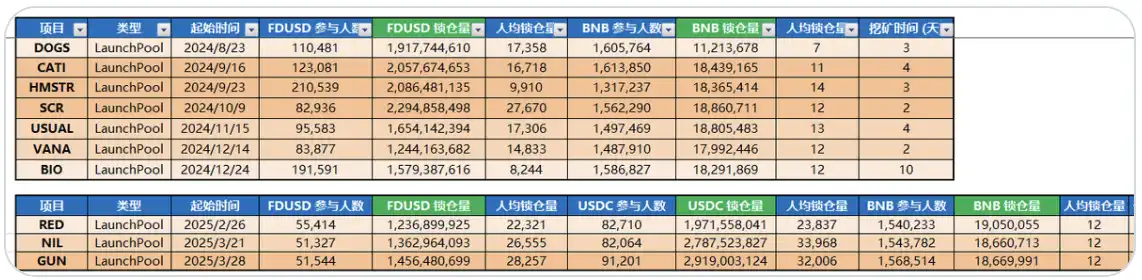
(Figure 1)
Figure 1 is a compilation of all LaunchPool-related data from August 2024 to the present. In 2024, only FDUSD and BNB could participate in LaunchPool, but in 2025, USDC was added, so we can compare the data in two parts.
From the 64th RED period to the 66th GUN period, the number of participants in each period remained relatively stable, but the amount of FDUSD and USDC locked in increased from one period to the next. Since swapping stablecoins on Binance is fee-less, theoretically, all idle stablecoins would have the incentive to participate in yield farming, including USDT. The more stablecoins participate, the more idle buying power exists within the Binance exchange.
At the same time, we also note that in these 3 events in 2025, the combined FDUSD+USDC scale was roughly between 30 billion to 40 billion USD, while in the August to December 2024 events, the quantity of FDUSD was around 15 billion to 20 billion USD, indicating that the funding scale in Q1 2025 is significantly larger than that of 2024. Some may attribute this to the addition of USDC in 2025, but I may have a different interpretation.
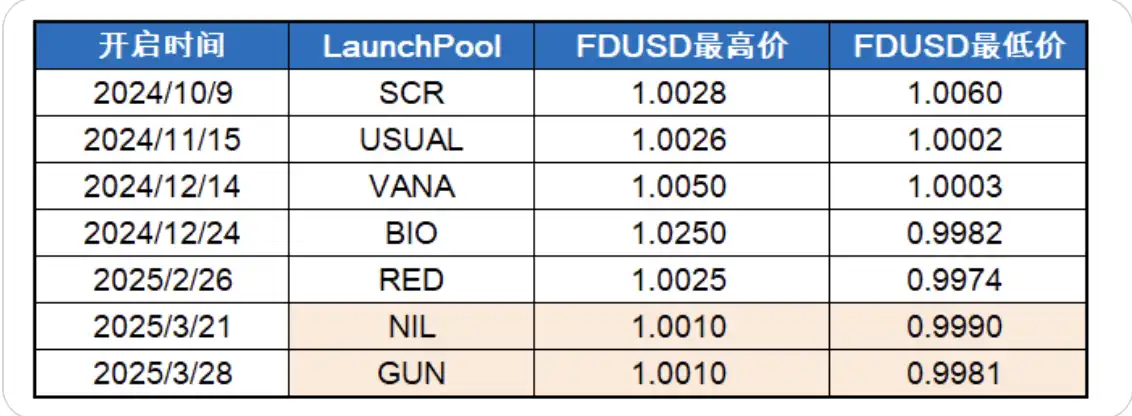
(Figure 2)
We can observe a detail: as shown in Figure 2, at the start of each LaunchPool period in 2024, FDUSD had a very high premium. This indicates a high demand for FDUSD at that time. For example, all USDT and USDC holders would convert to FDUSD to participate in mining at that moment, temporarily driving up the FDUSD exchange rate.
However, as the 25-year event began, the premium of FDUSD started to decline, indicating that the demand for FDUSD was not as high as before. The underlying reason is that USDC diverted the demand that was originally for FDUSD. Investors holding USDC do not need to exchange it for FDUSD, and some of the investors holding USDT have also switched to USDC (because after mining ended, USDC is more stable than FDUSD).
In other words, as long as funds are mostly idle, they will participate in LaunchPool. The FDUSD+USDC participants in Year 25 and the FDUSD participants in Year 24 should both be considered as the vast majority of idle funds deposited internally by the exchange. It is not solely because Binance opened a USDC participation channel in Year 25 that led to the significant increase in fund data.
Furthermore, the "per capita lockup amount" in Year 25 Q1 is also higher than in Year 24 November-December, indicating the entry into a stage dominated by whales. This means that the user base with idle purchasing power has become more dominated by "whales."
This also seems to indicate a reality: during November-December of Year 24, more whales held "coins," but by February-March of Year 25, whales held "U" instead. At this point, the market has completed a round of wealth transfer, and at the same time, whales have completed the encirclement of retail investors. They hold a large amount of idle funds and are patiently waiting for the next opportunity.
· Based on the above observations, we can draw several conclusions:
1. The idle funds in the market now are not only not decreasing compared to Year 24 but are increasing, but overall sentiment is cautious, and effective purchasing power has not been formed.
2. The increasing number of participants in LaunchPool indicates that more people have cashed out, but the funds remain in the market and are unwilling to exit, meaning that although the sentiment is cautious, it is far from being completely despairing.
3. The higher per capita lockup amount indicates that idle purchasing power is increasingly controlled by more whales; after a round of wealth redistribution, purchasing power has returned to the hands of whales. They generally believe that the bull market is not over and are therefore still waiting in the market for an opportunity.
You may also like

Morning News | CME Group launches Nasdaq Cryptocurrency Index futures; Asset management giant Janus Henderson strategically invests in Ethena

Bitcoin Layer 2 Network Botanix: Why Did We Choose to Dissolve?

Why did Oracle deliver the strongest financial report in history, yet its stock price fell?
When the P2P illicit funds from ten years ago turned into 60,000 bitcoins

Dialogue with OmenX Founder: Why does the prediction market need an evolution from "spot" to "derivatives"?
Galaxy in-depth report: Is Solana still worth paying attention to?

Young people in South Korea make a "final effort" in the epic bull market

The pricing controversy of Trade.xyz exposes the fatal weakness of Pre-IPO perpetual contracts

How much longer can Ethereum's last big buyer hold on?

World Cup 2026 Coming – WEEX Celebrates with $1M Prize Pool & Michael Owen Live

Morning Report | OpenAI has submitted an S-1 registration statement draft to the U.S. SEC; Morpho completes $175 million financing

Galaxy Deep Research Report: How Hyperliquid's HIP-4 Upgrade Changes the Landscape of Prediction Markets?

Latest research from 13 top universities including Cornell University: The current state, challenges, and misconceptions of the fusion of Crypto and AI

Deconstructing Anthropic: The Best AI Company, Possibly Also a Type of Organizational Invention

Every exchange is a "Universal Exchange."

The counterattack of traditional finance: Alliance chains are quietly reviving
Pantera Capital Partner: How Tokenization is Restructuring the Private Equity and Early Investment Ecosystem?

Mastercard Launches Agent Pay for AI, Plans to Record AI Agent Payment Authorizations on Polygon
Mastercard launched Agent Pay for AI, a new payment protocol designed to help AI agents make small payments such as pay-per-use access to data and APIs. The system plans to record human-granted AI agent permissions on Polygon, focusing on verifiable authorization, identity, and payment controls.
Morning News | CME Group launches Nasdaq Cryptocurrency Index futures; Asset management giant Janus Henderson strategically invests in Ethena
Bitcoin Layer 2 Network Botanix: Why Did We Choose to Dissolve?
Why did Oracle deliver the strongest financial report in history, yet its stock price fell?
When the P2P illicit funds from ten years ago turned into 60,000 bitcoins
Dialogue with OmenX Founder: Why does the prediction market need an evolution from "spot" to "derivatives"?
Galaxy in-depth report: Is Solana still worth paying attention to?

Popular coins
Latest Crypto News


