
Frame-by-Frame Analysis of the White House Crypto Summit: What Market Whisperings Have Gone Unnoticed?


Original Author: @TechLeviathan, Blockchain Developer
Original Translation: zhouzhou, BlockBeats
Editor's Note: The cryptocurrency summit hosted by Donald Trump marks the United States' leadership in the digital finance sector. The summit discussed cryptocurrency regulation and policies, with the government emphasizing the importance of Bitcoin as a strategic asset and announcing the establishment of a Bitcoin reserve. Despite the introduction of a long-term regulatory strategy, the market was disappointed by the lack of clear regulatory measures and the uncertainty surrounding altcoins.
Below is the original content (rearranged for ease of reading comprehension):
Donald Trump fooled the entire cryptocurrency community, the US cryptocurrency reserve was canceled, taxes still exist, I analyzed the full cryptocurrency summit, and here is everything you need to know and the future of cryptocurrency
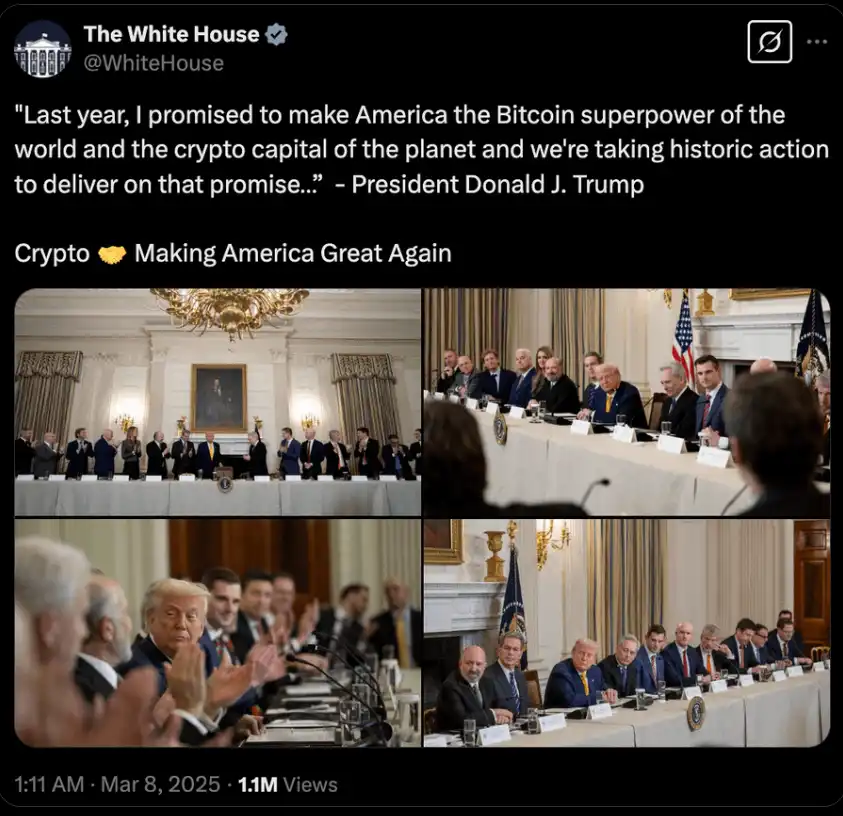
On March 7, 2025, the cryptocurrency summit hosted by President Donald Trump became a milestone event for the industry.
· This was the first summit in the US entirely dedicated to shaping cryptocurrency regulation and future policy.
· The government has increasingly shown support for Bitcoin, highlighting Bitcoin's strategic role in maintaining US digital economic dominance.
· The event was live-streamed through social media, attracting widespread attention from investors and the public.
· However, the market reaction was quite negative, with a significant drop in Bitcoin and other altcoins.
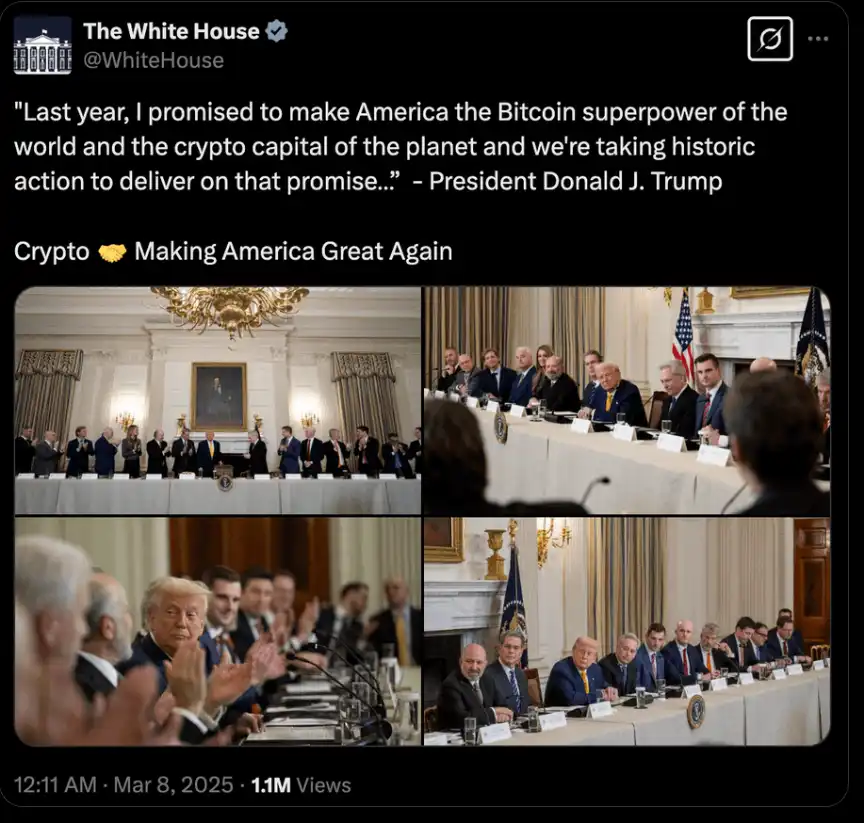
Summit Purpose
· The summit discussed the future of cryptocurrency regulation and its impact on the US financial industry
· The government reaffirmed its commitment to keeping the US a leading force in digital finance
· Bitcoin and digital assets were deeply discussed in terms of economic policy and financial stability
· The goal was to establish a sustainable and innovation-friendly regulatory environment for the cryptocurrency industry
Donald Trump presided over the summit, representing the US government's position in the cryptocurrency field
· David Sachs, serving as the White House cryptocurrency and artificial intelligence advisor, led high-level discussions with industry leaders
· Beau Haynes, head of the Digital Assets Working Group, played a key role in shaping strategic policies
·White House senior officials participated in the dialogue, advocating for the government's interest in the crypto space
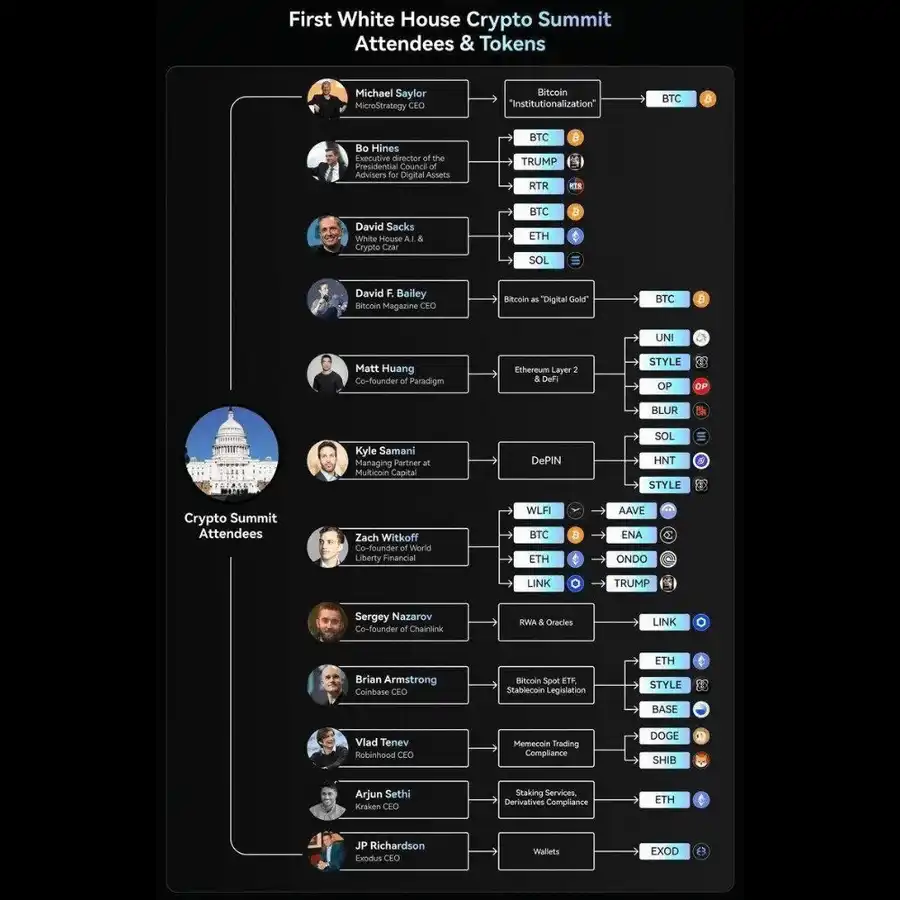
·Michael Saylor, Founder of MicroStrategy, lobbied for supportive Bitcoin policies and engaged in direct conversations with U.S. officials.
·Brian Armstrong, CEO of Coinbase, expressed concerns about cryptocurrency regulation, representing the exchange industry's voice.
·Cameron and Tyler Winklevoss, Founders of Gemini, shared their investment views, emphasizing market growth and innovation.
·Anthony Scaramucci, representing Ripple Labs, advocated for XRP and its role in the global financial system.
·Executives from Ethereum, Solana, and other blockchain networks discussed the evolving role of altcoins in the economy.
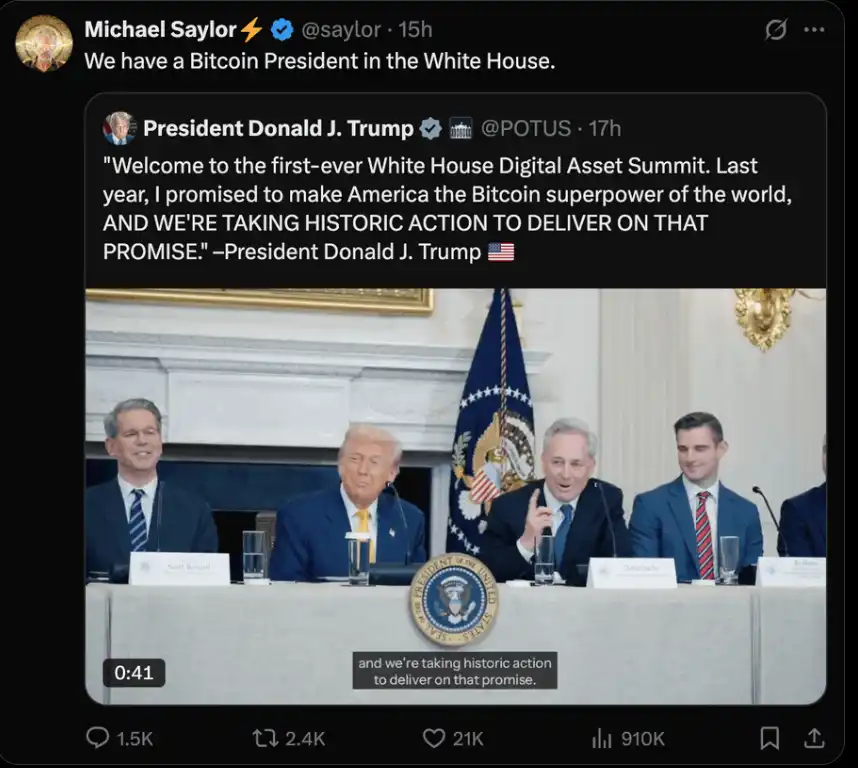
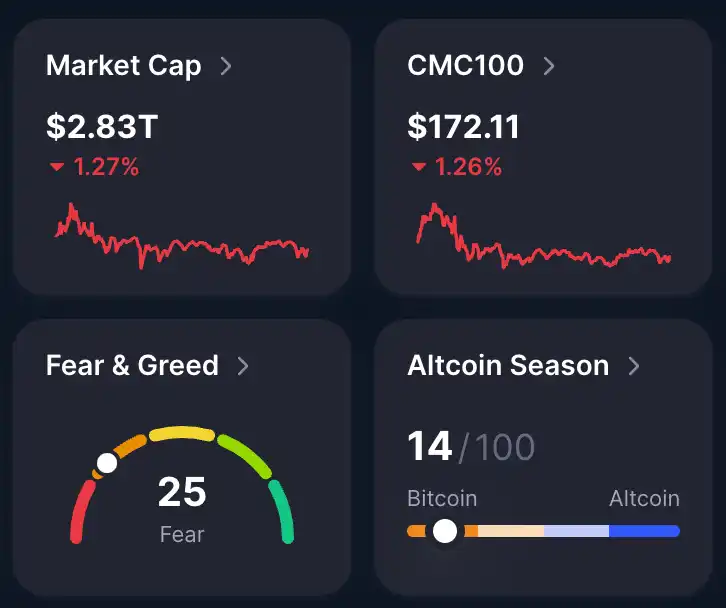
The summit marked a significant turning point, formally integrating cryptocurrency into U.S. financial discussions; however, market sentiment shifted to the negative as no substantive regulatory measures were announced. Expectations for transformative policy changes went unmet, leaving investors disillusioned. Despite the introduction of long-term strategies, short-term market volatility persists.
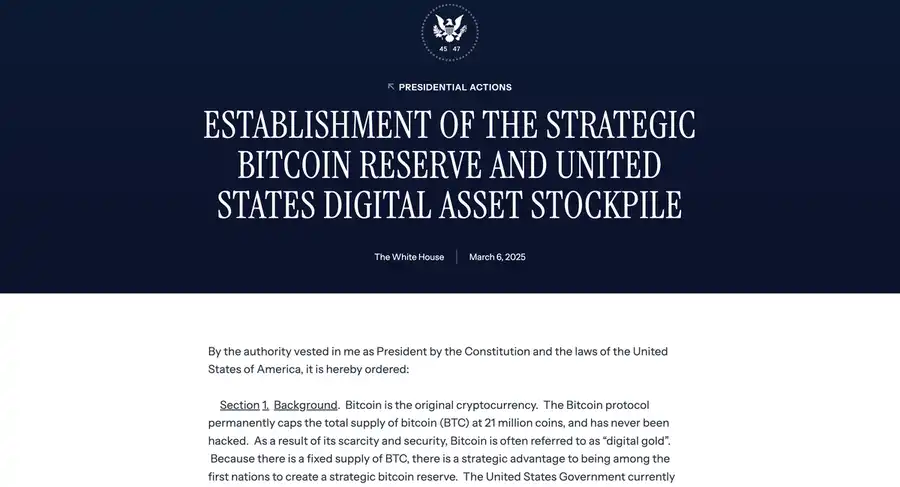
The U.S. government established a Bitcoin reserve consisting of 200,000 seized bitcoins. The Treasury Department will oversee this reserve without imposing additional burdens on taxpayers. There are no plans to acquire more bitcoins, leading to uncertainty in the market. Bitcoin has been formally classified as a strategic asset, akin to gold's status in the U.S. financial reserves.
The U.S. plans to enact federal stablecoin regulation by August 2025. The proposed framework aims to enhance oversight and stability for major stablecoins, including USDT and USDC. One key objective is to strengthen the U.S. dollar's role as the dominant global reserve currency. This legislation will prohibit the issuance and circulation of stablecoins pegged to foreign fiat currencies.
The U.S. government has designated Bitcoin as a strategic asset, distinguishing it from other cryptocurrencies. Ethereum, XRP, and Solana face ongoing regulatory uncertainty with no clear guidelines. There is mention of potentially establishing a separate fund for altcoins, but details remain vague.
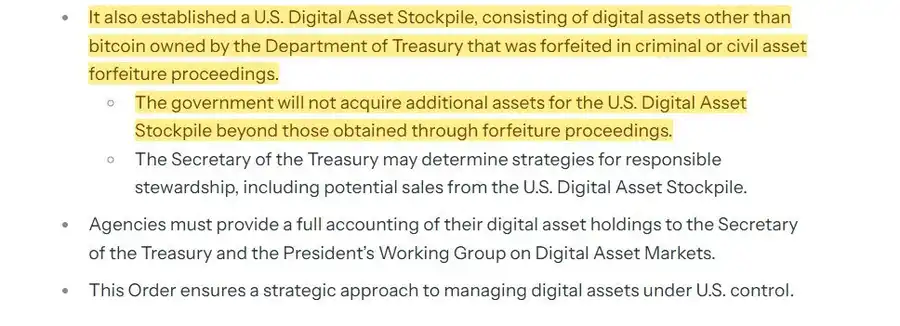
The current lack of clarity on altcoins has led to market speculation and instability. David Sachs has announced that alongside the Bitcoin Act, a digital asset reserve will be created. This reserve will be composed of non-Bitcoin crypto assets obtained through legal seizures, with the legislation strictly prohibiting the government from acquiring any asset beyond the scope of a seizure case.
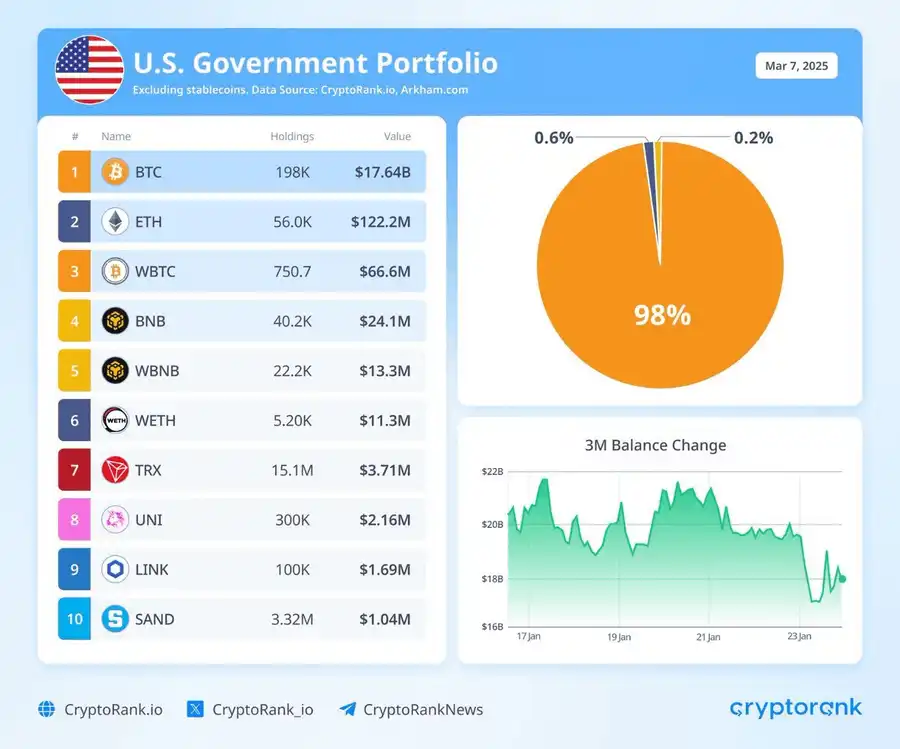
An analysis of the U.S. government's crypto asset portfolio indicates that certain altcoins may be included in the digital asset reserve. Potential assets include $ETH, $BNB, $TRX, $UNI, $LINK, and $SAND.
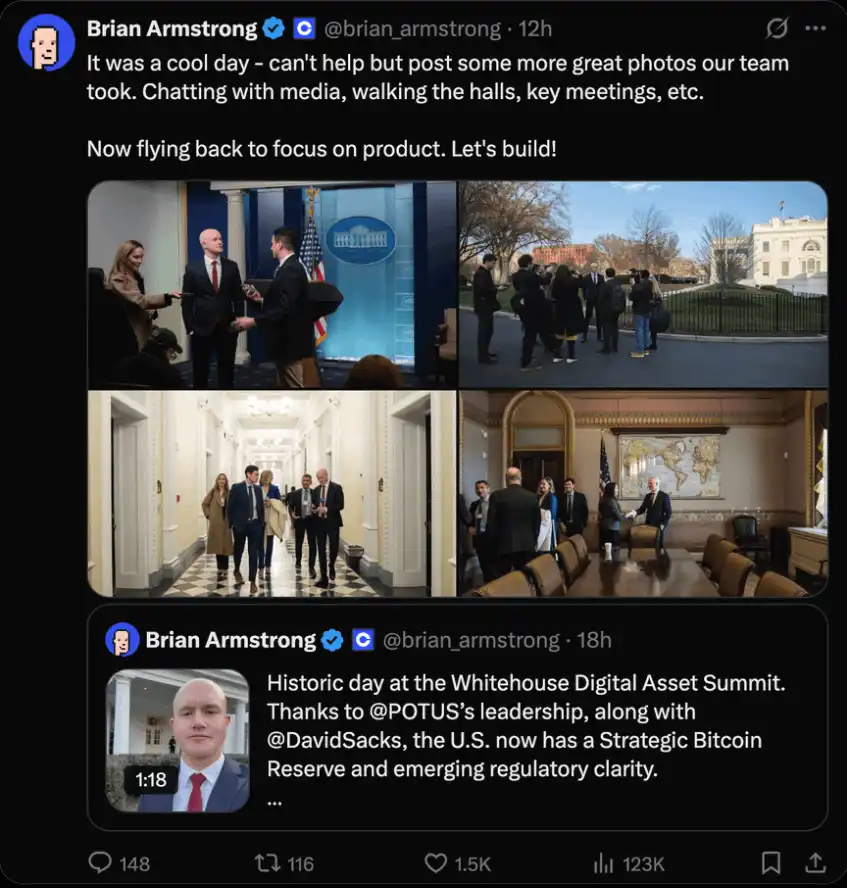
- Brian Armstrong views this summit as a milestone event but notes the lack of tax incentives for cryptocurrency investors.
- Cameron and Tyler Winklevoss praise the summit's significance while expressing concerns about unclear altcoin regulations.
- Anthony Scaramucci supports a focus on stablecoins but emphasizes the urgent need for regulatory clarity on XRP.
The White House emphasizes that this summit has solidified the U.S.'s position as a leader in the digital finance space. Government officials assure that the Bitcoin reserve will not incur any additional costs for taxpayers. The event highlighted the long-term goals of crypto regulation and industry development.
The aftermath of the summit has brought uncertainty to the crypto market, with Bitcoin dropping to $85,000, leading to widespread losses in altcoins. Short-term volatility persists as investors react to the lack of decisive policy action. Market recovery may occur if the government implements favorable measures.
Many expected the U.S. government to heavily acquire Bitcoin, but this has not been confirmed. Tax incentives were the main expectation for investors but were entirely absent from the discussions. Trump's speech failed to provide clear information, exacerbating market skepticism. The market's overbought condition has made it vulnerable to a sharp post-summit correction.
Although the summit has laid the groundwork for future growth, the short-term market response has been negative. Unless the government takes decisive action, market volatility is expected to continue. Regulatory uncertainty further intensifies investor doubts and hesitancy.
By 2025, stablecoin regulation and the introduction of Bitcoin reserves could support long-term market growth, with the recovery of Bitcoin and altcoins depending on the implementation of committed regulatory measures. Tracking stablecoin policies and reserve management is crucial, and the future of the U.S. crypto industry continues to be heavily influenced by government policy changes.
The future of cryptocurrency depends on regulation and institutional adoption. Clear policies can boost growth, while uncertainty can exacerbate volatility. Bitcoin still holds a dominant position, but DeFi and stablecoins are expanding. Mass adoption is inevitable, but the path will be tumultuous.
You may also like

CFTC Reportedly Plans New Prediction Market Rules Focused on Manipulation Risk and Public Interest Review
The CFTC is reportedly preparing new prediction market rules focused on manipulation risk, public interest review, and retail trader protections.

Meet the new WEEX trial fund—your gateway to greater profits

WEEX Labs Lands at Dutch Blockchain Week: A Disruptive Crypto × AI Conversation Sets Sail in Amsterdam

SK Hynix Reportedly Plans U.S. ADR Listing as Early as August, With SEC Approval Possible in Late June
SK Hynix may pursue a U.S. ADR listing as early as August, with SEC approval reportedly possible in late June amid strong AI chip supply chain demand.

SpaceX vs Tesla vs xAI: Which Elon Musk Trade Has the Biggest Upside in 2026?
OpenAI Reveals It Has Confidentially Submitted an S-1 to the SEC, Keeping the Door Open for a Future IPO
On June 9, according to an OpenAI announcement, the company recently confidentially submitted a draft S-1 registration statement to the U.S. Securities and Exchange Commission (SEC), beginning the preliminary compliance process for a potential initial public offering. OpenAI said it chose to disclose this proactively because it expected the news might leak; however, the company has not yet set a specific listing timeline, and related arrangements may still take some time.

Latest research from 13 top universities including Cornell University: The current state, challenges, and misconceptions of the fusion of Crypto and AI
Deconstructing Anthropic: The Best AI Company, Possibly Also a Type of Organizational Invention
Apollo and Blackstone Reportedly Back $35 Billion Anthropic Chip Financing as Deal Details Remain Unclear
On June 9, according to currently available news alerts, Apollo and Blackstone Group participated in a $35 billion financing for an Anthropic “chip project.” Based on the original wording of the report, the funding has already been raised, but public information remains limited. The financing structure, use of proceeds, project entity, and whether Apollo and Blackstone participated through equity, debt, or project financing have not yet been disclosed.

Humanity Protocol Security Incident Escalates: More Than $31 Million Stolen From Related Addresses as Attacker Continues Selling H for ETH
On June 9, according to monitoring by Onchain Lens, more than $31 million has been stolen from addresses linked to Humanity Protocol, and the attack is still ongoing, with the hacker continuously swapping H tokens for ETH. Project founder Terence Kwok later confirmed the security incident on X, saying the issue involved a private key leak.

Bloomberg: As Bitcoin Weakens, Stablecoins and RWA Continue to Drive Expansion in Crypto Businesses
In June, Bloomberg reported that despite Bitcoin falling below $60,000 last week, wiping out about $235 billion in market value within seven days, and dropping close to 50% from last year’s peak, some core businesses in the crypto industry are still expanding, mainly in stablecoins, real-world asset tokenization (RWA), payments, and infrastructure. The report also noted that overall altcoin activity has contracted significantly: altcoin market capitalization has fallen from a peak of about $431 billion in November 2021 to around $170 billion, and among the tens of millions of tokens issued in recent years, fewer than 1,700 still maintain meaningful trading activity.

Galaxy Deep Research Report: How Hyperliquid's HIP-4 Upgrade Changes the Landscape of Prediction Markets?
Binance Research: RWA Market Expected to Expand Nearly 6x from Early 2025, with Public Equities and Onchain Payments Heating Up Together
In June, Binance Research said in its monthly market report that the real-world asset (RWA) market is expected to grow by about 589% from the beginning of 2025. Bond- and money market fund-related RWA expanded by about $6.5 billion, up 83% year over year, while publicly traded equity RWAs grew by about 422%. The report also noted that monthly crypto debit card transaction volume exceeded $747 million in May, up 48.6% year to date.

Japan to Assess a Framework for Yen Stablecoins and Crypto ETFs as Asia’s Compliant Payments Narrative Heats Up
Recently, according to the original report, Japan is considering the launch of yen stablecoins and cryptocurrency ETFs. Public information remains limited at this stage, and there is still no complete policy text, regulatory draft, or clear implementation timeline, so this is better characterized as a “policy discussion” rather than formal implementation. The original wording also noted that advancing stablecoin regulation in Asia is driving XRP usage and supporting growth in the XRPL ecosystem. However, based on currently available public information, there is not enough evidence to directly establish a clear causal relationship between this round of discussion in Japan and XRP or XRPL.

ZachXBT: Humanity private key leak and abnormal surge in H token should be viewed separately
On June 9, according to related disclosures, on-chain investigator ZachXBT posted an update on Humanity’s roughly $31 million security incident, saying that after further analyzing fund flows, he currently tends to believe the project team was not involved in an “inside job” or a self-staged attack. According to him, the official explanation about the private key leak was broadly accurate, but before the token unlock, the price of H had been artificially pushed higher, and the hacker later took advantage of that market environment; therefore, the private key leak and the earlier abnormal price pumping should be regarded as two separate and independent events. This reframing has shifted the market’s understanding of the nature of the incident. Earlier discussion around Humanity had focused on whether the team directly participated in the attack or used the security incident to cover up internal operations. ZachXBT’s latest remarks shift the focus from “whether it was self-theft” to “whether there were pre-unlock market structure issues.” He also questioned whether the team may have.

Morning Report | OpenAI has submitted an S-1 registration statement draft to the U.S. SEC; Morpho completes $175 million financing

Morning Report | BitMine increased its holdings by 126,971 ETH last week; trader Eugene announced his exit from the crypto market

Wang Chuan: How can one not feel anxious after the neighbor Old Wang made thirty times profit by investing in storage stocks? (Seven) - A quarter-century cycle
CFTC Reportedly Plans New Prediction Market Rules Focused on Manipulation Risk and Public Interest Review
The CFTC is reportedly preparing new prediction market rules focused on manipulation risk, public interest review, and retail trader protections.
Meet the new WEEX trial fund—your gateway to greater profits
WEEX Labs Lands at Dutch Blockchain Week: A Disruptive Crypto × AI Conversation Sets Sail in Amsterdam
SK Hynix Reportedly Plans U.S. ADR Listing as Early as August, With SEC Approval Possible in Late June
SK Hynix may pursue a U.S. ADR listing as early as August, with SEC approval reportedly possible in late June amid strong AI chip supply chain demand.
SpaceX vs Tesla vs xAI: Which Elon Musk Trade Has the Biggest Upside in 2026?
OpenAI Reveals It Has Confidentially Submitted an S-1 to the SEC, Keeping the Door Open for a Future IPO
On June 9, according to an OpenAI announcement, the company recently confidentially submitted a draft S-1 registration statement to the U.S. Securities and Exchange Commission (SEC), beginning the preliminary compliance process for a potential initial public offering. OpenAI said it chose to disclose this proactively because it expected the news might leak; however, the company has not yet set a specific listing timeline, and related arrangements may still take some time.


