
ETHDenver2025 Flash Essay Collection: The Market Isn't as Bleak as It Seems


From February 27 to March 2, ETHDenver 2025 took place at the National Western Complex in Denver, Colorado, USA. The conference coincided with continued volatility in the crypto market, with Ethereum's price on a downward trend and overall market sentiment remaining subdued. Looking at the live pictures shared by attendees, this year's ETHDenver seems noticeably quieter compared to the bustling crowds of previous years.
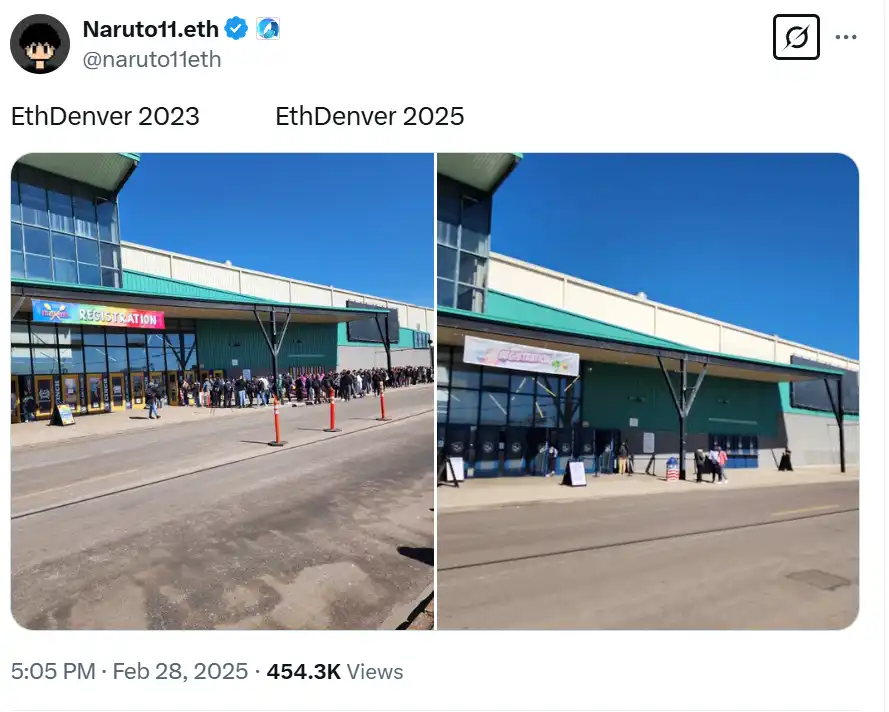
Nevertheless, ETHDenver still had a strong presence of genuine builders, with even higher density of core industry participants than in previous years. Compared to past focus on Layer 2 and Restaking, this year's discussions were more diverse, covering multiple areas including AI, modular blockchains, stablecoins, RWA, among others. Although a unified industry narrative was lacking, this may indicate a return to focusing on technology's essence rather than being solely driven by a single hot topic.
BlockBeats has selected three insights from investors and crypto researchers at the conference, covering market sentiment, technical trends, investment directions, and more. The full articles are reposted below:
Mason Nystrom (Pantera Investor)
Original Article Translation: Felix, PANews
ETH Denver Conference Takeaways
The Market Doesn't Look as Bad as It Seems
The sentiment on Crypto Twitter (CT) appears quite pessimistic, but it's not very representative. Memecoin speculators are feeling frustrated, and the overall investor consensus is bearish in the short term. This is not financial advice, and investors can also be wrong.
However, everyone should be able to recognize the current situation: a positive regulatory environment, growth of legitimate stablecoins, more RWAs and TradFi moving to the chain. In the long run, people are still very excited and optimistic about the market landscape.
However, the next catalyst remains unknown. Keep moving forward.
What Are People Building? What Are Investors Seeing?
AI—Many builders are still excited about AI's impact, with various Agentic and DeFAI projects. There is a lot of market "noise," making it difficult to find quality projects.
DePIN / Robotics—Related to AI but distinct enough. Many companies are building hardware or data collection networks for robotics, and DePIN seems to capture this narrative. Energy DePIN has also been of interest, presenting opportunities for new typical DePIN projects to emerge.
DeFi—still building a myriad of DeFi applications. More types of lending protocols, new stablecoins, Uni Hooks, more DeFi interfaces. PayFi and DeFAI also have some overlap in certain aspects.
zkTLS (Note: a novel technology combining zero-knowledge proofs and Transport Layer Security protocol)—has provided a real-world use case, but the focus now is on rollout and commercialization rather than the actual technical implementation.
Stablecoins—though discussed less on CT, every investor is watching and investing in this space, largely equity trading hence the lesser focus. Many companies will build upon the stablecoin market opportunity.
Three Dragons: Bitcoin, Ethereum, and Solana
Bitcoin: Many Bitcoin L2s are about to go live, all vying for Bitcoin deposits. Bitcoin's yield will continue to rise. Bitcoin lending will see improvements. Bitcoin is no longer a "pet rock."
Ethereum: Setting aside price sentiment, many builders continue to work on Ethereum. Optimism remains for a high-throughput ETH chain. Base remains fundamental. FlashBlocksTM is about to launch, heavily promoted at conferences. Unichain is overlooked by many. More chains are on the way.
Solana: Despite it being ETHDenver, there are still many Solana events, founders, and small gatherings. Despite the memecoin market correction, many are still excited about Solana. The DePIN narrative continues to evolve on Solana. More SVMs are rolling out, implying the need for interoperability "ducks" between SVM chains.
Regarding Venture Capital
For many investors, project investments at the seed pre and seed stage feel slow to return. The expected valuations of projects in the public markets are high, leading some funds to opt for a wait-and-see approach without investing. Most investments are concentrated in liquidity and Series A funding. Additionally, the Series B funding market seems better than six months ago. Please note, this analysis is purely based on market sentiment and hearsay, lacking data support.
Issuance of some tokens has not performed well in the recent market correction, with valuation mindsets readjusting. Like a clock, those who once prioritized trends and narratives are now driving projects to improve revenue and costs. Establishing trust is more important than ever.
kiwi (OKX Ventures Researcher)
【ETH Denver 2025 On-Site Observation】
1. Attended ETHDenver2025.
This year saw fewer attendees, but the quality was higher.
Although the number of participants was lower, the true builder density significantly increased, with the filtering cost much lower than Token2049 and events in Hong Kong. Many top researchers delved into hardcore content, with the Stanford Blockchain Association bringing solid ZK and cryptography research. Proval showcased many hardcore zk projects. However, some criticized that the academic elites seemed to be working in isolation. Hopefully, there will be outputs more closely aligned with the market in the end.
2. Project Quality?
Overall, it was mediocre. If we compare these projects to January last year, many of them would have been worth investing in or even oversubscribed; however, looking at it now, there aren't many narrative highlights. Timing and the market are indeed crucial, as the same project can have completely different values at different times.
3. Evolution of Topics:
Two years ago at ETH Denver, the focus was on Layer2, last year it was Restaking, and this year, it was expected to be about AI but surprisingly diversified. The top three hot topics were: Modularity+L2+ZK, compliant asset stablecoins, and AI BTC. Following them were DeSci, SUI, Solana, Story, and others. There was no single hot topic, which might actually be a good thing.
4. Many overvalued old projects are still striving for the last round of funding (RiscZero, PINAI, etc.) as the market has changed.
On the other hand, Story and Corn organized numerous events, and the Bitcoin ecosystem's BOB is also very active (TGE coming soon?). Even in a downturn, there are still projects working hard to create momentum.
5. Various Funds Showcasing Their Strengths:
1kx and Symbolic held multi-day events, while Hashed, Paradigm, and Dragonfly hosted single-day workshops.
During a conversation with a major fund, it was discovered that they are not in a hurry to exit investments; instead, they are using large investments to maintain the project's FDV and preserve the fund's MOIC, considering how high the management fees are. As many ten-year funds are compared to several five- to six-year Asian funds, long-term building may have a higher tolerance?
6. This cycle is clearly regulation-driven.
Stablecoins and the on-chain yield of traditional assets have become mainstream, with large asset management companies supporting blockchain projects, and an increasing number of projects focusing on the integration of traditional finance and DeFi. Unfortunately, the participation of Asian investors is relatively low. Compliance is key, but it also sets a high barrier.
7. Had a three-and-a-half-hour chat with Alliance DAO founder, Wang Qiao, and gained a lot.
The third-phase fund has invested in over 100 projects, and the ownership stake has increased from 5% to the current 9%. Interestingly, he is not chasing exits but aims to build useful consumer-grade applications. He even provides ideas to incubators for implementation and has recently invested in several purely AI projects.
8. The project PumpFun, backed by Alliance DAO, has shown impressive performance. Although daily revenue has dropped from a peak of 5-6 million to 2 million, the annualized return still reaches 500 million US dollars!
They guided PumpFun to develop a DEX a year ago and will be venturing into perpetual swaps in the future. After all, isn't perp option prediction meme all about a group of people?
9. Summary:
ETHDenver acts as a market thermometer—it appears to be cooling down on the surface, but the core remains hot.
With fewer attendees, quality has improved; there is no unified narrative, but research and development remain solid, investments are cautious, yet long-term strategies are clear. This may be the value of a bear market—filtering out true builders and allowing technology to break through in silence.
10. Perhaps this is what Web3 is:
After the hype subsides, real innovation begins to emerge; at the trough of disappointment, the next wave of prosperity is already brewing.
"True revolution is not noisy but silent."
We may be in the calm before the storm, and after the storm, spring will be even more brilliant?
Anthurine (Crypto KOL)
Insights from ETHDenver 2025
Background: Four-time ETHDenver attendee, three-time conference sponsor
First time writing a long post, please be gentle
1 Scale and Atmosphere Changes
Before the pandemic, ETHDenver was just a small gathering. However, after a three-year hiatus due to the pandemic, it has become the largest conference in the Ethereum ecosystem in terms of attendance, second only to Devcon. Especially the first edition after the pandemic was impressive—everyone arrived early, and the pre-conference week was full of peripheral activities, almost all of which required advance registration and approval for entry. This kind of scene is very rare in industry conferences, given that most events want as many people as possible. I remember the zkday at that time, with over 1000 people on-site simultaneously, which was very spectacular. In 2024, the number of attendees decreased, but high-quality events still attracted hundreds of people at the same time, with the only event requiring queuing for entry being Berachain's event. This year, the number of peripheral activities has significantly decreased, and apart from evening social events, daytime activities have very few attendees, and events with over 100 people in attendance are considered successful.
2 Evolution of Topic Hotness
2023 was the year of ZK, given the broad range of topics under ZK, which remained diverse and widespread. In addition to ZK, topics such as Chain, DeFi, GameFi, NFTs, etc., also attracted considerable attention. In 2024, the enthusiasm for ZK decreased, and the focus shifted to areas such as Restaking, Data Availability, Layer2, AI, and Account Abstraction. However, this year, apart from AI, particularly AI Agents, there doesn't seem to be any other fresh topics. Unlike other conferences, ETHDenver has a lower proportion of social activities, with more focus on hardcore technical lectures. However, this year, due to the lack of attractive topics, not only were there fewer attendees, but those willing to seriously listen to the lectures were also few, with many events having only a handful of people in the audience. The meme content of this edition is very low, even lower than last year, both in terms of special events and panels. Personally, I am not against memes, but if the industry only has memes without anything else, it definitely cannot last long.
3 Diminished Presence of VCs
In previous years, many VCs would host peripheral events, but this year the presence of VCs has significantly decreased. Although they still send representatives to attend, VCs that used to generously sponsor and host events as they did in the past two years are now seldom seen.
4 Booth Changes
The number of booths this year is on par with previous years, mainly because the sponsorship plan was already set in stone in Q2-Q3 of last year. However, the vast majority of booths are related to infrastructure projects, with very few pure DApp projects, and the Web3 games that were popular in previous years are almost non-existent. However, this year, many booths featured robots and robotic dogs for the first time. I found the most interesting booth design to be @Polygon set up to look like a storage room. The cutest was the kitten plushie from @ZircuitL2.
5 Decreased Peripheral Attraction
The peripheral activities of EthDenver have always been the most creative and engaging in my opinion, bar none. It is also the only event where I am willing to bring back a bunch of souvenirs. This year, the peripheral surprises have decreased significantly, especially in terms of hats. In the previous two years, I couldn't resist participating in a hat contest, so this year we intentionally prepared hats as souvenirs, but the competition was too weak, and 75% of them were given out by the first morning.
6 Decrease in Developer Presence
In previous years, what impressed me most about ETHDenver was the large number of developers. Rarely did I encounter a newbie who knew nothing about blockchain and Ethereum among the people visiting our booth. Over 30% were developers (maybe because our booth was infrastructure-related, so we interacted more with programmers). Everyone would ask high-quality technical questions. However, this year, the number of developers visiting our booth halved, and there were more BD and marketing personnel from other projects (such as node service providers, auditing companies, traffic platforms, etc.).
7 Mismanagement of Venue Arrangement for Talks
This year, the talk stage was moved from the exhibition area to another building (in the same area as the hackathon), which was a terrible arrangement. The crowd was mainly concentrated in the exhibition area. In previous years, everyone could freely switch between exploring the exhibition and attending talks, taking a break from wandering around to listen to interesting speeches. However, this year, the talk venue was hard to find and far away, resulting in an average audience of only a few people per talk, significantly diminishing the sponsorship effect.
8 Practical Tips for Denver
Although the trough made people feel lost, it is comforting to see that there are still many builders willing to stay in this industry. Many of the exhibiting projects are also long-term believers. After all, this industry needs some long-term mindset individuals. Lastly, here are some practical tips: In Denver, it is recommended to use Lyft instead of Uber for transportation. For the same route, a $10 trip under normal circumstances can skyrocket to $50 with Uber during peak hours, while Lyft costs around $20, although it also increases its prices, it is not as outrageous. Also, Chinese food in Denver is expensive and not very tasty, but surprisingly, Thai food is good, especially Aloy Modern Thai, which is worth a try.
You may also like

Morning Report | BitMine increased its holdings by 126,971 ETH last week; trader Eugene announced his exit from the crypto market

Wang Chuan: How can one not feel anxious after the neighbor Old Wang made thirty times profit by investing in storage stocks? (Seven) - A quarter-century cycle

Cryptocurrency CEXs are flocking to sell US stocks, and traditional brokerages are facing an "uninvited guest."

$75 billion in foreign capital has fled, and South Korean retail investors have absorbed it all using leverage

Japan’s Three Megabanks Plan Joint Stablecoin Issuance in Fiscal 2026
MUFG, SMBC, and Mizuho reportedly plan to jointly issue fiat-pegged stablecoins in fiscal 2026, signaling Japan’s growing push into bank-led digital payment infrastructure.

Humanity Discloses H Token Dual-Chain Attack Details, With Losses on Ethereum and BSC Exceeding $36 Million
Humanity said the H token attack across Ethereum and BSC caused more than $36 million in losses after leaked ProxyAdmin keys enabled malicious contract upgrades and token minting.
White House Discusses CLARITY Act With Law Enforcement Ahead of Senate Vote
The White House discussed the CLARITY Act with law enforcement ahead of a Senate vote, focusing on illicit finance risks and developer protections.

Bitcoin Trading Guide 2026: Strategies for Experienced Traders

What Is XAUT and PAXG? Why Tokenized Gold Is Booming in 2026

Will the SpaceX IPO Hurt Bitcoin? Here's What Traders Are Watching

Foreign selling in the South Korean stock market accelerates, with cumulative net sales reportedly reaching $75 billion this year
On June 9, The Kobeissi Letter, citing Goldman Sachs data, reported that global investors are selling South Korean stocks at an unusually rapid pace. In the latest trading session, foreign investors sold about $801 million worth of Kospi constituent stocks again; total foreign outflows last week reached about $10 billion, and the market has been in net foreign selling on nearly every trading day over the past month. According to the data cited in the report, foreign investors have sold about $75 billion worth of South Korean stocks so far this year. Meanwhile, South Korean retail and institutional investors together recorded roughly $69 billion in net buying over the same period, suggesting that the market’s main buying support has come from domestic capital rather than returning overseas funds. The information currently disclosed still mainly comes from The Kobeissi Letter’s retelling and Goldman Sachs data summaries, while public details on the statistical period and the specific definition of “selling” remain relatively limited.

Fortune Warns of Strategy’s Financing Structure Risks as Bitcoin Premium Narrows
Fortune warned that Strategy’s Bitcoin treasury model faces growing financing risks as MSTR’s net asset premium narrows and preferred stock dividend pressure increases.

Ferrari Challenge Le Mans: Carl Moon to Dominate in WEEX Livery

Sahara AI Responds to SAHARA’s Sharp Drop: No Contract or Product Security Issues Found, Internal Investigation Underway
Sahara AI responded to SAHARA’s 60% price drop, saying no token contract or product security issues have been found and an internal investigation is underway.

WEEX Deposit/Withdrawal Dynamic Island: Your Asset Status, Always in Sight
Scaling Crypto Derivatives: The Digital Asset Infrastructure Behind High-Volume Trading
In the fast-moving digital asset ecosystem, derivatives platforms face an extreme architectural test. High-leverage futures markets demand more than just standard security—they require absolute operational precision, zero-latency matching engines, and ironclad structural scalability, all while navigating intense market volatility.
As global platforms scale to meet these demands, the industry is shifting away from rigid, monolithic setups toward a more agile, "decoupled" infrastructure philosophy.
The Blueprint for High-Volume Copy TradingFor elite global exchanges like WEEX (founded in 2018), this architectural choice becomes critical when scaling high-volume retail features like social copy trading. When thousands of users automatically mirror the real-time strategies of elite traders simultaneously, it triggers sudden, monumental spikes in concurrent transactional volume.
To prevent execution latency or settlement bottlenecks during these peak volatility events, a platform's primary engine must remain entirely dedicated to risk management, copy-trade synchronization, and order matching.
The Architectural Rule: New-generation platforms must separate front-end user execution engines from heavy backend infrastructural overhead to eliminate operational friction.
By separating these layers, platforms can maintain complete sovereignty over their trading environments and user experiences while strategically aligning with institutional-grade infrastructure ecosystems. This strategic framework allows modern exchanges to leverage advanced Digital Asset Custody infrastructure such as Cobo’s behind the scenes, ensuring that backend wallet management scales elastically alongside trading spikes.
Capitalizing on Market Momentum and 400× LeverageIn a derivatives arena where platforms offer up to 400× leverage on perpetual contracts, capital efficiency and market agility are core business metrics. To capture market momentum, an exchange needs the ability to rapidly expand its asset offerings, supporting everything from legacy crypto assets to sudden, trending altcoins across a massive library of trading pairs.
Adopting a flexible, scalable Wallet-as-a-Service (WaaS) solution such as Cobo’s could completely rewrite the development timeline for high-growth exchanges. Instead of spending months of engineering capital building out custom backend wallet architectures for every new blockchain network, platforms can deploy localized infrastructure in days.
This agility allows platforms to instantly scale their listings to over a thousand trading pairs without compromising security or delaying time-to-market. It mirrors the exact operational advantages seen during high-velocity market events, similar to how advanced wallet infrastructure empowers platforms during sudden asset surges; allowing exchanges to pass that speed and liquidity directly to their global user base.
A Mature Foundation for GrowthThe synergy between trusted infrastructure ecosystems and global trading platforms represents the natural evolution of a maturing crypto market. As WEEX continues to scale its global spot and derivatives offerings for over 6 million users, adopting robust backend paradigms proves that platforms no longer have to compromise between cutting-edge trading velocity and uncompromised structural security.

Get Paid to Onboard? Try WEEX’s New Homepage with Rewards for Registration, Deposit & Trade
WEEX Custom Layout: Build Your Perfect Trading Workspace in Seconds
Morning Report | BitMine increased its holdings by 126,971 ETH last week; trader Eugene announced his exit from the crypto market
Wang Chuan: How can one not feel anxious after the neighbor Old Wang made thirty times profit by investing in storage stocks? (Seven) - A quarter-century cycle
Cryptocurrency CEXs are flocking to sell US stocks, and traditional brokerages are facing an "uninvited guest."
$75 billion in foreign capital has fled, and South Korean retail investors have absorbed it all using leverage
Japan’s Three Megabanks Plan Joint Stablecoin Issuance in Fiscal 2026
MUFG, SMBC, and Mizuho reportedly plan to jointly issue fiat-pegged stablecoins in fiscal 2026, signaling Japan’s growing push into bank-led digital payment infrastructure.
Humanity Discloses H Token Dual-Chain Attack Details, With Losses on Ethereum and BSC Exceeding $36 Million
Humanity said the H token attack across Ethereum and BSC caused more than $36 million in losses after leaked ProxyAdmin keys enabled malicious contract upgrades and token minting.


