
Decode Yeet: How Dragonfly Leads the Coin Circle's Version of "Las Vegas" to Ignite the Next Battle in the Prediction Market?




In the 2024 U.S. election, the entire crypto community was watching the show, but a group of people were not just watching; they were also betting big on Trump's victory on Polymarket. The trading volume soared to hundreds of millions of dollars, turning the once niche prediction market overnight into an online "casino hall." While prediction market projects like Augur had been around for a while, the user experience felt like using a dial-up website with a senior citizen interface, and the liquidity resembled a forgotten coin market shill, making it impossible for anyone to play.
On March 19, according to Decrypt, a newcomer named Yeet was quietly rising, having completed a $7.75 million funding round with Dragonfly leading the investment and angel investors such as Pudgy Penguins CEO Luca Netz and LayerZero CEO Bryan Pellegrino participating. So how does Yeet play? Can it roll a 777 in this "gamble on the future" race and hit the jackpot directly?
Yeet: The Crypto Version of "Las Vegas"
Yeet is a prediction market platform tailored for crypto users, offering various traditional casino games such as blackjack and roulette, specifically catering to those with a huge risk appetite, who love going all-in, the OGs of the crypto world. The track it is on - the Prediction Market - essentially uses market mechanisms to "vote" on the future, blending financial speculation and gambling. In simple terms, it allows users to open markets on-chain, bet on major events, and if they win, they win big; if they lose, they only have themselves to blame for their lack of foresight.
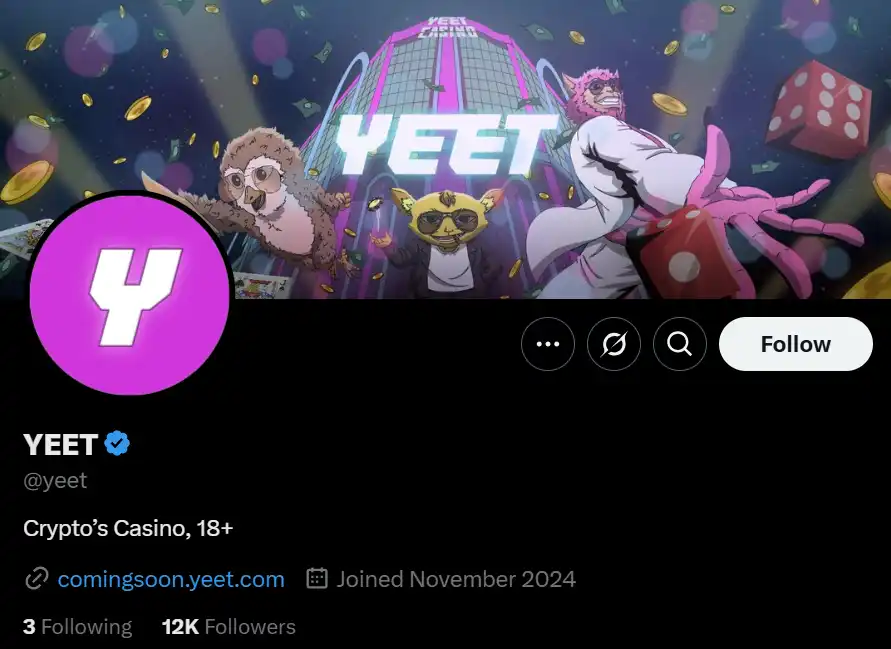
While the prediction market is not a new concept, with predecessors like Augur and Polymarket already in the field, Yeet plays in a more "crypto-native" way. It is not just a prediction market but more like a combination of a casino and a Web3 gambling paradise, taking the excitement of on-chain slot machines to the extreme.
Currently, the prediction market is experiencing rapid growth, especially after the DeFi gameplay upgrade. More and more people are getting hooked on high-risk, high-reward products, willing to bet on whether it will rain tomorrow or if a certain coin king will go crazy with price surges. However, this track is not a smooth one all the way, with regulatory uncertainty, smart contract vulnerabilities, and high user acquisition costs serving as pitfalls for players.
Although Yeet is still in its early stages, it has already secured a $7.75 million funding round and endorsements from industry leaders, causing quite a stir in the community. While its market share and user base have not been disclosed yet, judging from its gameplay and team background, Yeet is likely to become a new major player in the prediction market, and this gambling game has only just begun.
Who is Driving the Yeet On-Chain "Slot Machine" Operator?
Behind Yeet are two founders with drastically different styles but equally possessing a "gambler" gene—MichaelAnderson (alias Mando) and KeyboardMonkey. One is a strategic mastermind behind the scenes, while the other is a beast-mode player specializing in short-term kills. Their combination naturally imbues Yeet with the DNA of a speculator.
I refer to MichaelAnderson (Mando) as the "Strategic Mastermind." Although his true identity has never been fully revealed, Mando is experienced in crypto trading and investment market operations, knowing how to leverage market sentiment and community momentum to create FOMO. The other key player, KeyboardMonkey, can be understood just from his name: a keyboard monkey, representing the "beast-mode" traders in the crypto world. Although scant on background details, his trading style is crystal clear—short-term, technical analysis, precise trend capturing, essentially "quick fingers for wealth."
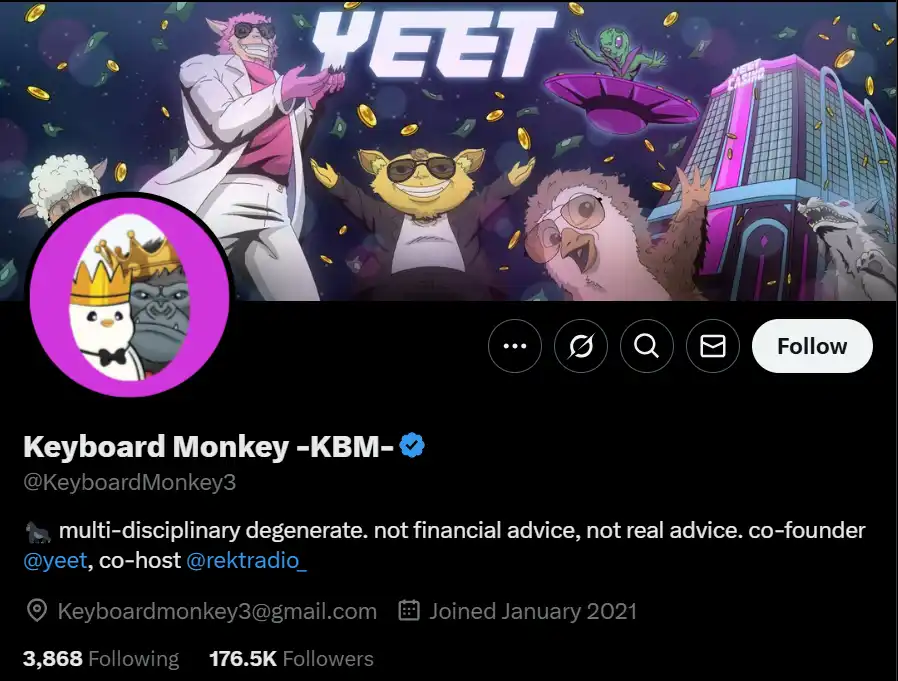
This combination of the two founders can be described as the perfect mix of "crypto + casino + speculation," making Yeet's DNA synonymous with going all-in.
Funding Background: Who is Powering Up Yeet?
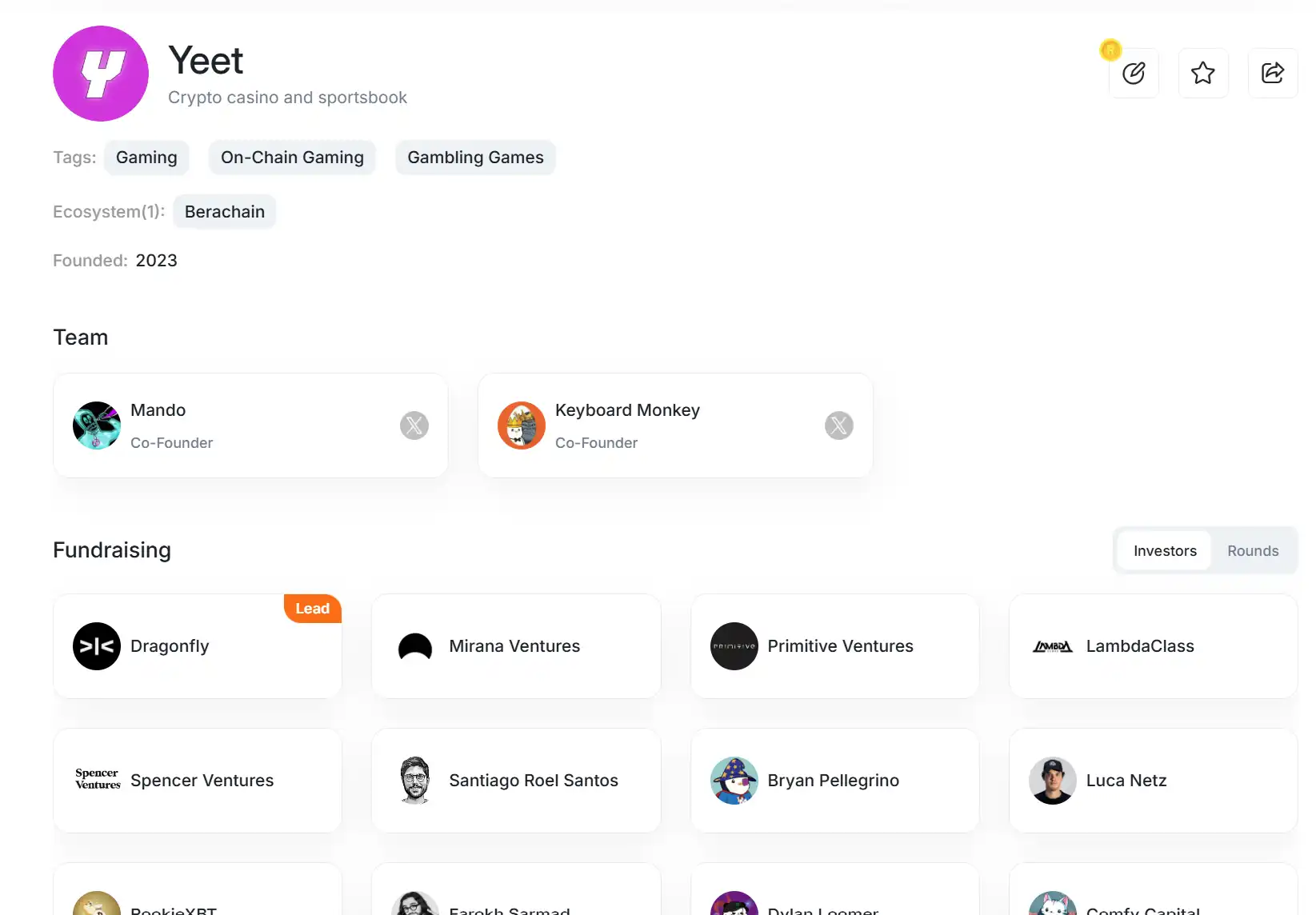
On March 19, 2025, Yeet secured a $7.75 million funding round, with the most prominent being Dragonfly leading the investment. This crypto VC can be considered the "Midas touch" of the crypto world, having invested in star projects like Avalanche and Near Protocol. Yeet also attracted a group of angel investors bringing traffic, tech, and resources, with two, in particular, worth mentioning:
LucaNetz (PudgyPenguins CEO), a top player in the NFT space who successfully holds community operations and brand building secrets with a group of adorable chubby penguins. His involvement implies that Yeet may evolve into an entertainment venue with its own cultural symbol and community consensus.
Another is BryanPellegrino (LayerZero CEO), the head of the LayerZero cross-chain protocol. His technical background might bring more innovation to Yeet in cross-chain liquidity and on-chain trading experience. If Yeet aims to become a true on-chain casino, Bryan's addition is definitely an accelerator.
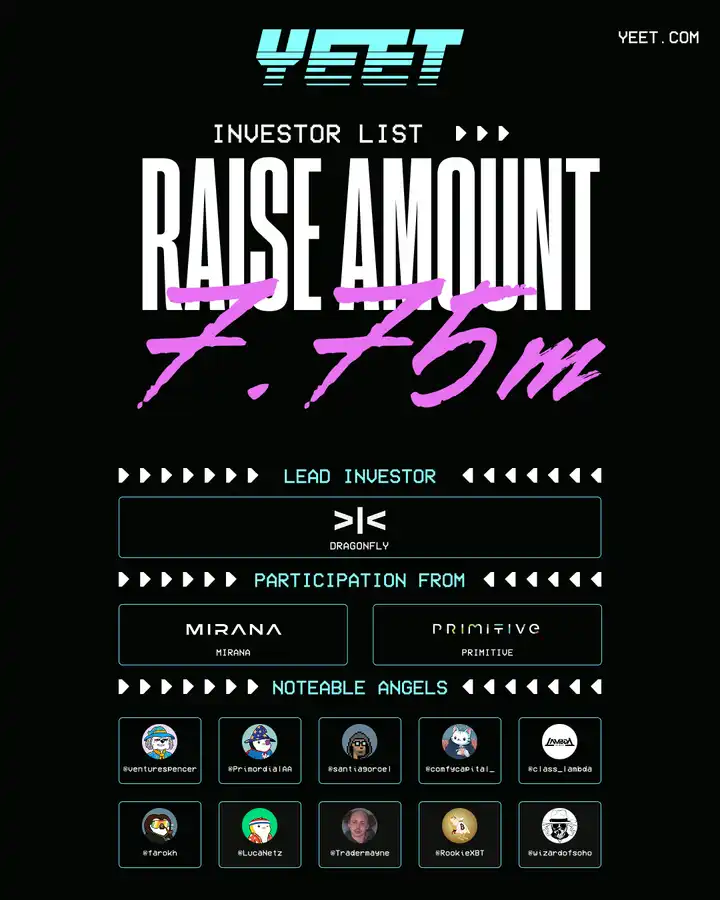
Funding amount of $7.75 million, which is considered above average in the prediction market space, not reaching unicorn status but enough to allow Yeet to rapidly expand its market presence in the early stages. However, how will the money be spent? Will it be a heavy investment in marketing or product optimization? Currently, Yeet has not revealed its strategy, but with the endorsement of these investors, it can be inferred that they are not merely aiming to "run a casino" but are headed towards building a larger crypto speculation ecosystem.
Backed by top-tier capital and guided by crypto industry heavyweights, can Yeet's on-chain slot machine hit the jackpot?
As a newcomer in the crypto prediction market, Yeet has rapidly gained prominence in a highly competitive field. Its uniqueness lies in boldly integrating gambling elements with crypto-native features, potentially sparking a new wave of trading frenzy catalyzed by market sentiment and speculative psychology.
Although the product has not fully launched yet, its technological strength, market acceptance, and user experience are yet to be tested. However, looking at its funding lineup and team background, Yeet has the potential to become a disruptor in the industry. For crypto players enthusiastic about high risks and high returns, this project may be worth continued attention—whether it will become the "Las Vegas of the crypto world" or the next prediction market dominator remains to be seen. Time will provide the answer.
You may also like

Dialogue with OmenX Founder: Why does the prediction market need an evolution from "spot" to "derivatives"?

When the P2P illicit funds from ten years ago turned into 60,000 bitcoins

Morning News | CME Group launches Nasdaq Cryptocurrency Index futures; Asset management giant Janus Henderson strategically invests in Ethena

Why did Oracle deliver the strongest financial report in history, yet its stock price fell?

Bitcoin Layer 2 Network Botanix: Why Did We Choose to Dissolve?

Morning Report | OpenAI has submitted an S-1 registration statement draft to the U.S. SEC; Morpho completes $175 million financing

Galaxy Deep Research Report: How Hyperliquid's HIP-4 Upgrade Changes the Landscape of Prediction Markets?

Latest research from 13 top universities including Cornell University: The current state, challenges, and misconceptions of the fusion of Crypto and AI
Deconstructing Anthropic: The Best AI Company, Possibly Also a Type of Organizational Invention

Every exchange is a "Universal Exchange."

The counterattack of traditional finance: Alliance chains are quietly reviving
Pantera Capital Partner: How Tokenization is Restructuring the Private Equity and Early Investment Ecosystem?

Mastercard Launches Agent Pay for AI, Plans to Record AI Agent Payment Authorizations on Polygon
Mastercard launched Agent Pay for AI, a new payment protocol designed to help AI agents make small payments such as pay-per-use access to data and APIs. The system plans to record human-granted AI agent permissions on Polygon, focusing on verifiable authorization, identity, and payment controls.

Curve Deploys Llamalend v2 on Optimism With 250,000 OP Incentives
Curve launched Llamalend v2 on Optimism with 250,000 OP incentives from the Optimism Foundation. The upgrade expands Llamalend beyond its earlier crvUSD-focused model, adding broader collateral support, LlamaRisk market reviews, and the ability to use Curve LP tokens as collateral.

Raydium Old Liquidity Pool Reportedly Exploited, With $1.34 Million Moved to Ethereum and Tornado Cash
An old Raydium liquidity pool was reportedly exploited for around $1.34 million in USDC, RAY, and wSOL, with the stolen funds bridged to Ethereum and deposited into Tornado Cash. The incident highlights the tail risks of legacy DeFi pools, old contracts, and cross-chain fund laundering paths.
Kalshi Executive Challenges “SBF Backed AI Unicorns” Narrative, Says Leopold Aschenbrenner Was Key Figure
Kalshi executive John Wang questioned the “SBF backed AI unicorns” narrative, saying Leopold Aschenbrenner was the key figure behind major AI investment decisions.

New York Proposes Stricter Stablecoin Issuer Rules Aligned With Federal GENIUS Act
NYDFS proposed stricter stablecoin issuer rules aligned with the GENIUS Act, covering reserves, custody, redemption timelines, audits, and capital buffers.

CryptoQuant Says Bitcoin Profitable Supply Is Near 45% Pressure Zone as On-Chain Data Points to Market Repricing
CryptoQuant said Bitcoin’s profitable supply is nearing the 45% pressure zone, signaling rising market stress, unrealized losses, and a possible on-chain repricing phase.
Dialogue with OmenX Founder: Why does the prediction market need an evolution from "spot" to "derivatives"?
When the P2P illicit funds from ten years ago turned into 60,000 bitcoins
Morning News | CME Group launches Nasdaq Cryptocurrency Index futures; Asset management giant Janus Henderson strategically invests in Ethena
Why did Oracle deliver the strongest financial report in history, yet its stock price fell?
Bitcoin Layer 2 Network Botanix: Why Did We Choose to Dissolve?
Morning Report | OpenAI has submitted an S-1 registration statement draft to the U.S. SEC; Morpho completes $175 million financing


