
David Sacks strives to dispel conflicts of interest, will the "Crypto Tsar" pull out all the stops at the White House Cryptocurrency Summit?




The Crypto Tsar David Sacks has had a tumultuous few days. As the highly anticipated inaugural White House Crypto Summit approaches, various accusations and criticisms have been circulating on social media.
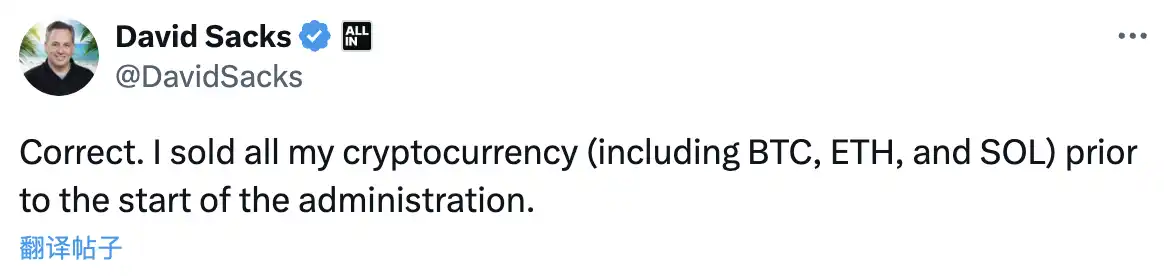
David Sacks has been busy preparing for the summit while frequently posting clarifications: "Yes, I sold all my cryptocurrencies (including BTC, ETH, and SOL) before this administration took office."; "I also sold Multicoin. At that time, I didn't actually need to sell because the ethical review process was still ongoing. But I voluntarily sold all my cryptocurrencies and focused on crypto-related funds."
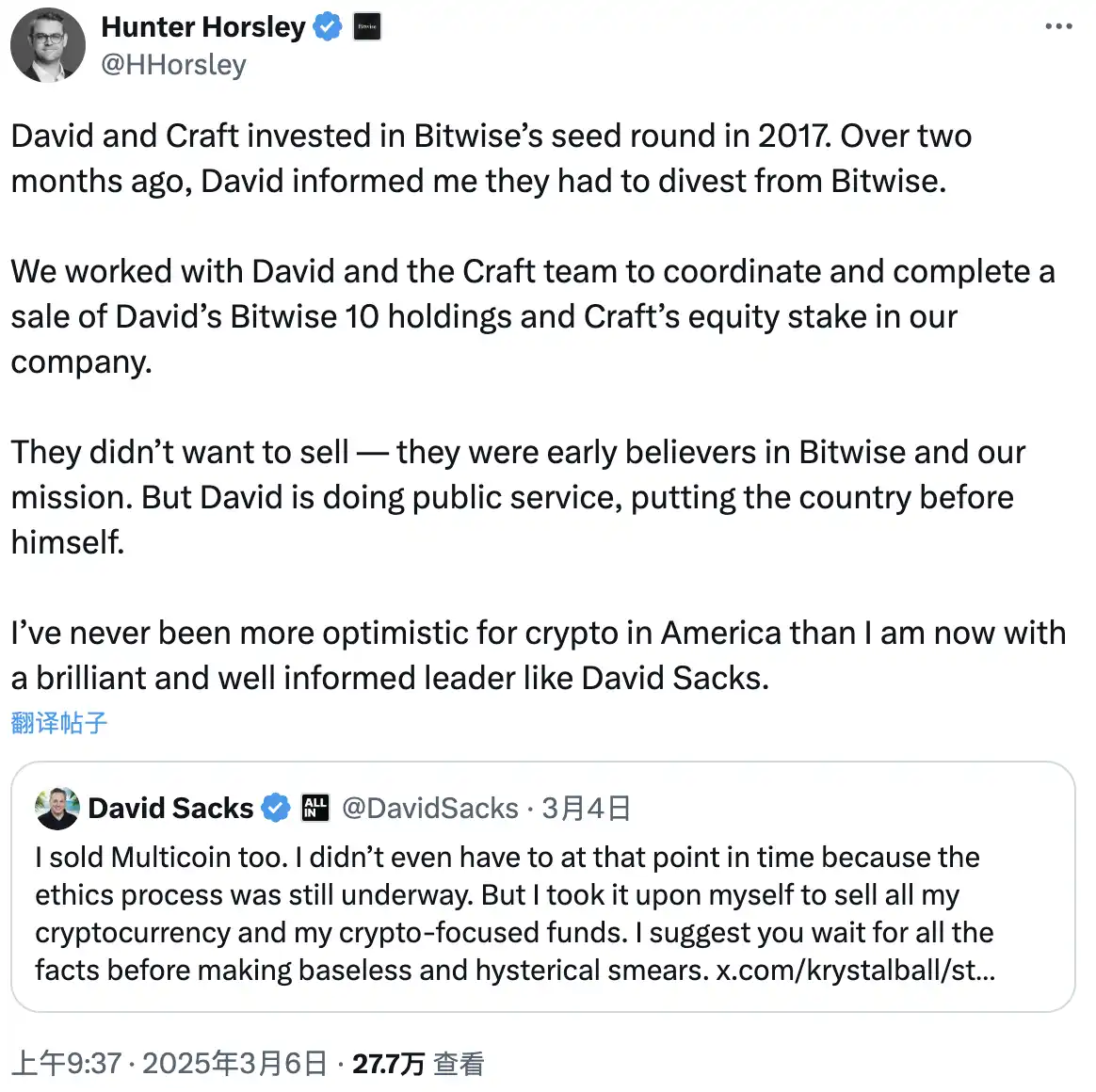
The CEO of Bitwise and the Co-Founder of Multicoin also spoke out on his behalf: "David Sacks has sold his Bitwise shares"; "White House AI and Cryptocurrency Czar David Sacks is clear about his role. Several months ago, his team reached out to us, and we found buyers for the remaining Multicoin-related assets under his Craft Ventures."
Why the Ongoing Accusations?
Why has David Sacks been repeatedly accused recently? The accusations mainly focus on Bitwise and Multicoin Capital, two companies closely related to David Sacks's interests.
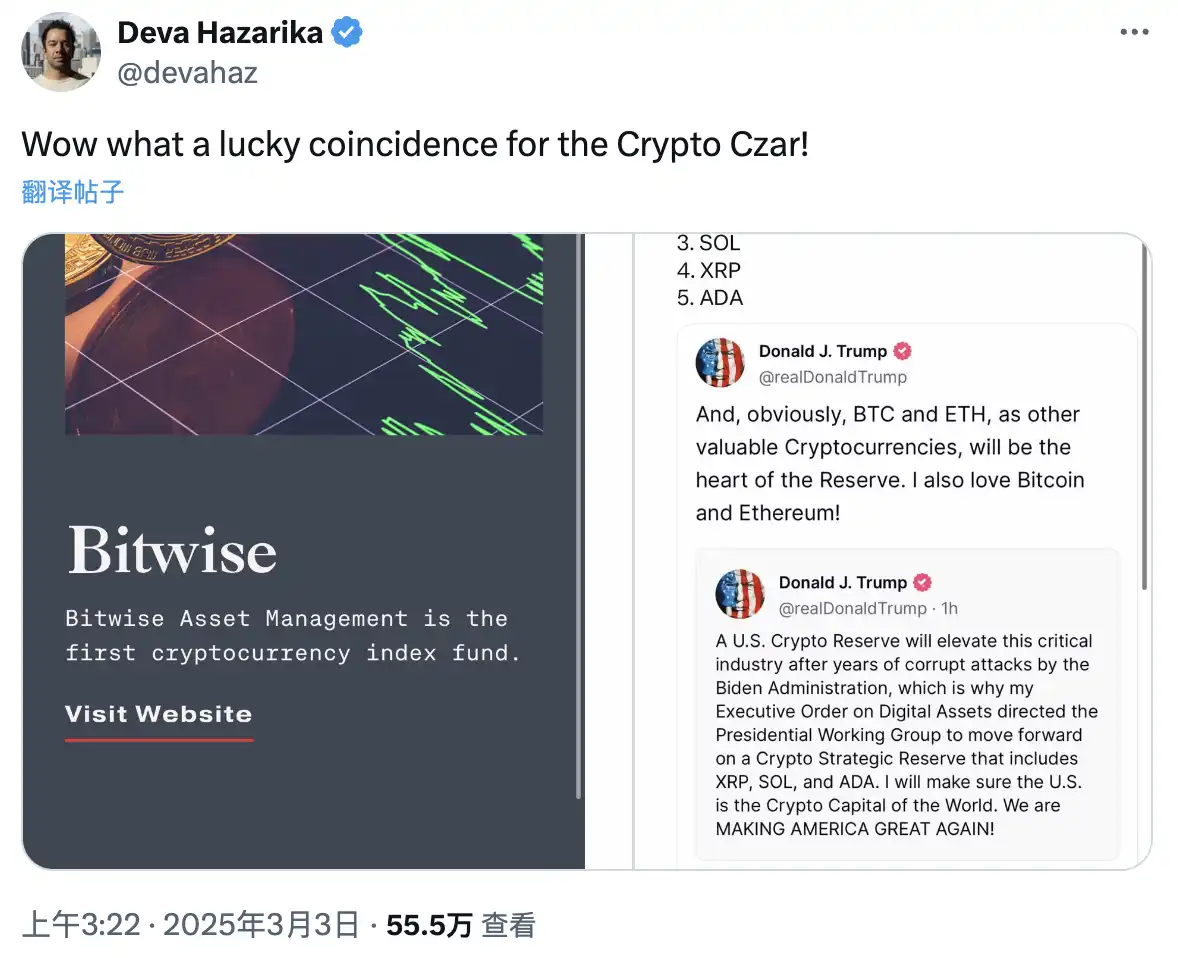
The direct trigger was the striking similarity between the cryptocurrency reserves listed by Trump and Bitwise's asset portfolio. David Sacks's venture capital firm, Craft Ventures, had invested in Bitwise's seed round as early as 2017, establishing close ties with Bitwise. Bitwise's cryptocurrency index funds hold a large amount of BTC, ETH, SOL, XRP, and ADA—coincidentally, these five assets happen to be the cryptocurrencies proposed by Trump for strategic reserves. Critics sarcastically point out that Bitwise's investment portfolio is a "fortunate coincidence" for David Sacks; if the government were to purchase the strategic reserve assets proposed by Trump (such as BTC and ETH), Bitwise would naturally benefit.
However, according to a statement made by Bitwise's CEO on the morning of March 6, "David Sacks has sold Bitwise shares," indicating that David Sacks is unlikely to directly receive dividends from the company's profits.
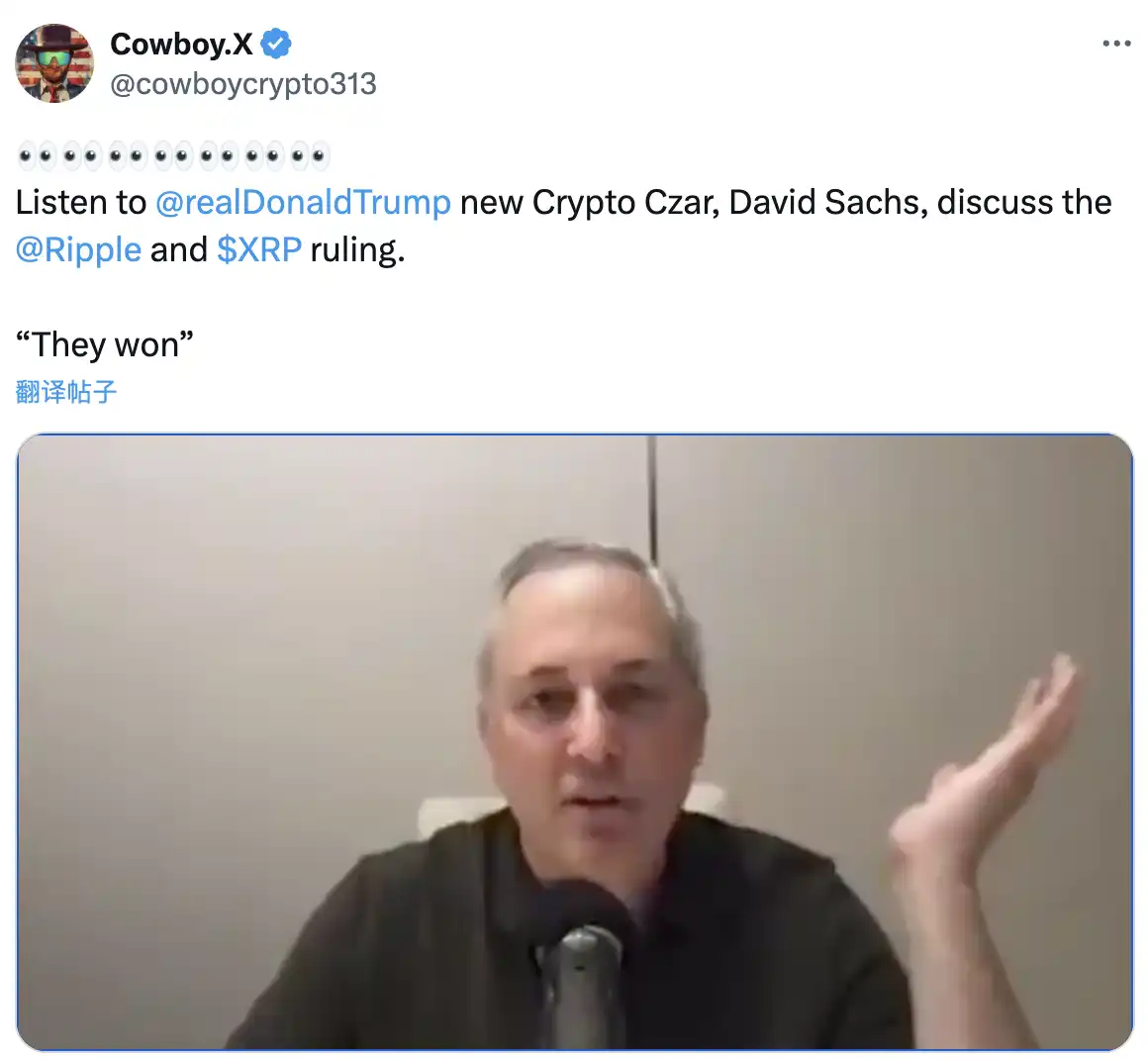
It is also worth noting that David Sacks was once a "Solana enthusiast" and in 2018 invested early in Solana as an LP of Multicoin Capital. He has also mentioned on a popular podcast, "All-In," that he has remained steadfast in not selling SOL even after the FTX crash. As a defender of Republican ideals, David Sacks has also described the mixed ruling in court regarding XRP being sold on public exchanges not constituting a security but constituting a security when sold to institutional investors as a victory for the entire crypto industry.
Considering the above factors, despite David Sacks repeatedly clarifying that he no longer holds any crypto assets and has sold off shares in relevant companies, his past outspoken support for certain altcoins has made it difficult to dispel market suspicions.
What to Expect at the First Cryptocurrency Summit?
For David Sacks, the upcoming White House Cryptocurrency Summit is of paramount importance. This summit is the first of its kind hosted by the White House and is of a high level of significance. In addition to U.S. President Trump, AI and crypto czar David Sacks, and Cryptocurrency Task Force Executive Director Bo Hines, political figures reportedly attending the summit include U.S. Treasury Secretary Scott Bessent, U.S. Commerce Secretary Howard Lutnick, New York State Attorney General Letitia James, U.S. Attorney General Pam Bondi, and SEC Chairman Paul Atkins, among others. Of course, prominent figures within the crypto industry will also be present at the summit, such as Ripple CEO Brad Garlinghouse, Strategy Chairman Michael Saylor, Paradigm co-founder Matt Huang, and more.
According to multiple media reports, the most notable aspect of this summit may be the "National Strategic Crypto Reserve" plan. The plan intends to include mainstream cryptocurrencies such as Bitcoin, Ethereum, Solana, Cardano, and Ripple (XRP) in the national reserve system, with a scale and function similar to traditional oil reserves. As disclosed by Forbes, the selection of reserve assets considers the characteristics of each currency: Bitcoin for its inflation-resistant "digital gold" properties, Ethereum for its smart contract ecosystem, Solana as a high-performance application platform, Cardano for its research-driven secure architecture, and Ripple for its cross-border payment efficiency.
In terms of regulatory system development, the summit will focus on discussing stablecoins and the top-level design of the overall regulatory framework. Cointelegraph revealed that Trump advisor David Sacks advocates strengthening the dominance of the US dollar through stablecoins, a view that may influence the federal regulatory scheme. Currently, a draft bill being pushed forward by the House Financial Services Committee indicates that stablecoin issuers with a circulation exceeding one hundred billion US dollars may be brought into the Federal Reserve's regulatory system, forming a dual-layer regulatory framework involving both federal and state governments. At the same time, the 2023 proposed "21st Century Financial Innovation and Technology Act" may see substantive progress, with its core aim to coordinate the regulatory powers of the SEC and CFTC to establish a digital asset regulatory paradigm that balances innovation and security.
To achieve the strategic goal of becoming the "Crypto Capital," the summit may introduce a series of innovation incentives. CryptoBriefing analysis suggests that the government may relax regulatory restrictions from the Biden era. An unexpected detail is that the summit may also discuss cryptocurrency-related tax reforms. According to BeInCrypto reports, tax reform may be part of the agenda, potentially impacting investors' tax burdens, involving simplification of tax reporting for crypto transactions or providing tax incentives to promote industry growth.
David Sacks is responsible for designing a legal framework favorable to the development of the crypto industry. In a press conference on February 4, 2025, he discussed with Republican policymakers the United States' leadership position in the digital asset ecosystem, emphasizing the importance of maintaining domestic innovation. It can be imagined that if public opinion continues to ferment, it will not only weaken David Sacks' influence but also significantly undermine the transparency and credibility of the Trump administration's crypto policy.
The White House Crypto Summit may become the key for David Sacks, the crypto czar, to reverse public opinion. At a time when the market is already deeply mired in various trust crises such as rug pulls, frontrunning, and insider trading, can this summit restore market confidence, rebuild trust? Will David Sacks hedge the accusation of "conflict of interest" with "policy outcomes," or will he continue to be questioned as "endorsing specific tokens"? Let us wait and see.
You may also like

WEEX Labs Lands at Dutch Blockchain Week: A Disruptive Crypto × AI Conversation Sets Sail in Amsterdam

SK Hynix Reportedly Plans U.S. ADR Listing as Early as August, With SEC Approval Possible in Late June
SK Hynix may pursue a U.S. ADR listing as early as August, with SEC approval reportedly possible in late June amid strong AI chip supply chain demand.

SpaceX vs Tesla vs xAI: Which Elon Musk Trade Has the Biggest Upside in 2026?

OpenAI Reveals It Has Confidentially Submitted an S-1 to the SEC, Keeping the Door Open for a Future IPO
On June 9, according to an OpenAI announcement, the company recently confidentially submitted a draft S-1 registration statement to the U.S. Securities and Exchange Commission (SEC), beginning the preliminary compliance process for a potential initial public offering. OpenAI said it chose to disclose this proactively because it expected the news might leak; however, the company has not yet set a specific listing timeline, and related arrangements may still take some time.

Latest research from 13 top universities including Cornell University: The current state, challenges, and misconceptions of the fusion of Crypto and AI
Deconstructing Anthropic: The Best AI Company, Possibly Also a Type of Organizational Invention
Apollo and Blackstone Reportedly Back $35 Billion Anthropic Chip Financing as Deal Details Remain Unclear
On June 9, according to currently available news alerts, Apollo and Blackstone Group participated in a $35 billion financing for an Anthropic “chip project.” Based on the original wording of the report, the funding has already been raised, but public information remains limited. The financing structure, use of proceeds, project entity, and whether Apollo and Blackstone participated through equity, debt, or project financing have not yet been disclosed.

Humanity Protocol Security Incident Escalates: More Than $31 Million Stolen From Related Addresses as Attacker Continues Selling H for ETH
On June 9, according to monitoring by Onchain Lens, more than $31 million has been stolen from addresses linked to Humanity Protocol, and the attack is still ongoing, with the hacker continuously swapping H tokens for ETH. Project founder Terence Kwok later confirmed the security incident on X, saying the issue involved a private key leak.

Bloomberg: As Bitcoin Weakens, Stablecoins and RWA Continue to Drive Expansion in Crypto Businesses
In June, Bloomberg reported that despite Bitcoin falling below $60,000 last week, wiping out about $235 billion in market value within seven days, and dropping close to 50% from last year’s peak, some core businesses in the crypto industry are still expanding, mainly in stablecoins, real-world asset tokenization (RWA), payments, and infrastructure. The report also noted that overall altcoin activity has contracted significantly: altcoin market capitalization has fallen from a peak of about $431 billion in November 2021 to around $170 billion, and among the tens of millions of tokens issued in recent years, fewer than 1,700 still maintain meaningful trading activity.

Galaxy Deep Research Report: How Hyperliquid's HIP-4 Upgrade Changes the Landscape of Prediction Markets?
Binance Research: RWA Market Expected to Expand Nearly 6x from Early 2025, with Public Equities and Onchain Payments Heating Up Together
In June, Binance Research said in its monthly market report that the real-world asset (RWA) market is expected to grow by about 589% from the beginning of 2025. Bond- and money market fund-related RWA expanded by about $6.5 billion, up 83% year over year, while publicly traded equity RWAs grew by about 422%. The report also noted that monthly crypto debit card transaction volume exceeded $747 million in May, up 48.6% year to date.

Japan to Assess a Framework for Yen Stablecoins and Crypto ETFs as Asia’s Compliant Payments Narrative Heats Up
Recently, according to the original report, Japan is considering the launch of yen stablecoins and cryptocurrency ETFs. Public information remains limited at this stage, and there is still no complete policy text, regulatory draft, or clear implementation timeline, so this is better characterized as a “policy discussion” rather than formal implementation. The original wording also noted that advancing stablecoin regulation in Asia is driving XRP usage and supporting growth in the XRPL ecosystem. However, based on currently available public information, there is not enough evidence to directly establish a clear causal relationship between this round of discussion in Japan and XRP or XRPL.

ZachXBT: Humanity private key leak and abnormal surge in H token should be viewed separately
On June 9, according to related disclosures, on-chain investigator ZachXBT posted an update on Humanity’s roughly $31 million security incident, saying that after further analyzing fund flows, he currently tends to believe the project team was not involved in an “inside job” or a self-staged attack. According to him, the official explanation about the private key leak was broadly accurate, but before the token unlock, the price of H had been artificially pushed higher, and the hacker later took advantage of that market environment; therefore, the private key leak and the earlier abnormal price pumping should be regarded as two separate and independent events. This reframing has shifted the market’s understanding of the nature of the incident. Earlier discussion around Humanity had focused on whether the team directly participated in the attack or used the security incident to cover up internal operations. ZachXBT’s latest remarks shift the focus from “whether it was self-theft” to “whether there were pre-unlock market structure issues.” He also questioned whether the team may have.

Morning Report | OpenAI has submitted an S-1 registration statement draft to the U.S. SEC; Morpho completes $175 million financing

Morning Report | BitMine increased its holdings by 126,971 ETH last week; trader Eugene announced his exit from the crypto market

Wang Chuan: How can one not feel anxious after the neighbor Old Wang made thirty times profit by investing in storage stocks? (Seven) - A quarter-century cycle
Cryptocurrency CEXs are flocking to sell US stocks, and traditional brokerages are facing an "uninvited guest."
$75 billion in foreign capital has fled, and South Korean retail investors have absorbed it all using leverage
WEEX Labs Lands at Dutch Blockchain Week: A Disruptive Crypto × AI Conversation Sets Sail in Amsterdam
SK Hynix Reportedly Plans U.S. ADR Listing as Early as August, With SEC Approval Possible in Late June
SK Hynix may pursue a U.S. ADR listing as early as August, with SEC approval reportedly possible in late June amid strong AI chip supply chain demand.
SpaceX vs Tesla vs xAI: Which Elon Musk Trade Has the Biggest Upside in 2026?
OpenAI Reveals It Has Confidentially Submitted an S-1 to the SEC, Keeping the Door Open for a Future IPO
On June 9, according to an OpenAI announcement, the company recently confidentially submitted a draft S-1 registration statement to the U.S. Securities and Exchange Commission (SEC), beginning the preliminary compliance process for a potential initial public offering. OpenAI said it chose to disclose this proactively because it expected the news might leak; however, the company has not yet set a specific listing timeline, and related arrangements may still take some time.
Latest research from 13 top universities including Cornell University: The current state, challenges, and misconceptions of the fusion of Crypto and AI
Deconstructing Anthropic: The Best AI Company, Possibly Also a Type of Organizational Invention


