
Cryptocurrency's "Schrodinger's Cat," Trump's Cryptocurrency Strategic Reserve Plan




We are so back! Trump spoke out again last night, with two tweets that reignited the recently sluggish cryptocurrency market, bringing back excitement to a market that had fallen silent during a bearish period.
From last night to early this morning, Trump posted on his self-owned platform Truth Social, stating, "I am advancing a Cryptocurrency Executive Order, directing the President's Working Group to develop a cryptocurrency strategy that includes XRP, SOL, and ADA in strategic reserves. I will ensure that America remains the world's cryptocurrency capital. We are making America great again!" The prices of the three mentioned tokens surged, followed by adding, "Obviously, BTC and ETH, along with other valuable cryptocurrencies, will be at the core of the reserves. I also like Bitcoin and Ethereum!" BTC and ETH also saw rapid growth, leading to an overall market resurgence.
Since Trump was elected as the "Crypto President," the market has experienced several rounds of news-driven ups and downs. BlockBeats will provide a brief analysis of this event and share the community's views on this event.
Cryptocurrency Market Rebounds
Following Trump's remarks on national reserves of "shitcoins" and his fondness for BTC and ETH, the cryptocurrency market saw a general uptrend. According to CoinGecko data, the total cryptocurrency market cap reached $3.2 trillion, up 5.2% in the past 24 hours.
According to TradingView data:
SOL briefly approached $180, now retraced to around $160, with an intraday gain of 18.2%.
XRP's price once stood above $3, now retreated to $2.63, with a surge of over 24.83% in the past 24 hours.
ADA peaked above $1.16, now retraced to around $0.95, with a daily gain of over 43%.
BTC reached a high of $94,500, currently retracing to around $91,800, with a daily gain of over 7.52%.
ETH briefly surpassed $2,550, now retreated to around $2,350, with a 24-hour surge of over 9.79%.
Market's Discussion on Cryptocurrency Reserves Varies
Since Trump's tweets last night, it has sparked a plethora of community discussions, with almost polarized views on the event itself.
First, Eric Trump said that announcing a strategic reserve on Sunday was a "genius move" because the traditional markets were closed and Wall Street was asleep, making it a "first victory" for retail investors. He also said that if traditional finance doesn't catch up soon, it will "go extinct," and MicroStrategy's founder Michael Saylor commented under the post, saying "Bitcoin never sleeps!"
Ethereum co-founder and Consensys founder Joseph Lubin said that this is a good thing as the decentralized protocol ecosystem now has the support of an open and sovereign nation. He believes now is the best time to leave behind the tribalism and infighting.
However, Udi Wertheimer, founder of Taproot Wizards, believes that the likelihood of altcoins joining the national reserve is zero. He thinks that Trump's move is not a genuine proposal to add altcoins to the national reserve but rather a political strategy. He said, "He is telling Congress, 'If you don't give me a Bitcoin reserve, I will shove Ripple down your throat.'
While there are positive views, there are also many opposing voices. Peter Schiff, Chief Economist of Europac, agreed with Elon Musk and Joe Rogan's previous interview point of view, that "American International Development Agency employees taking advantage of their positions to receive kickbacks from a phony nonprofit organization for personal gain is a shame." He questions why Trump can manipulate XRP, SOL, or ADA for personal gain using his position. Schiff believes that such matters should not be decided by the government but by the market. He stated, "Even if Trump believes that cryptocurrency will eventually become an important industry, he should not use taxpayers' money to hoard cryptocurrency to subsidize it."
JoshEakle, Chairman of the Project Liberal, a libertarian team, believes that from the outset of Trump's announcement to establish a crypto strategic reserve, it included David Sacks' hand-picked junk coins. He criticized the Trump family and Sacks for making significant bets on these tokens and cashing out with billions in profits using taxpayer money.
Former NSA member Derek Martin, who holds a similar view, posted a thread on Twitter listing evidence of Sacks benefiting from the crypto strategic reserve. David Stacks later posted that he had already divested his cryptocurrency assets "including BTC, ETH, and SOL" before taking office.
On the other hand, BitMEX co-founder Arthur Hayes is more pessimistic about Trump's call this time, believing that the government lacks the funds to make the purchase. He said, "There's nothing new here, just hot air. Let's talk when the crypto working group gets congressional approval to borrow money or revalue gold." Hayes has expressed his views on cryptocurrency reserve policy multiple times, stating that unless Trump adopts a "Bitcoin" national reserve, the market will head in a worse direction.
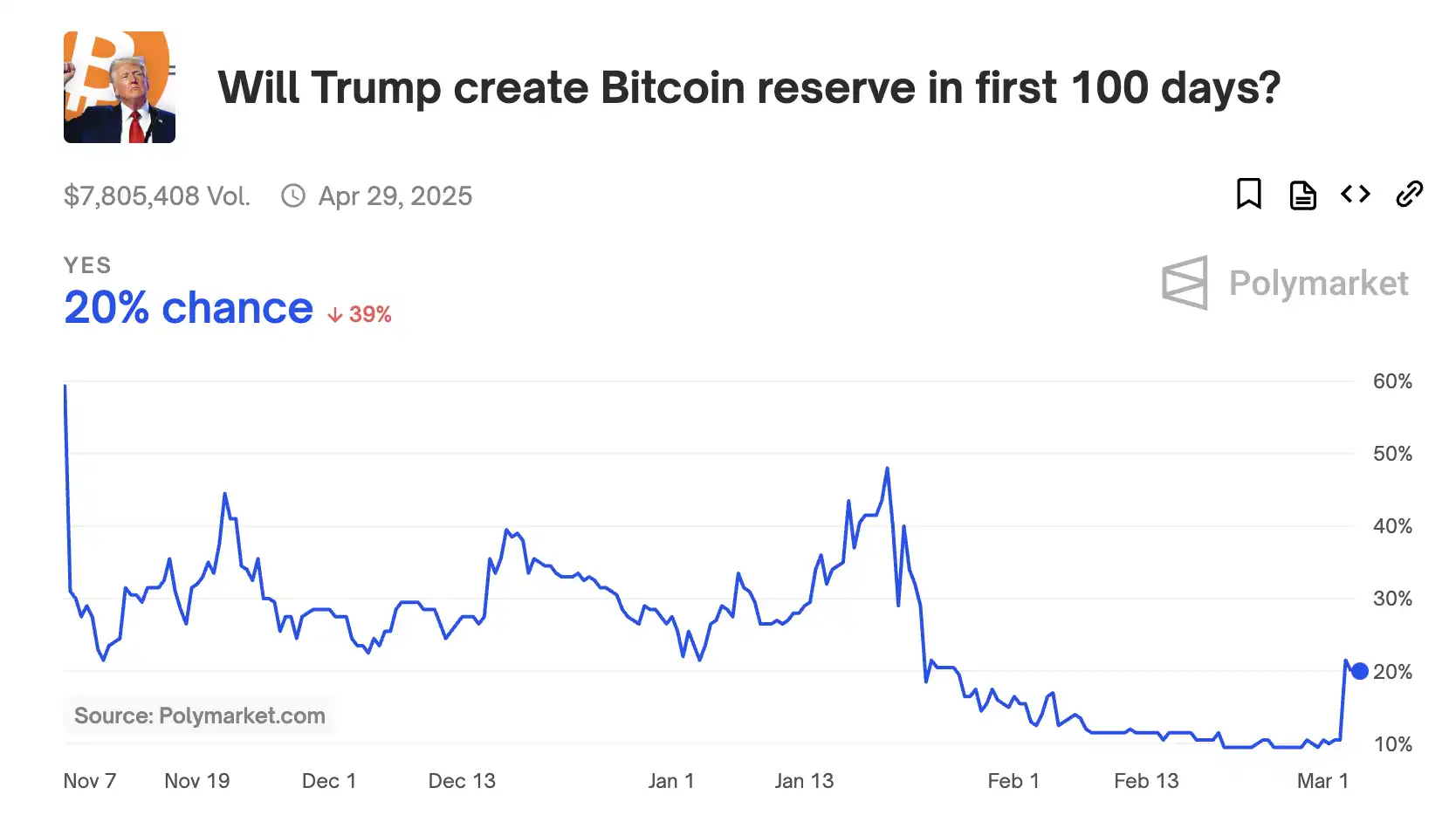
According to Polymarket data, the chance of Trump reintroducing a Bitcoin bill within the first 100 days of his term has increased to 20%, after previously dropping to a low of 10%. Currently, at least 20 states have proposed legislation related to Bitcoin reserves, and there may be deeper discussions at the federal level. Additionally, Trump is set to host the inaugural White House cryptocurrency summit on March 7, bringing together industry leaders to discuss regulatory policies, stablecoin oversight, and the potential role of Bitcoin in the US financial system. The discussion of whether there will be more policy breakthroughs on that day has become a short-term market focus.
HyperLiquid 50x Leverage Whale Suspicion
According to LookintoChain monitoring, the whale on HyperLiquid leveraging 50x to long ETH and BTC has closed most of its long positions today, earning over $6.8 million. A few days ago, this whale used a $6 million USDC principal to open over $200 million nominal value ETH and BTC long positions, sparking various speculations within the community.
Market analyst CryptoPainter_X believes that the "50x long on HyperLiquid is a manipulation," and before the Trump "news" came out, both BTC and ETH had almost reached the liquidation point for this user at 0.44% and 1.8%, respectively. There was no need to make such a large leverage trade on-chain at 50x instead of on a centralized exchange unless they knew in advance that this "strategic reserve" news would be released tonight or had the ability to prompt or control the release of relevant content and speculated on this behavior.
He thinks that usually, a whale looking to conduct a 50x leverage trade would split the position to avoid being targeted, but this transaction was openly displayed for everyone. After the transaction, the prices of BTC and ETH continued to fall, gradually approaching the liquidation price and intensifying the market's bearish sentiment. Especially in the 60 minutes before the Trump bullish news announcement, short-term speculative selling pressure surged, with the market generally expecting a sharp drop from the $200 million liquidation. However, in the 30 minutes before the news release, there were clear signs of support, the 15-minute retracement halted abruptly, then the bullish news came out, trapping the shorts instantly. This wave of operation involved "openly high leverage longs for media hype," "further guiding short liquidity aggregation," and "finally leveraging the news advantage to counter short positions," seizing profits and stabilizing market confidence.
However, later on, Coinbase executive Conor stated in a post that after tracking the address, it was found that the funds came from a phishing scam and belonged to a high-roller at Roobet. He also liquidated his long position before Trump's second announcement, missing out on tens of millions of dollars in gains. In reality, he was just a gambler using stolen funds and not someone with insider information.
Another prominent trader is the contract whale "Set 10 Big Goals First" @jasonleo, who closed his long position opened at $83,563.92 in Bitcoin on March 3 at 2:47 am at a closing price of $92,630.6 USDT, realizing a total profit of $15,394,374.05 USDT. Previously, on February 25, he had just liquidated his long position of 1,783.48 BTC opened at an average price of $100,320.8 at $89,138.
Why ADA, XRP, SOL?
Most of the community members believe that the likelihood of the United States actually adopting a meme coin as a national reserve is very low. After the short-term bullish close, the discussion has shifted from "if it can succeed" to why choose a meme coin and why specifically $ADA, $XRP, and $SOL.
Alex Xu, a research partner at Mint Ventures, analyzed that SOL, XRP, and ADA have been frequent visitors to Mar-a-Lago since Trump took office, providing Trump with a lot of visible sponsorship, such as donations to the inauguration fund, among other things. There is a high probability of various indirect benefits being provided privately. Trump has reciprocated this time as well, arranging a "presidential ad space" within his authority.
Well-known KOL ABKuaiDong listed the "sponsorship" behaviors of these tokens, with Ripple of $XRP donating a total of $30 million. While Cardano's $ADA has not made any direct donations, its founder has repeatedly supported the appointment of a new executive director for the Crypto Council. $SOL has no direct connection, but one of its largest backers, Multicoin, donated SOL for 10 consecutive days.
Cardano founder Charles Hoskinson stated in a previous live broadcast that he has established contact with "very important" individuals and in another live broadcast, showed another host that Trump had called him, actions that the community believes indicate collaboration with the Trump team, including the formulation of crypto policies. Earlier, as one of Ethereum's early team members, Charles advised Vitalik that if cryptocurrency "must" be involved in politics irreversibly, one should choose the side that favors crypto.
Trump's "Policy" Impact on the Future Market
Data analyst dataalchemist12 shared that the future market is very bullish under the policies of the Trump administration. The FIT21 Act has officially taken effect, clarifying the regulatory division of duties between the SEC and CFTC, with high-decentralized projects like Ethereum coming under CFTC regulation. The Safe Harbor mechanism is attracting more innovative projects to enter. After the repeal of SAB 121, banks such as JPMorgan Chase and Citigroup are rapidly expanding into crypto custody, institutional funds flowing in are boosting Bitcoin ETF volumes. The Bitcoin Strategic Reserve Act is being piloted in Michigan and Texas, with a federal-level game still in progress. There is a change of SEC chairmanship, indicating a loosening of regulations. The cryptocurrency IPO wave is restarting, with Kraken and Fireblocks set to go public, and Wall Street investment banks and sovereign funds accelerating their entry.
Renowned trader Eugene Ng Ah Sio has provided an analysis of the short-term market, stating, "Currently, latecomer bears and bulls will be liquidated, and only disciplined traders can maintain profitability." He also mentioned that he has already closed his positions and will decide on investment direction based on the market's strength or weakness after March 7.
Shenyu, the founder of Cobo, expressed his views on the medium to long-term market. He believes that a more favorable market development may emerge in the second half of this year, around "June to October," as the situation at the U.S. national reserve level gradually becomes clearer and receives approval, leading to an influx of additional funds. However, regarding application-level issues, short to medium-term solutions may not suffice. Ultimately, the outcome will depend on whether the U.S. national reserve-related matters can yield some results this year. If not, the market trend may come to an end.
As Trump continues his efforts to "establish crypto hegemony," cryptocurrency is becoming increasingly intertwined with the current political landscape. Based on President Trump's past tendencies, the development direction of policies remains uncertain, with various forces balancing behind a single sentence or event. Currently, both institutions and retail investors are in an observation phase, with market attention focused on whether the Bitcoin bill can pass rather than the possibility of current altcoin reserves. In this market environment, we should treasure our feathers and quietly await the arrival of opportunities.
You may also like

Morning Report | BitMine increased its holdings by 126,971 ETH last week; trader Eugene announced his exit from the crypto market

Wang Chuan: How can one not feel anxious after the neighbor Old Wang made thirty times profit by investing in storage stocks? (Seven) - A quarter-century cycle

Cryptocurrency CEXs are flocking to sell US stocks, and traditional brokerages are facing an "uninvited guest."

$75 billion in foreign capital has fled, and South Korean retail investors have absorbed it all using leverage

Japan’s Three Megabanks Plan Joint Stablecoin Issuance in Fiscal 2026
MUFG, SMBC, and Mizuho reportedly plan to jointly issue fiat-pegged stablecoins in fiscal 2026, signaling Japan’s growing push into bank-led digital payment infrastructure.

Humanity Discloses H Token Dual-Chain Attack Details, With Losses on Ethereum and BSC Exceeding $36 Million
Humanity said the H token attack across Ethereum and BSC caused more than $36 million in losses after leaked ProxyAdmin keys enabled malicious contract upgrades and token minting.
White House Discusses CLARITY Act With Law Enforcement Ahead of Senate Vote
The White House discussed the CLARITY Act with law enforcement ahead of a Senate vote, focusing on illicit finance risks and developer protections.

Bitcoin Trading Guide 2026: Strategies for Experienced Traders

What Is XAUT and PAXG? Why Tokenized Gold Is Booming in 2026

Will the SpaceX IPO Hurt Bitcoin? Here's What Traders Are Watching

Foreign selling in the South Korean stock market accelerates, with cumulative net sales reportedly reaching $75 billion this year
On June 9, The Kobeissi Letter, citing Goldman Sachs data, reported that global investors are selling South Korean stocks at an unusually rapid pace. In the latest trading session, foreign investors sold about $801 million worth of Kospi constituent stocks again; total foreign outflows last week reached about $10 billion, and the market has been in net foreign selling on nearly every trading day over the past month. According to the data cited in the report, foreign investors have sold about $75 billion worth of South Korean stocks so far this year. Meanwhile, South Korean retail and institutional investors together recorded roughly $69 billion in net buying over the same period, suggesting that the market’s main buying support has come from domestic capital rather than returning overseas funds. The information currently disclosed still mainly comes from The Kobeissi Letter’s retelling and Goldman Sachs data summaries, while public details on the statistical period and the specific definition of “selling” remain relatively limited.

Fortune Warns of Strategy’s Financing Structure Risks as Bitcoin Premium Narrows
Fortune warned that Strategy’s Bitcoin treasury model faces growing financing risks as MSTR’s net asset premium narrows and preferred stock dividend pressure increases.

Ferrari Challenge Le Mans: Carl Moon to Dominate in WEEX Livery

Sahara AI Responds to SAHARA’s Sharp Drop: No Contract or Product Security Issues Found, Internal Investigation Underway
Sahara AI responded to SAHARA’s 60% price drop, saying no token contract or product security issues have been found and an internal investigation is underway.

WEEX Deposit/Withdrawal Dynamic Island: Your Asset Status, Always in Sight
Scaling Crypto Derivatives: The Digital Asset Infrastructure Behind High-Volume Trading
In the fast-moving digital asset ecosystem, derivatives platforms face an extreme architectural test. High-leverage futures markets demand more than just standard security—they require absolute operational precision, zero-latency matching engines, and ironclad structural scalability, all while navigating intense market volatility.
As global platforms scale to meet these demands, the industry is shifting away from rigid, monolithic setups toward a more agile, "decoupled" infrastructure philosophy.
The Blueprint for High-Volume Copy TradingFor elite global exchanges like WEEX (founded in 2018), this architectural choice becomes critical when scaling high-volume retail features like social copy trading. When thousands of users automatically mirror the real-time strategies of elite traders simultaneously, it triggers sudden, monumental spikes in concurrent transactional volume.
To prevent execution latency or settlement bottlenecks during these peak volatility events, a platform's primary engine must remain entirely dedicated to risk management, copy-trade synchronization, and order matching.
The Architectural Rule: New-generation platforms must separate front-end user execution engines from heavy backend infrastructural overhead to eliminate operational friction.
By separating these layers, platforms can maintain complete sovereignty over their trading environments and user experiences while strategically aligning with institutional-grade infrastructure ecosystems. This strategic framework allows modern exchanges to leverage advanced Digital Asset Custody infrastructure such as Cobo’s behind the scenes, ensuring that backend wallet management scales elastically alongside trading spikes.
Capitalizing on Market Momentum and 400× LeverageIn a derivatives arena where platforms offer up to 400× leverage on perpetual contracts, capital efficiency and market agility are core business metrics. To capture market momentum, an exchange needs the ability to rapidly expand its asset offerings, supporting everything from legacy crypto assets to sudden, trending altcoins across a massive library of trading pairs.
Adopting a flexible, scalable Wallet-as-a-Service (WaaS) solution such as Cobo’s could completely rewrite the development timeline for high-growth exchanges. Instead of spending months of engineering capital building out custom backend wallet architectures for every new blockchain network, platforms can deploy localized infrastructure in days.
This agility allows platforms to instantly scale their listings to over a thousand trading pairs without compromising security or delaying time-to-market. It mirrors the exact operational advantages seen during high-velocity market events, similar to how advanced wallet infrastructure empowers platforms during sudden asset surges; allowing exchanges to pass that speed and liquidity directly to their global user base.
A Mature Foundation for GrowthThe synergy between trusted infrastructure ecosystems and global trading platforms represents the natural evolution of a maturing crypto market. As WEEX continues to scale its global spot and derivatives offerings for over 6 million users, adopting robust backend paradigms proves that platforms no longer have to compromise between cutting-edge trading velocity and uncompromised structural security.

Get Paid to Onboard? Try WEEX’s New Homepage with Rewards for Registration, Deposit & Trade
WEEX Custom Layout: Build Your Perfect Trading Workspace in Seconds
Morning Report | BitMine increased its holdings by 126,971 ETH last week; trader Eugene announced his exit from the crypto market
Wang Chuan: How can one not feel anxious after the neighbor Old Wang made thirty times profit by investing in storage stocks? (Seven) - A quarter-century cycle
Cryptocurrency CEXs are flocking to sell US stocks, and traditional brokerages are facing an "uninvited guest."
$75 billion in foreign capital has fled, and South Korean retail investors have absorbed it all using leverage
Japan’s Three Megabanks Plan Joint Stablecoin Issuance in Fiscal 2026
MUFG, SMBC, and Mizuho reportedly plan to jointly issue fiat-pegged stablecoins in fiscal 2026, signaling Japan’s growing push into bank-led digital payment infrastructure.
Humanity Discloses H Token Dual-Chain Attack Details, With Losses on Ethereum and BSC Exceeding $36 Million
Humanity said the H token attack across Ethereum and BSC caused more than $36 million in losses after leaked ProxyAdmin keys enabled malicious contract upgrades and token minting.


