
Bull and Bear cycle by month, what's next for the crypto market?


Original Article Title: Bull or Bear: And What's next?
Original Article Author: Ignas, DeFi Research
Original Article Translation: Deep Tide TechFlow
In June 2021, when ETH plummeted from $4,300 to $2,150, halving in price, I chose to sell all my assets.
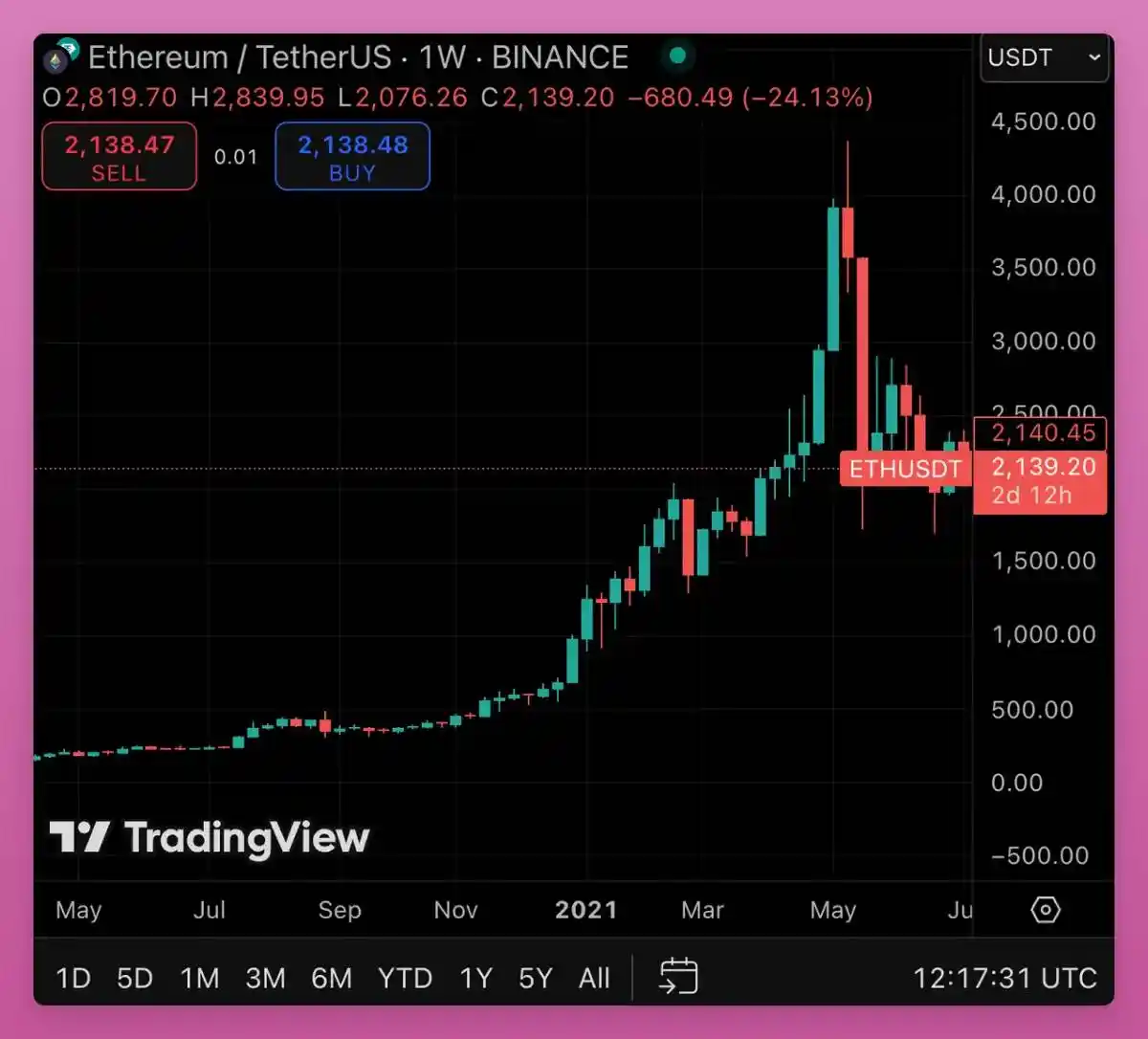
At that time, I was exhausted by the high intensity of the bull market. The continuous research and work had worn me out, and I was desperate for everything to stop. When my investment portfolio shrunk by 50%, I thought it was a signal of a bear market, so I decisively liquidated all my holdings and felt a wave of relief.
However, the market quickly rebounded afterwards, with ETH skyrocketing by 125% to reach $4,800. I could only watch from the sidelines, although I earned some gains by holding stablecoins, I missed out on this rebound.
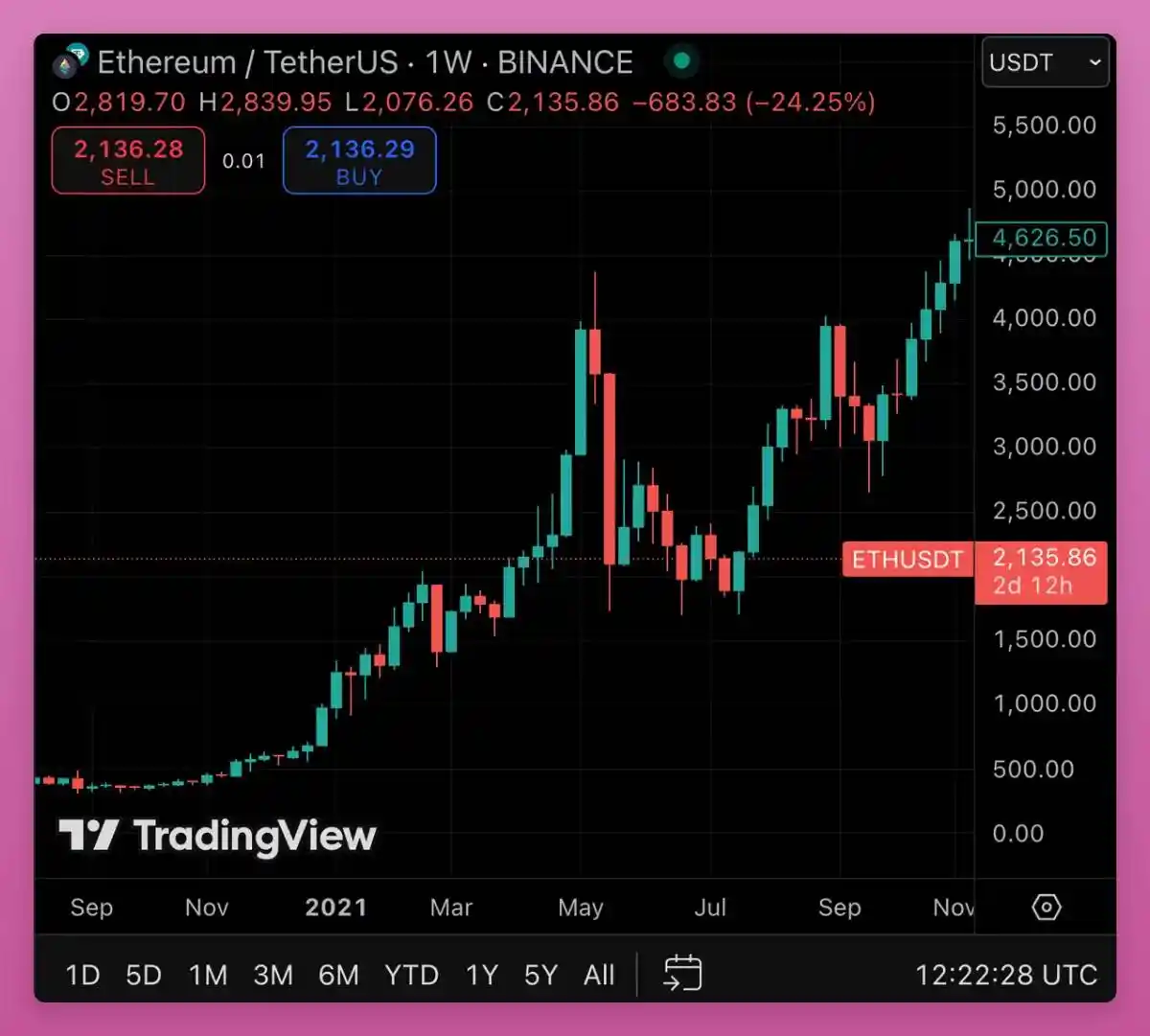
Now, I feel like we are in a similar stage again, but this time my mental state is stronger. I choose to hold my assets firmly and wait for the market to recover.
But what if I am wrong? What if this time is really the beginning of a bear market?
The current market sentiment is dominated by fear: the impact of Trump's tariff policy, the stock market at an all-time high which may trigger a crash, subsequently dragging down the cryptocurrency market. At the same time, you may have noticed that Warren Buffett is holding a large amount of cash, which makes you wonder if he knows something we don't. The "smart people" on Social Media platform X are making pessimistic forecasts, claiming that the market is about to collapse.
This is what is known as Goblin Town (a colloquial term for a market crash).
Nevertheless, I choose not to be overwhelmed by this fear, uncertainty, and doubt (FUD), and I hope to help everyone calmly analyze the current situation by sharing some market data and insights.
Is Bitcoin Still in a Bull Market?
Here are some indicators from CryptoQuant to help determine whether the Bitcoin price is overvalued (expensive) or undervalued (cheap).
MVRV Z-Score Indicator
The MVRV Z-Score is used to measure whether the Bitcoin price is deviating from its historical trend, indicating whether it is overvalued (red zone) or undervalued (green zone).
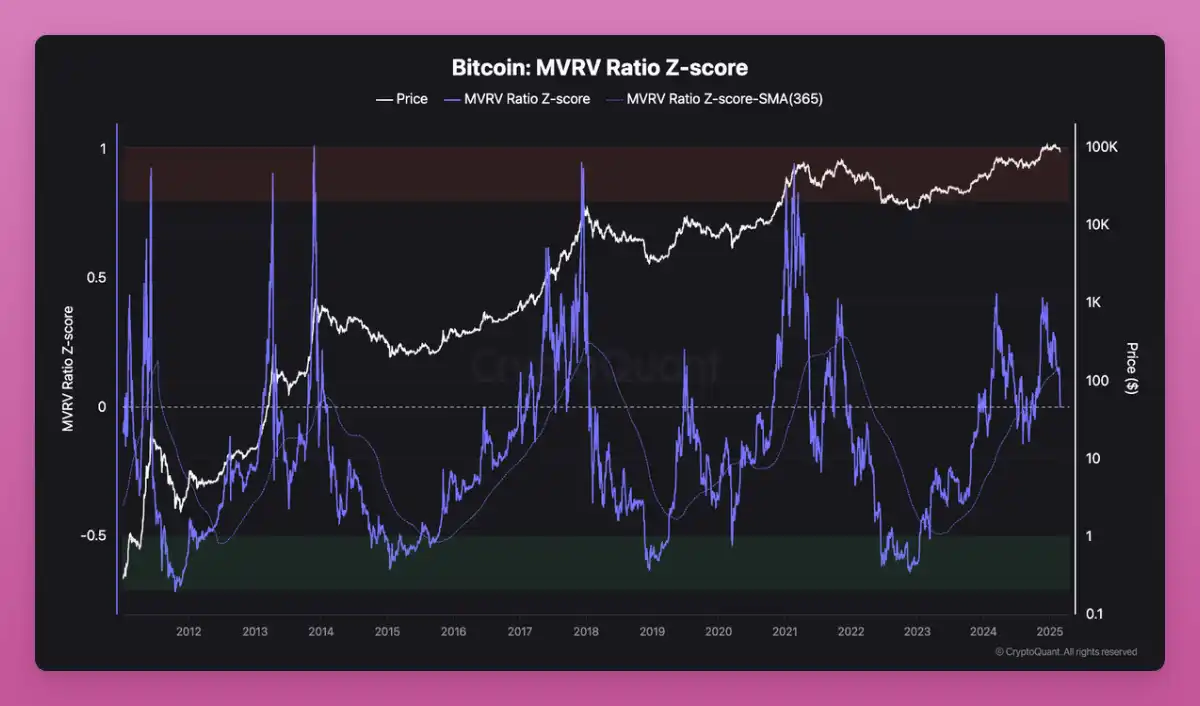
Currently, the Bitcoin price has not entered the overvalued zone but is also significantly above the undervalued zone.
The market still has room for growth, but it is currently in a mid-term cycle rather than an early stage.
NUPL (Net Unrealized Profit/Loss) Ratio
The NUPL indicator measures market sentiment based on unrealized profits, indicating whether the market is fearful, optimistic, or euphoric.
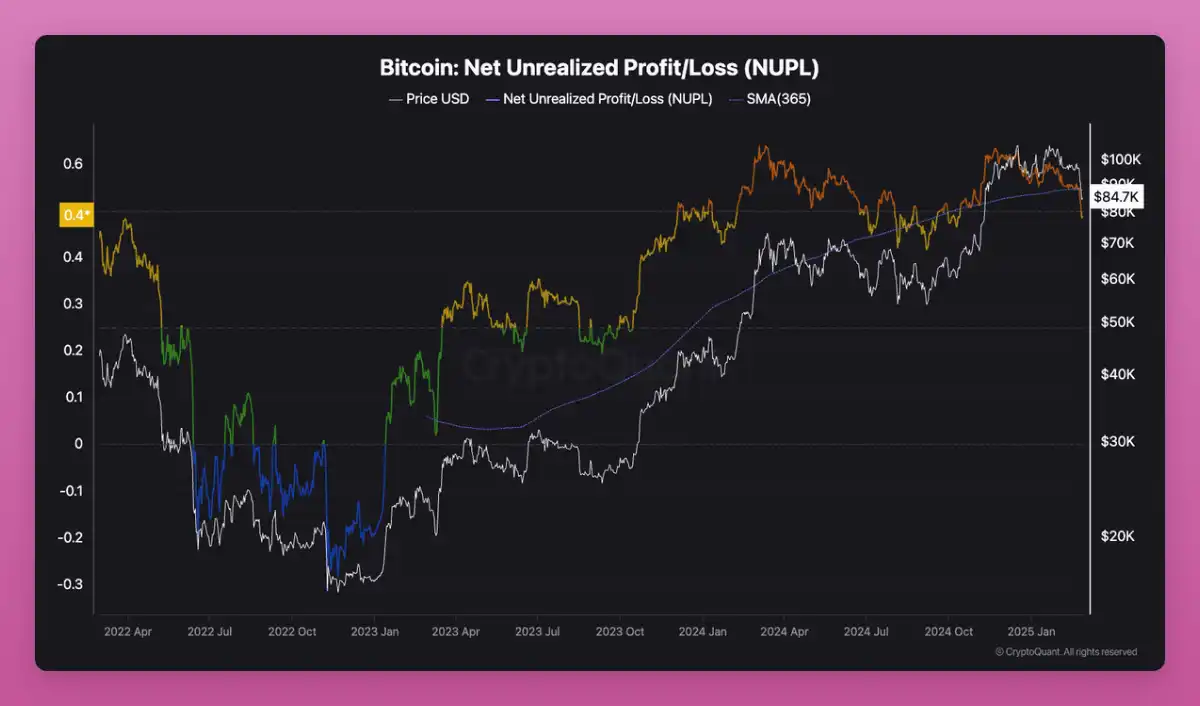
Currently in the optimistic/denial phase (~0.48), indicating that the majority of holders are still in a profitable state.
Historically, when NUPL is above 0.6, the market usually enters a greedy/euphoric phase, signaling the arrival of a top.
HODLer SOPR (Spent Output Profit Ratio)
SOPR tracks the behavior of long-term holders to determine whether they are selling assets at a profit or loss.
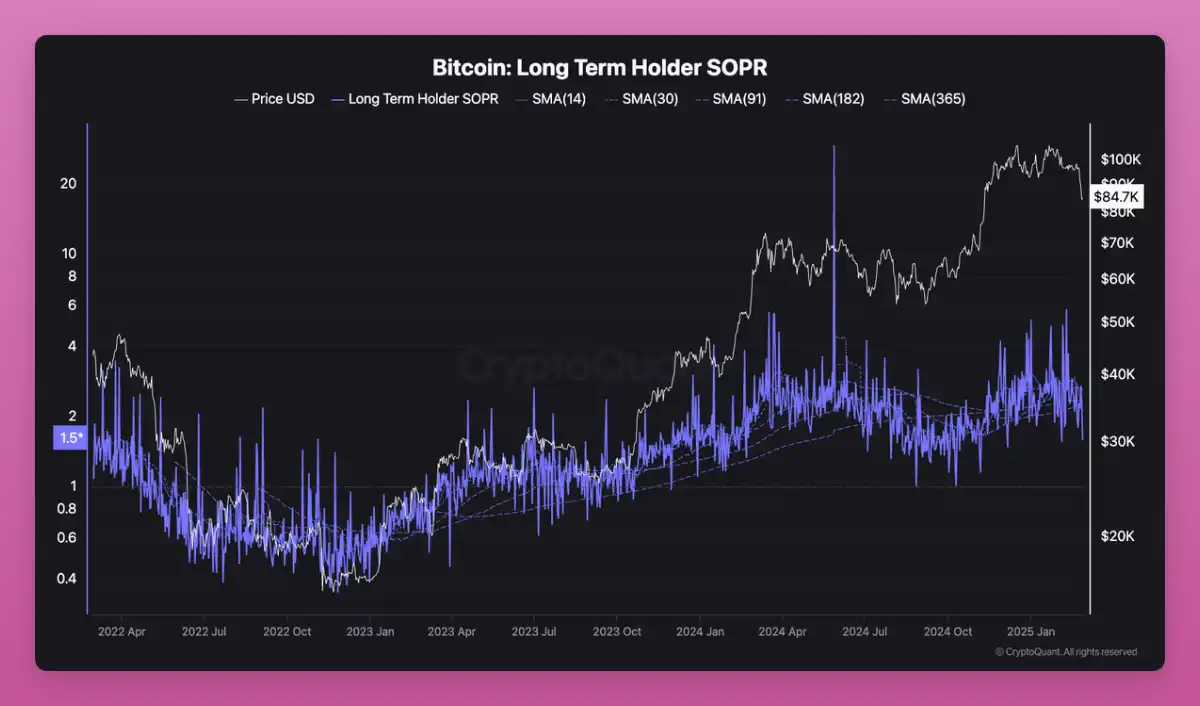
· The current value is 1.5, indicating that long-term holders are realizing profits, but the selling pressure is not aggressive.
· In a healthy uptrend, long-term holders consistently taking profits is a normal occurrence.
CryptoQuant P&L Index
This index combines MVRV, NUPL, and SOPR data to assess the overall market valuation.
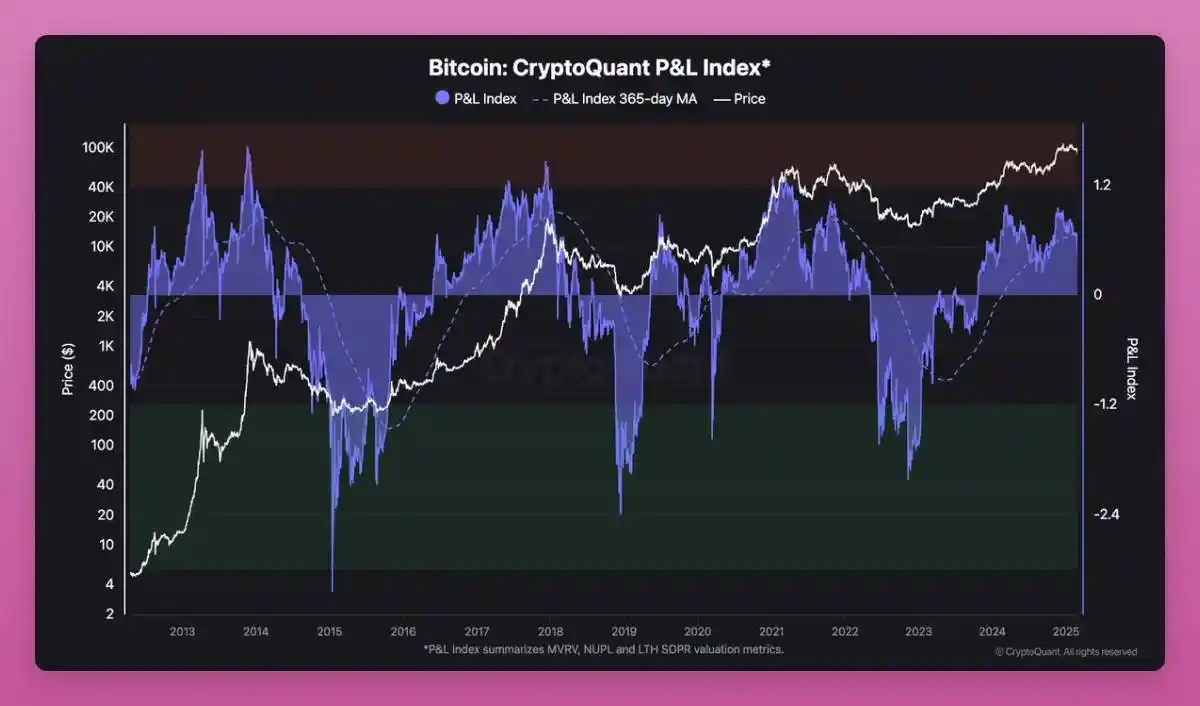
· Currently above its 365-day moving average, confirming the bull market is still ongoing.
· When the index exceeds 1.0, it may indicate the formation of a market cycle top.
CryptoQuant Bitcoin Bull/Bear Cycle Index
If you only pay attention to one Bitcoin indicator, I recommend this one. It is a momentum indicator based on the P&L index used to track Bitcoin's bull/bear cycles.
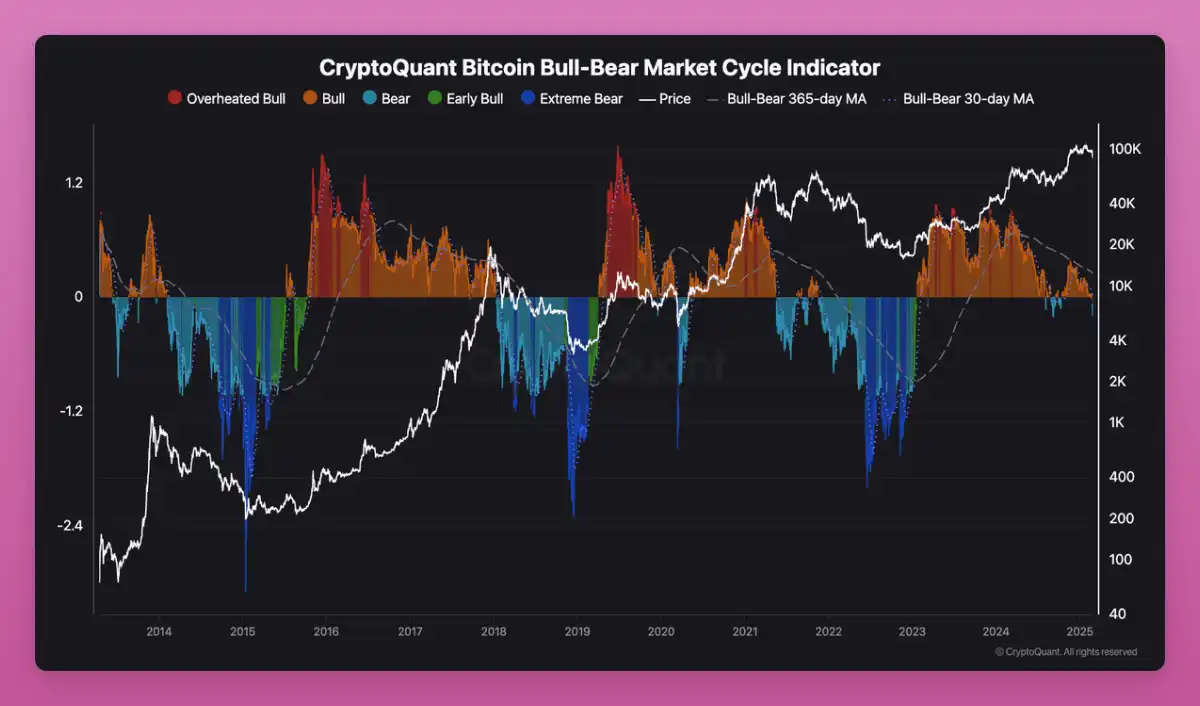
Bitcoin is currently firmly in the bull market zone (orange), indicating a strong upward market trend.
However, it has not yet entered the overheated bull market zone (red), which historically signals the top of the cycle.
Summary – What Will Happen Next?
· Bitcoin is currently in the mid-term stage of the bull market cycle.
· Holders are gradually taking profits, but the market has not shown extreme euphoria yet.
· There is still room for further upside potential before the price reaches overvaluation.
If history repeats itself, Bitcoin still has the potential to rise before reaching the key cycle top.
Interestingly, a chart shared by CZ on Twitter perfectly reflects my sentiment about the market's future direction:
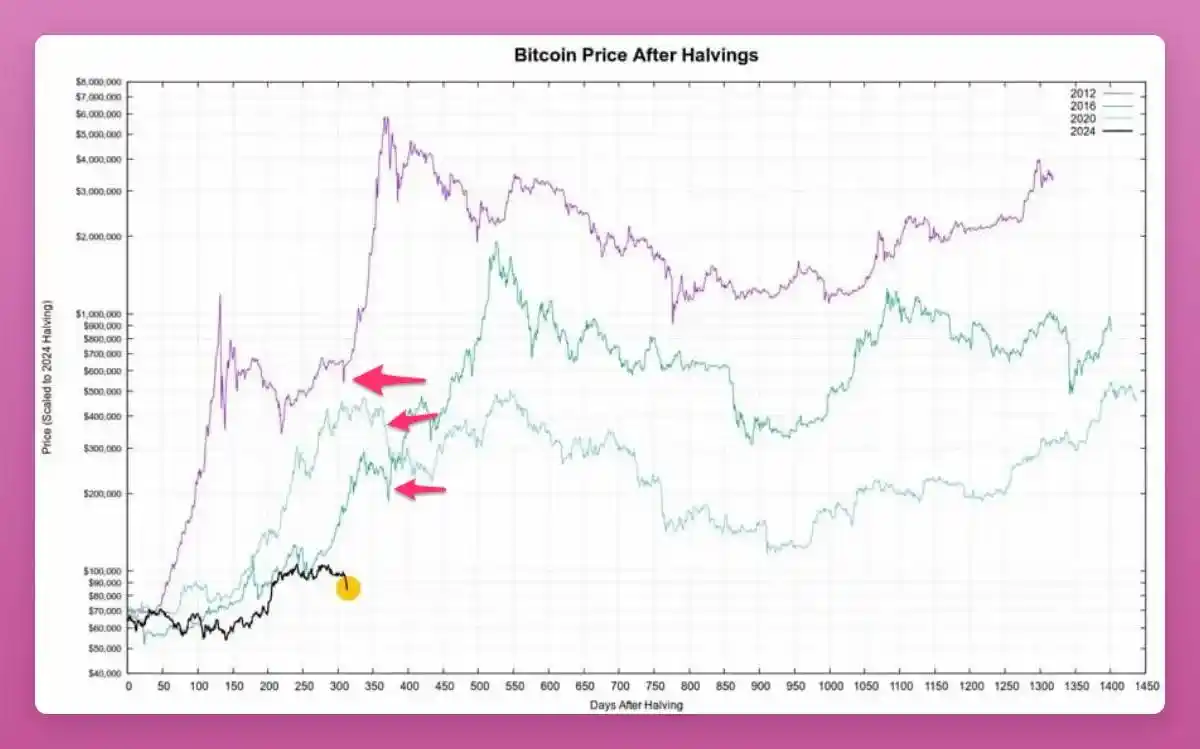
「I won't look at the chart, but...」—CZ said this on Twitter.
Currently, Bitcoin has confirmed its entry into a bull market, but it has not reached the euphoric levels seen at the top of past cycles. On-chain data indicates that the market still has room to rise, but some holders have started to take profits.
Ethereum's Current State: Cause for Concern
Over the past two years, ETH has seen a 70% price decline against BTC. Just since December 2024, it has already dropped by 48%!
Furthermore, there have been no positive signals from ETH ETF fund outflows.
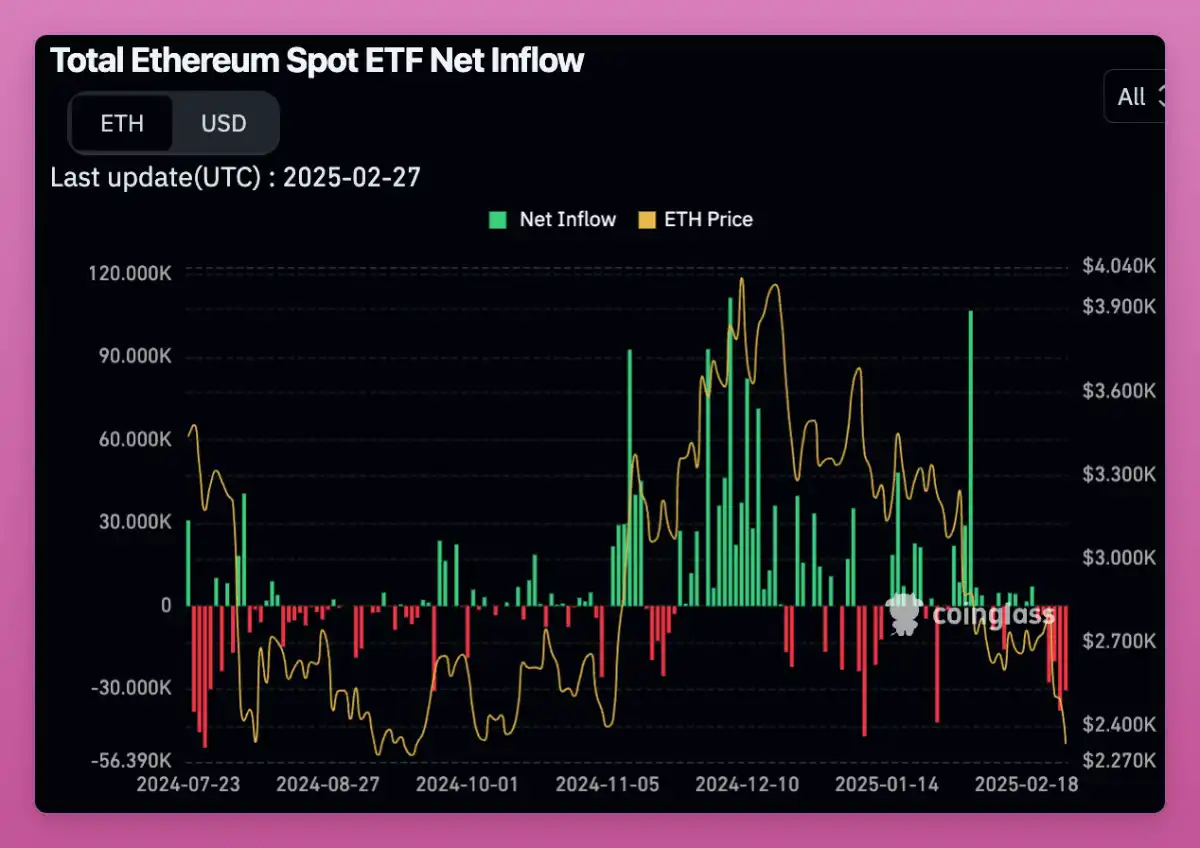
Is ETH Currently the Most Attractive Risk-Reward Opportunity?
I shared some viewpoints on Twitter, suggesting that catalysts for ETH are gradually building up:
· There has been a leadership change at the Ethereum Foundation (Aya stepping down, but the new executive director has not been announced yet).
· Initiatives to scale L1 have begun. Although currently only adjusting the Gas limit, the shift in mindset itself is significant.
· Pectra has introduced EIP-7702 (Simplified Approval Mechanism) and the EF's Open Intents Framework, both of which will significantly improve the user experience of L2.
· The community's interest in memecoins is gradually waning, with more people starting to focus on Ethereum's fundamentals.
· The buzz around MegaETH indicates: 1) People are still enthusiastic about innovative L2 solutions, 2) The success of L2 further validates the modularization concept.
· Base has announced a reduction in block time from 2 seconds to 200 milliseconds and the introduction of L3 (similar to MegaETH's concept). Although I am personally not a fan of Base.
· Ethereum remains the best public blockchain for asset tokenization, with even BlackRock endorsing it.
· ETH's price has been severely oversold, really low, haha.
The implementation of L1 scaling may take several years, and improving user experience will require support from multiple partners (e.g., Base has not yet joined the Open Intents Framework).

Ethereum's Future Outlook: Bullish or Bearish?
My major concern is that ETH may completely miss out on this bull run and only become a compelling buy opportunity during the next bear market.
However, market sentiment can change rapidly. If the Ethereum Foundation and the broader community can make substantial progress in the following areas:
1) L1 scaling,
2) Significant improvement in L2 modularized user experience,
3) The community overcoming the current "loser mentality,"
then ETH may see a strong rebound in the latter part of this cycle and take the lead.
However, as of now, SOL's market cap is only 3.8% of ETH's, it offers a better user experience, and over time, its Lindy Effect is strengthening (as long as the network remains stable).
These factors will pose a challenge to ETH's dominance in the smart contract arena.
Memecoin: Metrics to Watch
Robust Speculation Index can measure a memecoin's outperformance against Bitcoin across multiple timeframes.
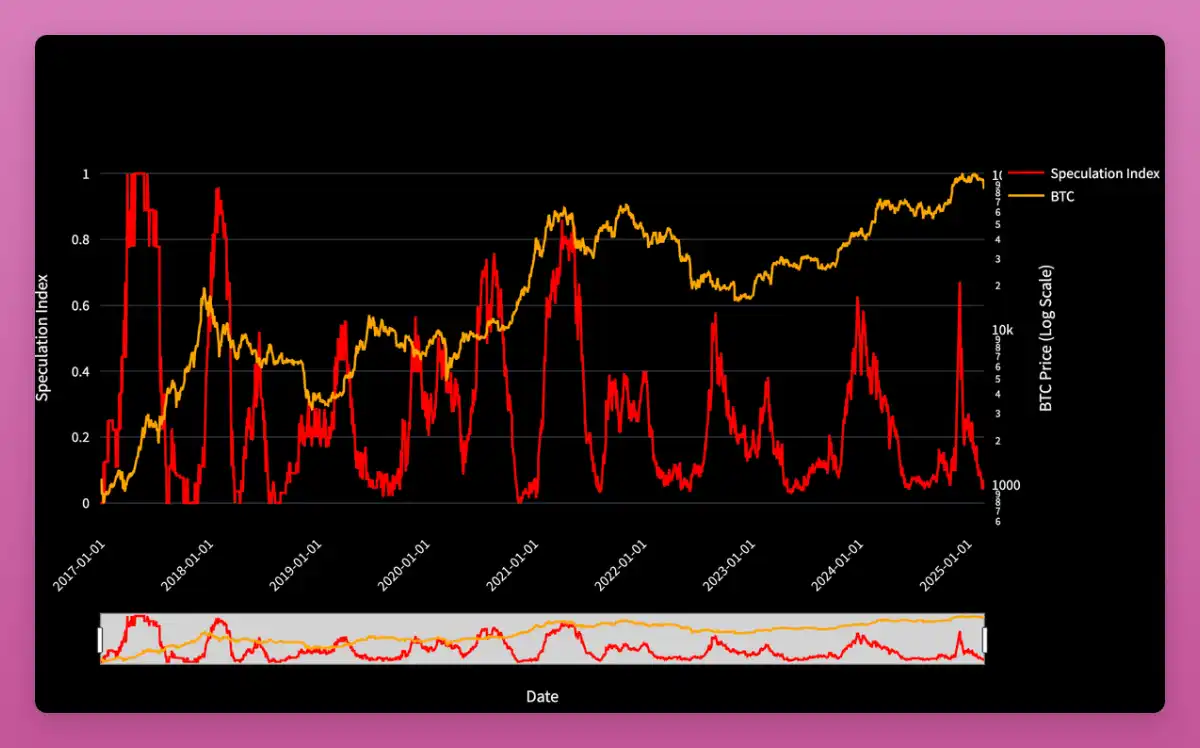
· The current metric is at a low level (around 0.0-0.2), indicating that Bitcoin is outperforming most altcoins.
· Historically, when speculative activity is at a low point, it usually sets the stage for an altcoin bounce.
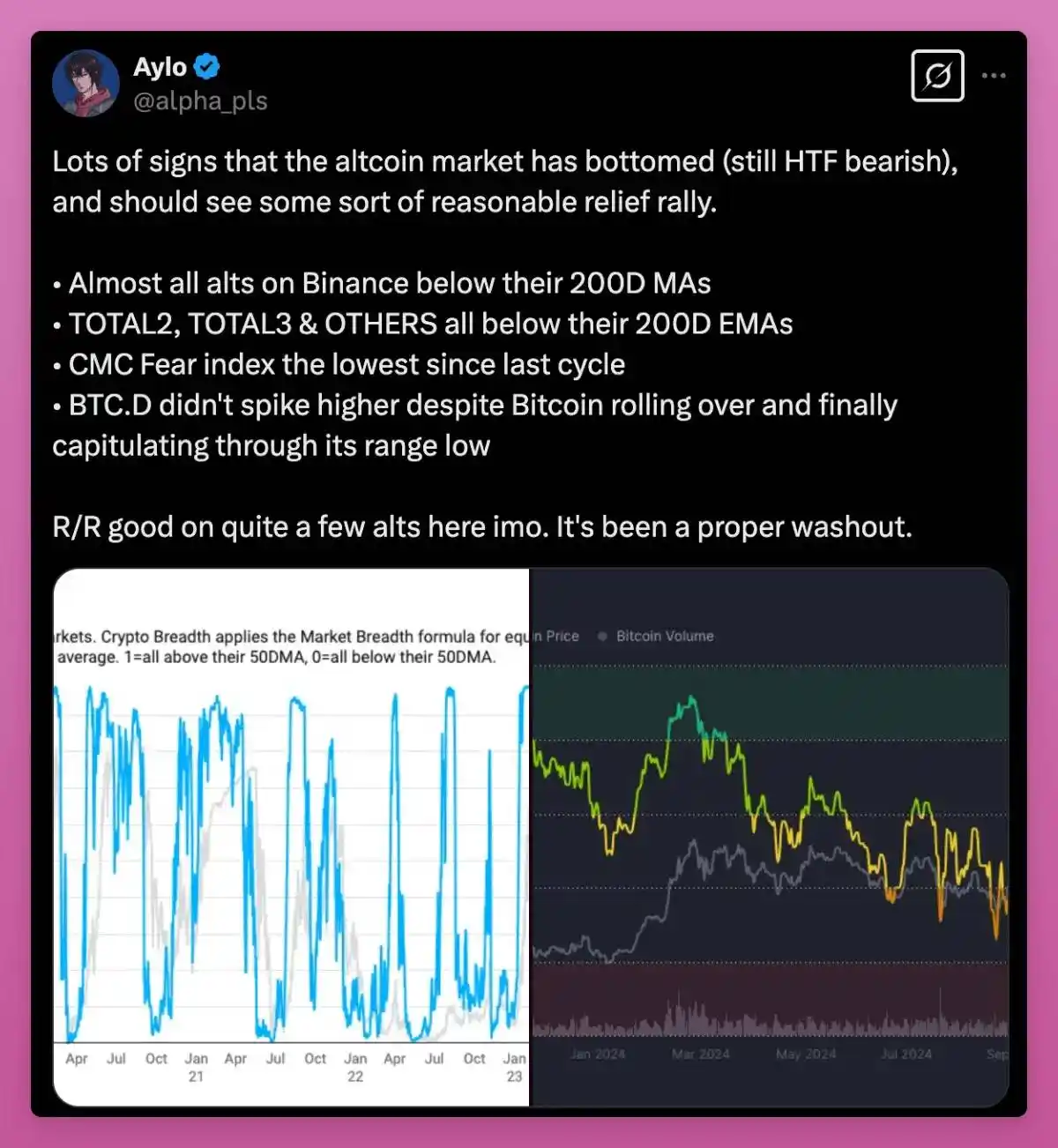
Aylo shared a similar Crypto Breadth chart on Twitter, suggesting that altcoins may have bottomed out. If Bitcoin's strength can persist, we may expect a rally in altcoins.
Question: Which Altcoins Should I Buy?
When selecting altcoins, I rely on the following criteria:
· No significant token unlock events in the short term.
· Product-Market Fit is good, meaning the product can meet market demand and gain user acceptance.
· Revenue-Sharing Mechanism (e.g., token buyback) is a significant bonus.
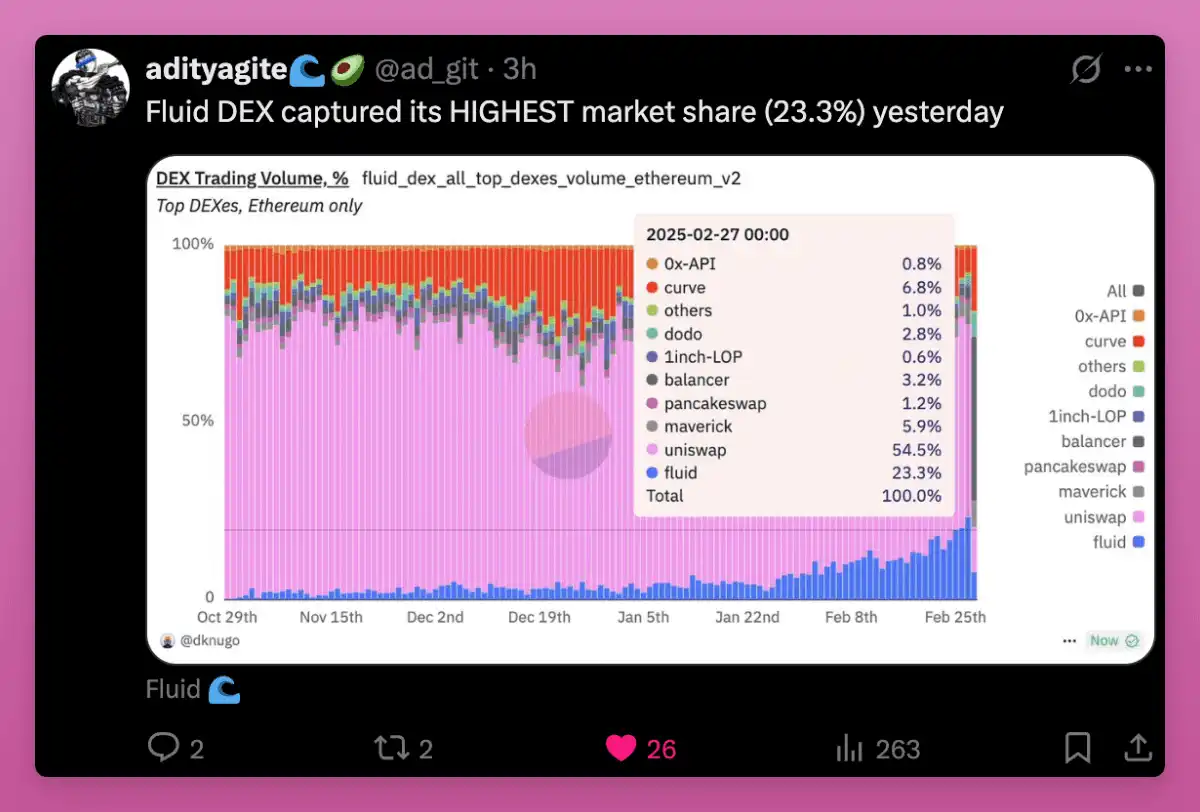
FLUID is a decentralized lending protocol that was launched just a few months ago, but it has already shown competitive trading volume on decentralized exchanges (DEXes) compared to Uniswap. Recently, FLUID announced an upcoming token buyback plan, which makes me confident about its future development.
Other Altcoins Worth Watching:
ENA: Successfully survived the Bybit hack and multiple rounds of liquidation waves. Recently completed a $100 million funding round at a price of $0.4. Additionally, more protocols and centralized exchanges (CEXes) are adopting sUSDe, which makes me very bullish on its potential. The issue is that a significant token unlock for ENA is imminent, which could put pressure on the price.
$SKY (formerly MKR): Taiki's analysis highlighted some key points:
· $30 million in token buybacks monthly (approximately 1.9% of the supply).
· USDS (formerly DAI) supply is nearing an all-time high.
· SPK Farming has increased token demand and a source of revenue.
· Stablecoin regulation may become a positive factor.
$KMNO: Dominating the lending market on the Solana chain, with a TVL (Total Value Locked) of up to $1.8 billion while having a market cap of only $85 million. This indicates that its valuation may be underestimated. The issue is that Solana chain users are more traders than yield farmers. However, this situation could change at any time.
Sonic's $S: Its DeFi ecosystem is rapidly expanding (including deployments on key protocols like Aave), in addition to a 200 million $S airdrop plan, a high-quality user experience, and growing attention on X. More importantly, there are no large-scale token unlock events, providing it with a more stable price foundation.
HYPE: There are many discussions on X about its excellent tokenomics and strong community, worth paying attention to.
PENDLE: As the market begins to focus on fundamentals and speculators look for yield, Pendle is a very promising choice.
AAVE: Undergoing a tokenomics adjustment, the 3.3 version upgrade has brought stronger income performance.
What else am I missing?
Additionally, I am very excited about the upcoming token airdrops for MegaETH, Monad, Farcaster, Eclipse, Initia, Linea, and Polymarket.
Macroeconomic Environment
I fully believe in Bitcoin's value as digital gold. Compared to gold, Bitcoin supports self-custody and has greater portability, making it more attractive.
The current macroeconomic environment provides an excellent testing ground for Bitcoin: tariff policies, wars, fiscal deficits, large-scale money printing... All of this presents a potential tailwind for Bitcoin.
In my 2025 blog post "The Truth and Lies of Cryptocurrency," I cited BlackRock's research: Bitcoin sometimes experiences sell-offs at the onset of major macro events. However, chaos and uncertainty, along with potential money printing, will ultimately provide strong support for Bitcoin.
Current Market Observation
I believe that the recent market volatility is a result of the sudden deviation from the established global order by Trump. This uncertainty has led to short-term panic in the market. However, people will gradually adapt to this new global reality.
Fundamentally, there has been no real change that undermines the basic principles of cryptocurrency. On the contrary, we see more and more positive news every day: the U.S. Securities and Exchange Commission (SEC) has dismissed some cryptocurrency lawsuits, introduced new cryptocurrency bills, and even the government's overall attitude towards cryptocurrency is gradually becoming more positive.
However, one point raised by Ansem is worth noting: when positive news fails to drive price increases, it is actually a bearish signal. This indicates that the market may need some time to digest and adjust to the current situation.
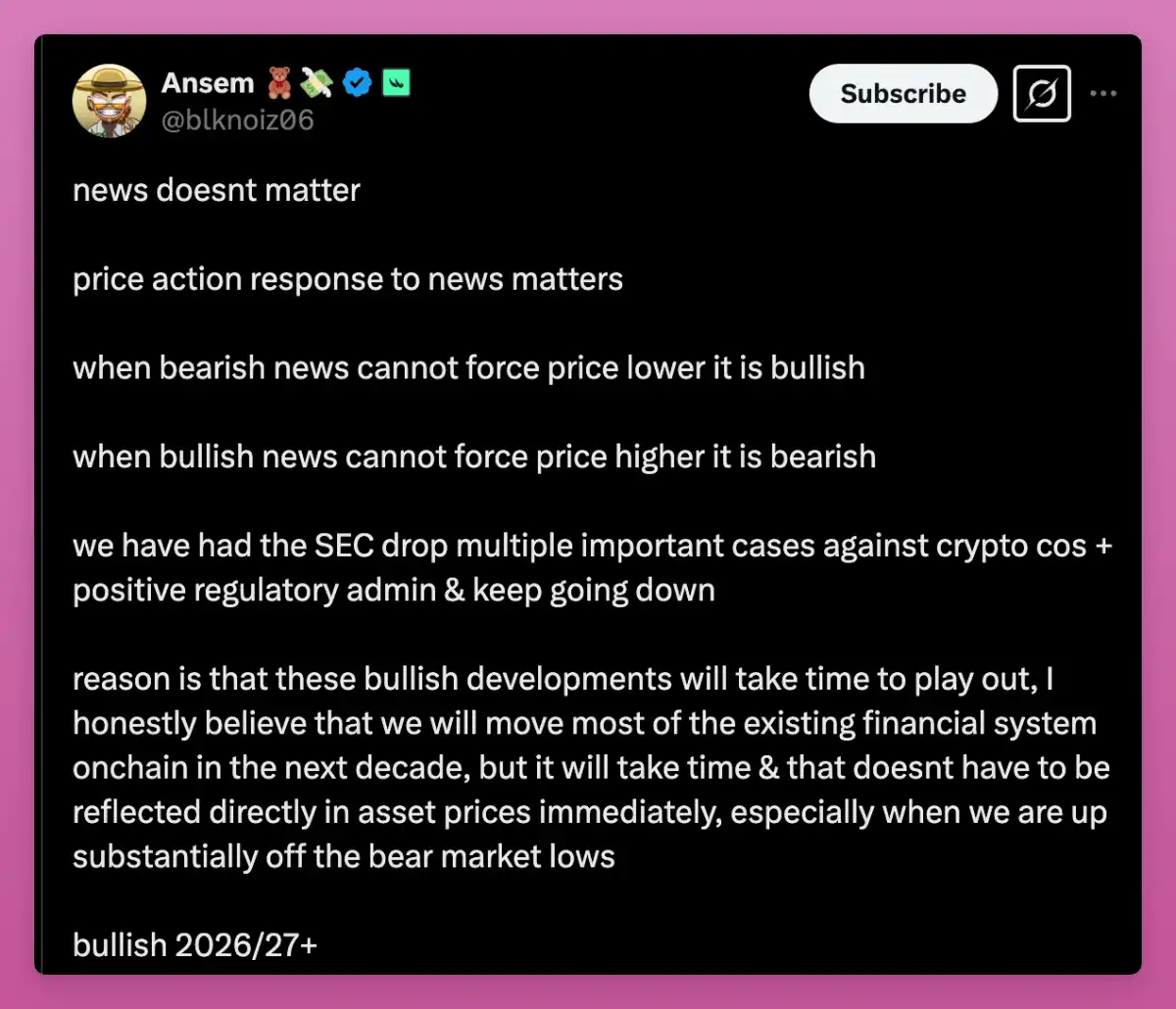
Nevertheless, I still hope that the market's adjustment speed will be faster than his optimistic predictions for 2026/27.
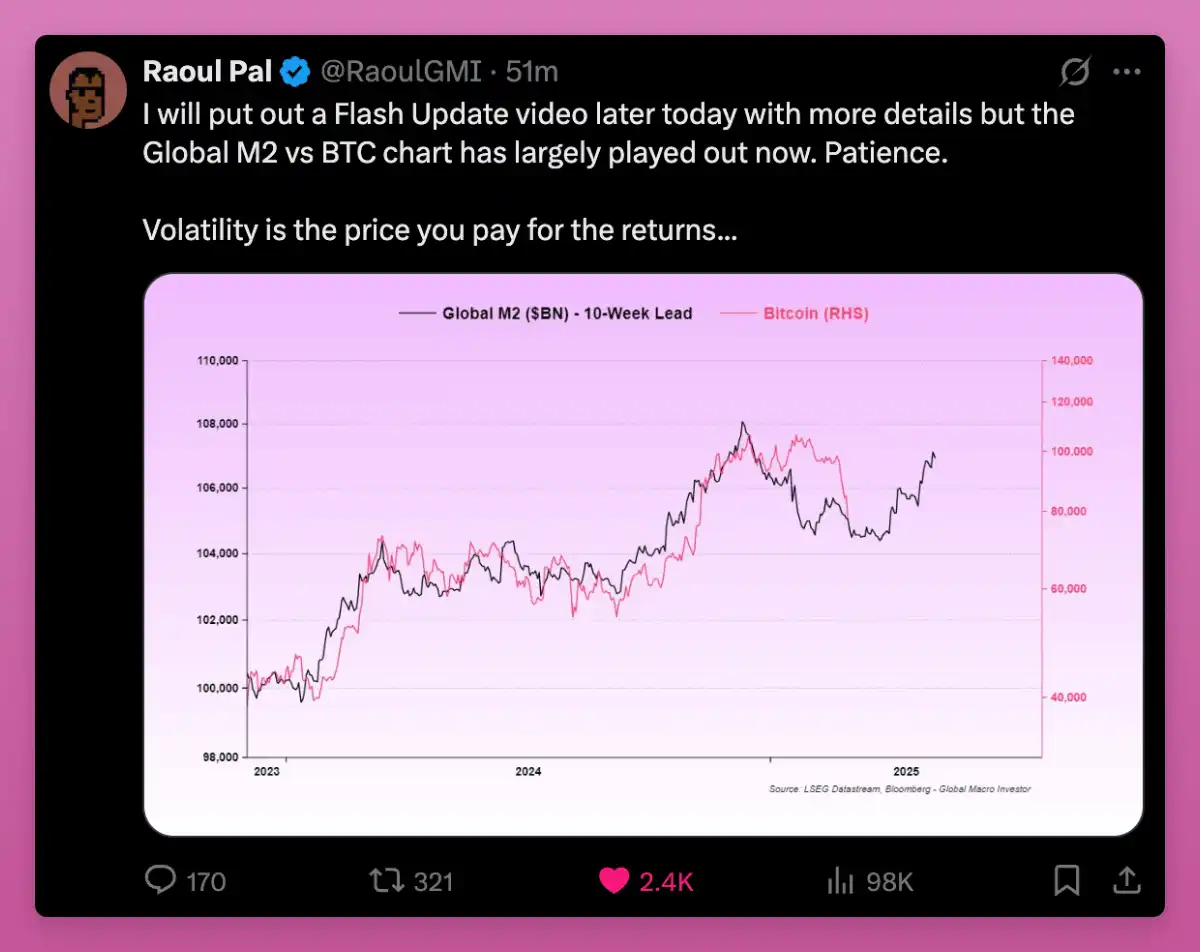
If Raoul Pal's analysis and charts are correct, Bitcoin's price should catch up with the global M2 money supply growth trend before 2026. M2 money supply is a key indicator of global currency circulation, and if Bitcoin can match it, it will further solidify its position as "digital gold."
Summary
In conclusion, I remain confident in the cryptocurrency market and believe that as long as we remain patient, we will eventually reap the rewards.
You may also like

Morning Report | BitMine increased its holdings by 126,971 ETH last week; trader Eugene announced his exit from the crypto market

Wang Chuan: How can one not feel anxious after the neighbor Old Wang made thirty times profit by investing in storage stocks? (Seven) - A quarter-century cycle

Cryptocurrency CEXs are flocking to sell US stocks, and traditional brokerages are facing an "uninvited guest."

$75 billion in foreign capital has fled, and South Korean retail investors have absorbed it all using leverage

Japan’s Three Megabanks Plan Joint Stablecoin Issuance in Fiscal 2026
MUFG, SMBC, and Mizuho reportedly plan to jointly issue fiat-pegged stablecoins in fiscal 2026, signaling Japan’s growing push into bank-led digital payment infrastructure.

Humanity Discloses H Token Dual-Chain Attack Details, With Losses on Ethereum and BSC Exceeding $36 Million
Humanity said the H token attack across Ethereum and BSC caused more than $36 million in losses after leaked ProxyAdmin keys enabled malicious contract upgrades and token minting.
White House Discusses CLARITY Act With Law Enforcement Ahead of Senate Vote
The White House discussed the CLARITY Act with law enforcement ahead of a Senate vote, focusing on illicit finance risks and developer protections.

Bitcoin Trading Guide 2026: Strategies for Experienced Traders

What Is XAUT and PAXG? Why Tokenized Gold Is Booming in 2026

Will the SpaceX IPO Hurt Bitcoin? Here's What Traders Are Watching

Foreign selling in the South Korean stock market accelerates, with cumulative net sales reportedly reaching $75 billion this year
On June 9, The Kobeissi Letter, citing Goldman Sachs data, reported that global investors are selling South Korean stocks at an unusually rapid pace. In the latest trading session, foreign investors sold about $801 million worth of Kospi constituent stocks again; total foreign outflows last week reached about $10 billion, and the market has been in net foreign selling on nearly every trading day over the past month. According to the data cited in the report, foreign investors have sold about $75 billion worth of South Korean stocks so far this year. Meanwhile, South Korean retail and institutional investors together recorded roughly $69 billion in net buying over the same period, suggesting that the market’s main buying support has come from domestic capital rather than returning overseas funds. The information currently disclosed still mainly comes from The Kobeissi Letter’s retelling and Goldman Sachs data summaries, while public details on the statistical period and the specific definition of “selling” remain relatively limited.

Fortune Warns of Strategy’s Financing Structure Risks as Bitcoin Premium Narrows
Fortune warned that Strategy’s Bitcoin treasury model faces growing financing risks as MSTR’s net asset premium narrows and preferred stock dividend pressure increases.

Ferrari Challenge Le Mans: Carl Moon to Dominate in WEEX Livery

Sahara AI Responds to SAHARA’s Sharp Drop: No Contract or Product Security Issues Found, Internal Investigation Underway
Sahara AI responded to SAHARA’s 60% price drop, saying no token contract or product security issues have been found and an internal investigation is underway.

WEEX Deposit/Withdrawal Dynamic Island: Your Asset Status, Always in Sight
Scaling Crypto Derivatives: The Digital Asset Infrastructure Behind High-Volume Trading
In the fast-moving digital asset ecosystem, derivatives platforms face an extreme architectural test. High-leverage futures markets demand more than just standard security—they require absolute operational precision, zero-latency matching engines, and ironclad structural scalability, all while navigating intense market volatility.
As global platforms scale to meet these demands, the industry is shifting away from rigid, monolithic setups toward a more agile, "decoupled" infrastructure philosophy.
The Blueprint for High-Volume Copy TradingFor elite global exchanges like WEEX (founded in 2018), this architectural choice becomes critical when scaling high-volume retail features like social copy trading. When thousands of users automatically mirror the real-time strategies of elite traders simultaneously, it triggers sudden, monumental spikes in concurrent transactional volume.
To prevent execution latency or settlement bottlenecks during these peak volatility events, a platform's primary engine must remain entirely dedicated to risk management, copy-trade synchronization, and order matching.
The Architectural Rule: New-generation platforms must separate front-end user execution engines from heavy backend infrastructural overhead to eliminate operational friction.
By separating these layers, platforms can maintain complete sovereignty over their trading environments and user experiences while strategically aligning with institutional-grade infrastructure ecosystems. This strategic framework allows modern exchanges to leverage advanced Digital Asset Custody infrastructure such as Cobo’s behind the scenes, ensuring that backend wallet management scales elastically alongside trading spikes.
Capitalizing on Market Momentum and 400× LeverageIn a derivatives arena where platforms offer up to 400× leverage on perpetual contracts, capital efficiency and market agility are core business metrics. To capture market momentum, an exchange needs the ability to rapidly expand its asset offerings, supporting everything from legacy crypto assets to sudden, trending altcoins across a massive library of trading pairs.
Adopting a flexible, scalable Wallet-as-a-Service (WaaS) solution such as Cobo’s could completely rewrite the development timeline for high-growth exchanges. Instead of spending months of engineering capital building out custom backend wallet architectures for every new blockchain network, platforms can deploy localized infrastructure in days.
This agility allows platforms to instantly scale their listings to over a thousand trading pairs without compromising security or delaying time-to-market. It mirrors the exact operational advantages seen during high-velocity market events, similar to how advanced wallet infrastructure empowers platforms during sudden asset surges; allowing exchanges to pass that speed and liquidity directly to their global user base.
A Mature Foundation for GrowthThe synergy between trusted infrastructure ecosystems and global trading platforms represents the natural evolution of a maturing crypto market. As WEEX continues to scale its global spot and derivatives offerings for over 6 million users, adopting robust backend paradigms proves that platforms no longer have to compromise between cutting-edge trading velocity and uncompromised structural security.

Get Paid to Onboard? Try WEEX’s New Homepage with Rewards for Registration, Deposit & Trade
WEEX Custom Layout: Build Your Perfect Trading Workspace in Seconds
Morning Report | BitMine increased its holdings by 126,971 ETH last week; trader Eugene announced his exit from the crypto market
Wang Chuan: How can one not feel anxious after the neighbor Old Wang made thirty times profit by investing in storage stocks? (Seven) - A quarter-century cycle
Cryptocurrency CEXs are flocking to sell US stocks, and traditional brokerages are facing an "uninvited guest."
$75 billion in foreign capital has fled, and South Korean retail investors have absorbed it all using leverage
Japan’s Three Megabanks Plan Joint Stablecoin Issuance in Fiscal 2026
MUFG, SMBC, and Mizuho reportedly plan to jointly issue fiat-pegged stablecoins in fiscal 2026, signaling Japan’s growing push into bank-led digital payment infrastructure.
Humanity Discloses H Token Dual-Chain Attack Details, With Losses on Ethereum and BSC Exceeding $36 Million
Humanity said the H token attack across Ethereum and BSC caused more than $36 million in losses after leaked ProxyAdmin keys enabled malicious contract upgrades and token minting.


