
Arthur Hayes: BTC Could Fall to $70,000 at Worst, But Bull Market Cycle Still Intact

Original Title: KISS of Death
Original Author: Arthur Hayes
Original Translation: Bitpush News
(The views expressed in this article are those of the author and should not be taken as investment advice, nor interpreted as recommendations or opinions to engage in investment transactions.)

Keep—It—Simple—Stupid = KISS
Many readers, when dealing with the deluge of policies from the US President Donald Trump's administration, often forget the KISS principle.
Trump's media strategy goal is to have you wake up every day and say to your friends, partner, or to yourself, "My goodness, did you see what Trump/Musk/Little Kennedy did yesterday, I can't believe they actually did that." Whether you are in high spirits or feeling down, this farce called "The Emperor's Day" is quite entertaining.
For investors, this ongoing state of excitement is not conducive to stacking sats. You may buy in today, only to quickly sell out after digesting the next headline news. The market oscillates throughout this process, rapidly depleting your Bitcoin reserves.
Remember the KISS principle.
Who is Trump? Trump is a real estate showman. To succeed in real estate, you must master the art of borrowing large sums of money at the lowest possible interest rates. Then, to sell condo units or rent out space, you must boast about how impressive the new building or development project is. I am not interested in Trump's ability to evoke sympathy in global society, but I am interested in his ability to finance policy objectives.
I am convinced Trump wants to achieve his "America First" policy through debt financing. If not, he would allow the market to naturally clear the credit embedded in the system, ushering in an even more severe economic depression than that of the 1930s. Is Trump seeking to be called the Herbert Hoover of the 21st century or the Franklin Delano Roosevelt (FDR)? American history belittles Hoover because historians believe he did not print money fast enough and praises FDR because his New Deal policies were paid for with printed money. I believe Trump wants to be considered the greatest president in history, so he does not want to destroy the empire's foundation through a contractionary policy.
To emphasize this point, remember that Andrew Mellon, the U.S. Secretary of the Treasury under Hoover, once said the following when discussing how to address the over-leveraging of the U.S. and global economy after a stock market crash:
“Liquidate labor, liquidate stocks, liquidate farmers, liquidate real estate. It will purge the rottenness out of the system. High costs of living and high living will come down. People will work harder, live a more moral life. Values will be adjusted, and enterprising people will pick up the wrecks from less competent people.”
Current U.S. Treasury Secretary Scott Bessent is unlikely to make such bold statements.
If my view is correct that Trump will pursue “America First” through debt financing, how does this affect my outlook on future global risk asset markets, especially cryptocurrency?
To answer this question, I must form an opinion on how Trump may increase the money/credit supply (i.e., printing money) and lower its price (i.e., interest rates). Therefore, I must have a view on how the relationship between the U.S. Treasury led by Scott Bessent and the Federal Reserve led by Jerome Powell may evolve.
KISS Principle

Who do Bessent and Powell serve? Are they the same person?
Bessent was appointed by Trump 2.0, and from his past and present interviews, he seems to align closely with this “emperor’s” worldview.
Powell was appointed by Trump 1.0 but has been a fickle turncoat, switching sides to the Obama and Clinton camps. When Powell aggressively cut rates by 0.5% in September 2024, destroying what little credibility he had left, the U.S. economy was growing above trend and inflationary pressures were present, making a rate cut unnecessary. However, the Obama-Clinton puppet Kamala Harris needed a boost, and Powell dutifully cut rates. The outcome did not pan out as expected, but after Trump's reelection, Powell announced he would fulfill his term and once again staunchly fight inflation.
When you carry a large debt burden, several things happen.
First, interest payments consume most of your free cash flow. Second, you cannot secure additional asset financing because no one will lend to you given the high debt levels. Therefore, you must restructure your debt, extending maturities and lowering coupon rates. This is a form of soft default as it mathematically reduces the present value burden of the debt. Once your effective debt burden is reduced, you can again borrow at an affordable price. Viewing the issue from these angles, both the Treasury and the Fed play a role in restoring American financial health. However, due to Bessent and Powell serving different masters, the success of this effort has been hindered.
Debt Restructuring
Bessent publicly stated that the current debt structure in the United States needs to change. He hopes to eventually extend the average term of the debt burden, known on Wall Street as "debt maturity extension." Various macroeconomic experts have proposed suggestions on how to achieve this goal; I discussed such solutions in detail in The Genie article. However, for investors, the most important thing is that the United States will soft default on its debt burden by reducing the net present value.
Given the global distribution of U.S. debt holders, achieving this kind of restructuring will take time. This is a geopolitical "Gordian Knot." Therefore, in the short term, within the next three to six months, this is unrelated to our cryptocurrency inventors.
New Loans
Powell and the Federal Reserve have broad control over the quantity and pricing of credit. The law allows the Fed to print money to purchase debt securities, thereby increasing the money/credit supply, i.e., printing money. The Fed also sets short-term rates. Since the U.S. cannot default on the nominal dollar, the Fed determines the risk-free rate of the dollar, i.e., the Effective Federal Funds Rate (EFFR).
The Fed has four main levers to manipulate the short-term rate: Reverse Repurchase Agreements (RRP), Interest on Reserve Balances (IORB), the Federal Funds Rate floor, and the Federal Funds Rate ceiling. Without delving into the intricate details of the money market, all we need to understand is that the Fed can unilaterally increase the quantity of dollars and lower their price.
If Bessent and Powell were serving the same Leader, then analyzing the future path of dollar liquidity and the reactions of China, Japan, and the EU to U.S. monetary policy would be very easy. As they are clearly not serving the same person, I wonder how Trump can allow Powell to stick to the Fed's task of fighting inflation while still manipulating Powell to print money and lower rates.
Economic Collapse
Fed - Recession Law: If the U.S. economy enters a recession, or if the Fed fears the U.S. economy will enter a recession, it will cut rates and/or print money.
Let's test this law with recent economic history (thanks to the excellent table provided by Bianco Research).
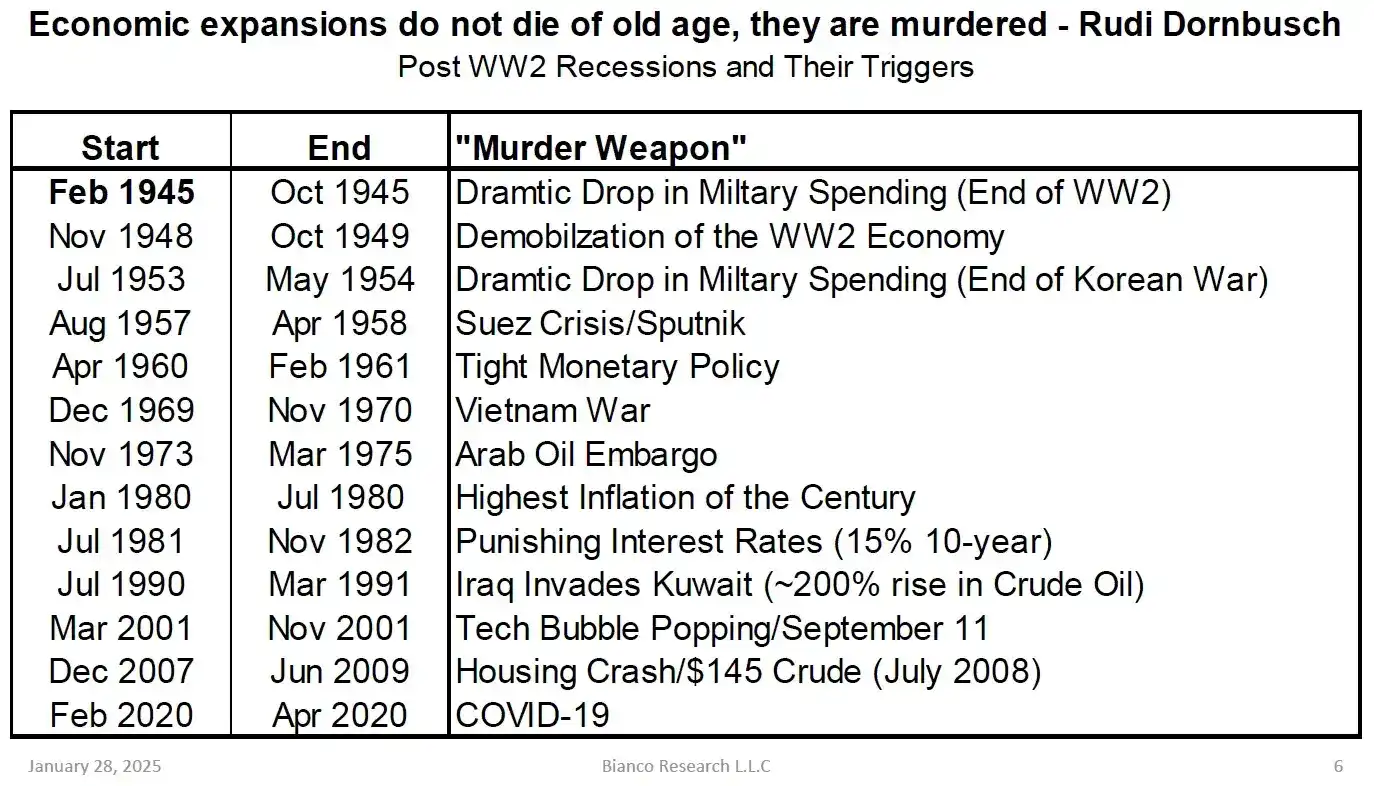
This is a direct cause list of modern U.S. economic recessions post-World War II. A recession is defined as a negative quarterly GDP growth rate. I will focus on the 1980s to the present.
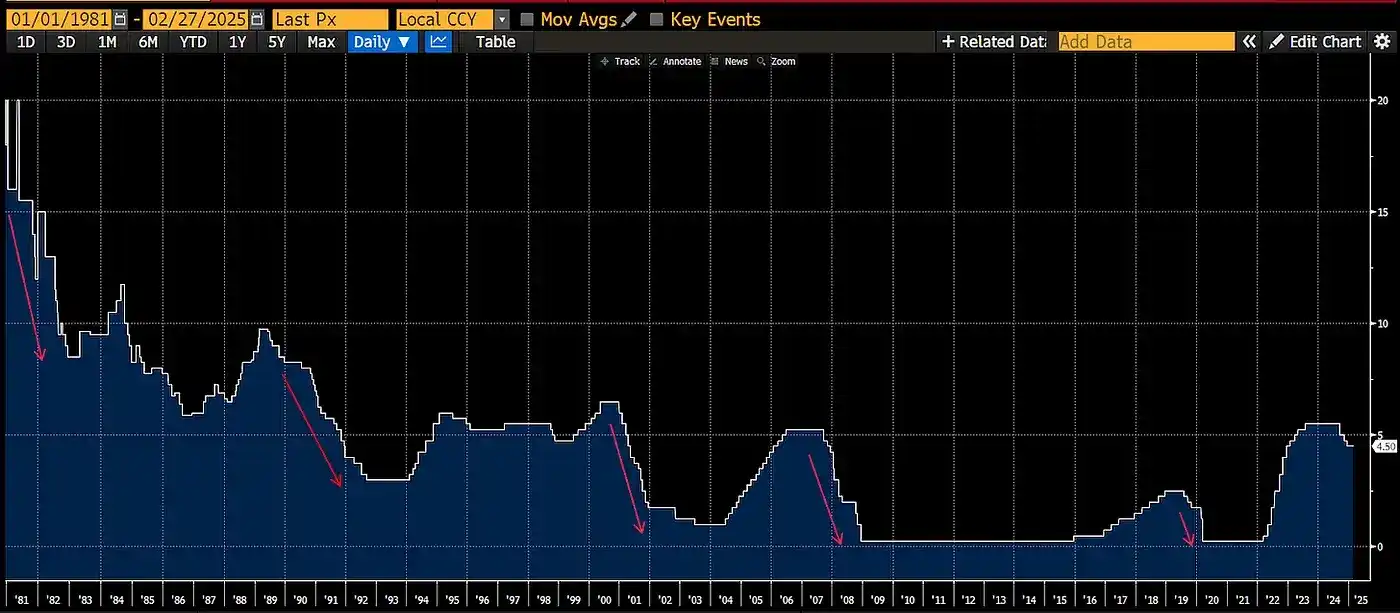
This is a chart of the Federal Funds Rate Lower Bound. Each red arrow represents the beginning of an easing cycle coinciding with a recession. As you can see, it is very clear that the Federal Reserve will at least cut rates during a recession.
Fundamentally, "Pax Americana" and its dominance of the global economy are built on debt financing. Large corporations fund future production expansion and current operations by issuing bonds. If cash flow growth significantly slows down or declines entirely, the repayment of debt eventually comes into question. This is problematic because a significant portion of a company's debt is essentially an asset to banks. The corporate debt assets held by banks support their customer deposit liabilities. In essence, if debt cannot be repaid, it calls into question the "value" of all existing legal credit banknotes.
Furthermore, in the United States, most households are leveraged. Their consumption patterns are marginally financed with mortgage loans, car loans, and personal loans. If their cash flow generation capability slows down or diminishes, they will be unable to meet their debt obligations. Similarly, the banking system holds this debt and supports it with their deposit liabilities.
It is crucial that the Federal Reserve does not allow a significant rise in default probabilities for corporate and/or household debt during an economic recession or before cash flow generation slows down or contracts. This could lead to corporate and consumer debt defaults, resulting in systemic financial distress. To safeguard the solvency of a debt-financed economic system, whenever a recession occurs or people's perception of recession risk intensifies, the Federal Reserve will proactively or reactively cut rates and print money.
KISS Principle
Trump manipulates Powell to ease the financial environment by triggering a recession or making the market believe that a recession is imminent.
To avoid a financial crisis, Powell will subsequently take the following partial or full measures: rate cuts, ending quantitative tightening (QT), restarting quantitative easing (QE), and/or suspending the Supplementary Leverage Ratio (SLR) for banks buying U.S. Treasuries.
Insert a chart from DOGE here:

How Can Trump Unilaterally Trigger a Recession?
The marginal driver of U.S. economic growth has always been the government itself. Whether the spending is fraudulent or necessary, government expenditures create economic activity. Additionally, government spending has a money multiplier effect. That's why the Washington D.C. metropolitan area is one of the wealthiest regions in America because there are plenty of professional parasites feeding off the government. It's challenging to estimate the exact money multiplier directly, but in concept, it's easy to understand the delayed effects of government spending.
According to Perplexity's data:
● The median household income in Washington D.C. is $122,246, much higher than the national median household income.
● This places Washington D.C. at the 96th percentile in U.S. cities by median household income.
As a former president, Trump is well aware of the extent of fraud, waste, and abuse within the government. The establishment of both parties does not want to curb this situation as everyone benefits from it. Considering Trump supporters are outside of the Democrats and Republicans, they unreservedly expose the flaws in government spending plans. Establishing an advisory council led by Elon Musk and backed by Trump, named the Department of Government Efficiency (DOGE), is a key driver in significantly reducing government spending.
When many of the largest expenditure items are non-discretionary spending, how does DOGE achieve this? If payments are fraudulent, they can be stopped. If computers can replace government employees managing these projects, the human resource costs will plummet. The question then becomes, how much fraud and inefficiency is there in government spending each year? If DOGE and Trump are to be believed, the annual amount would reach trillions of dollars.
One potentially very visible example is the Social Security Administration (SSA) and who they send checks to. If we believe DOGE's claims, the department is issuing trillions of dollars to deceased individuals and persons whose identities have not been properly verified. I do not know the veracity of these claims. But imagine you are an SSA welfare fraudster and know that Elon and the "big shots" are deeply analyzing the data, potentially uncovering the fraudulent payments you have received over the years and submitting them to the Department of Justice. Would you continue your scheme or flee? The key is that the mere threat of discovery could lead to a reduction in fraudulent activities. As the old Chinese saying goes, kill the chicken to scare the monkey. Therefore, even though the establishment media is trying to hoodwink Elon and DOGE, I believe that even if it's not trillions of dollars, it's likely hundreds of billions of dollars.
Next, let's discuss the human resources aspect of the government spending equation. Trump and DOGE are in the process of laying off hundreds of thousands of government employees. Whether unions have enough power to legally challenge the mass removal of "non-essential" government workers remains to be seen. But the consequences are already apparent.
DeAntonio explains, "So far, the workforce reductions we've seen may only be the tip of the iceberg. The scale and timing of future layoffs will determine whether the labor market can remain stable. We currently anticipate that due to ongoing hiring freezes, delayed retirements, and layoffs initiated by DOGE, the number of federal government employees is expected to decrease by approximately 400,000 by 2025."
– Fox Business
Even though the Trump 2.0 presidential term has just begun a little over a month ago, the impact of DOGE is already evident. Unemployment claims in the Washington D.C. area have surged. Housing prices have plummeted. And consumer discretionary spending, arguably driven by widespread government fraud and malfeasance, has also left financial analysts disappointed. The market is starting to talk about the "R" word — recession.
A new analysis by real estate transaction platform Parcl Labs shows that since the beginning of this year, housing prices in the Washington D.C. area have dropped by 11%, with the analysis tracking the effects of the Department of Government Efficiency (DOGE) on the city's real estate market.
– Newsweek
Rothstein posted on Bluesky stating that due to massive government layoffs and abrupt cancellation of federal contracts, the U.S. is almost certain to head towards a severe economic recession.
– The Economic Times
The "R" word is an economic disgrace. Powell does not want to be a modern-day Hester Prynne (subjected to public shame and condemnation), thus, he must respond.
Powell's Pivot Again
How many times has Powell pivoted since 2018? He must be feeling quite dizzy by now. The question for investors is whether Powell will act preemptively to save the financial system from collapse or only react after a major financial institution has gone bankrupt. Powell's chosen path is purely political. Therefore, I cannot predict.
But what I do know is that this year, $2.08 trillion of U.S. corporate debt and $10 trillion of U.S. national debt need to be rolled over. If the U.S. is on the brink of or in a recession, the cash flow shock would make it nearly impossible to roll over these massive bonds at current interest rates. Therefore, to uphold the sanctity of the "American peace" financial system, the Fed must and will act.
For us cryptocurrency investors, the question is how fast and at what scale will the U.S. unleash credit? Let's break down the four key measures the Fed will take to turn the tide.
Rate Cut
It is estimated that for every 0.25% reduction in the federal funds rate, it is equivalent to $100 billion in quantitative easing or money printing. Assuming the Fed lowers the rate from 4.25% to 0%.
This is equivalent to $1.7 trillion of quantitative easing. Powell may not lower the rate to 0%, but you can be sure Trump will allow Elon to continue cutting expenses until Powell lowers the rate to the desired level. Once the acceptable rate level is reached, Trump will control his "mad dog."
Stop Quantitative Tightening (QT)
The recently released Fed minutes from the January 2025 meeting detail that some committee members believe quantitative tightening must end at some point in 2025. Quantitative tightening is the Fed's process of reducing the size of its balance sheet, thereby reducing the amount of US dollar credit. The Fed is conducting $600 billion of quantitative tightening each month. Assuming the Fed takes action in April, this means that relative to previous expectations, stopping quantitative tightening will inject $540 billion of liquidity into 2025.
Restart Quantitative Easing (QE) / Supplementary Leverage Ratio (SLR) Exemption
To absorb the supply of US Treasuries, the Fed can restart quantitative easing and grant banks a supplementary leverage ratio exemption. Through quantitative easing, the Fed can print money and purchase Treasuries, thereby increasing the credit quantity. The supplementary leverage ratio exemption allows US commercial banks to use unlimited leverage to purchase Treasuries, thereby increasing the credit quantity. The key is that both the Fed and the commercial banking system are allowed to create money out of thin air. Restarting quantitative easing and granting a supplementary leverage ratio exemption are decisions that only the Fed can make.
If the federal deficit stays in the range of $1 trillion to $2 trillion per year, and the Fed or banks absorb half of the new issuance, this means the annual money supply will increase by $500 billion to $1 trillion. A 50% participation rate is conservative, as during COVID-19, the Fed bought 40% of the new issuance. Nevertheless, in 2025, a major exporting country (China) or an oil-producing country (Saudi Arabia) has ceased or significantly slowed down their behavior of using dollar surpluses to buy Treasuries; therefore, the Fed and banks have more maneuvering room.
Let's do the math:
Rate Cut: $1.7 trillion + Stop Quantitative Tightening: $0.54 trillion + Restart Quantitative Easing/SLR Exemption: $500 billion to $1 trillion = Total = $2.74 trillion to $3.24 trillion
COVID-19 vs. DOGE Money Printing
In the United States alone, the Fed and the Treasury created approximately $4 trillion in credit from 2020 to 2022 to address the Covid-19 pandemic.
The DOGE-inspired money printing scale could reach 70% to 80% of the level seen during the COVID-19 pandemic.
With the U.S. alone printing $4 trillion, Bitcoin surged approximately 24x from its 2020 low to 2021 high. Considering Bitcoin's market cap is much larger now than it was then, let's conservatively call a 10x surge in the U.S. alone printing $3.24 trillion as an increase. That's the answer for those wondering how Bitcoin could reach $1 million during President Trump's term.
Several Key Assumptions
Even amidst the current market turmoil, I have painted a very optimistic future outlook for Bitcoin. Let's look at my assumptions so readers can judge for themselves whether these assumptions are reasonable.
Trump will achieve "America First" through debt financing.
Trump is using DOGE as a means to clear out politically addicted to fraudulent income sources, reduce government spending, and increase U.S. government spending to slow down the possibility of a recession.
The Fed will take a series of actions before or after a recession, increasing the money supply and lowering the price of money.
It's up to your worldview to decide whether this is reasonable.
U.S. Strategic Reserve
Waking up on Monday morning, I saw the Trump rally kick off. On Truth Social, Trump reiterated that the U.S. will establish a strategic reserve filled with Bitcoin and a bunch of junk coins. The market surged due to the "news." This is nothing new, but the market will view Trump's reiteration of his cryptocurrency policy intentions as an excuse for a violent dead cat bounce.
If this reserve is to have a positive impact on prices, the U.S. government needs the ability to physically buy these cryptocurrencies. There is no secret stash of dollars waiting to be deployed. Trump needs the help of Republican lawmakers to raise the debt ceiling and/or revalue gold to match current market prices. These are the only two ways to fund a strategic cryptocurrency reserve. I'm not saying Trump won't keep his promise, but the timeframe for when purchases might start could be longer than how long traders can hold on before getting liquidated. Therefore, sell on rallies.
Trading Strategy
Bitcoin and the broader cryptocurrency market are the only truly global free markets in existence. Bitcoin's price in real-time tells the world how global society views the current state of fiat currency liquidity. Bitcoin reached a high of $110,000 on the eve of Trump's coronation in mid-January, touching a local low of $78,000, representing a drop of around 30%. Bitcoin is screaming, and a liquidity crisis is looming, even as U.S. stock market indices remain near all-time highs. I believe Bitcoin's signal, therefore, a severe pullback in the U.S. stock market driven by recession concerns is imminent.
errorYou may also like

Morning Report | BitMine increased its holdings by 126,971 ETH last week; trader Eugene announced his exit from the crypto market

Wang Chuan: How can one not feel anxious after the neighbor Old Wang made thirty times profit by investing in storage stocks? (Seven) - A quarter-century cycle

Cryptocurrency CEXs are flocking to sell US stocks, and traditional brokerages are facing an "uninvited guest."

$75 billion in foreign capital has fled, and South Korean retail investors have absorbed it all using leverage

Japan’s Three Megabanks Plan Joint Stablecoin Issuance in Fiscal 2026
MUFG, SMBC, and Mizuho reportedly plan to jointly issue fiat-pegged stablecoins in fiscal 2026, signaling Japan’s growing push into bank-led digital payment infrastructure.

Humanity Discloses H Token Dual-Chain Attack Details, With Losses on Ethereum and BSC Exceeding $36 Million
Humanity said the H token attack across Ethereum and BSC caused more than $36 million in losses after leaked ProxyAdmin keys enabled malicious contract upgrades and token minting.
White House Discusses CLARITY Act With Law Enforcement Ahead of Senate Vote
The White House discussed the CLARITY Act with law enforcement ahead of a Senate vote, focusing on illicit finance risks and developer protections.

Bitcoin Trading Guide 2026: Strategies for Experienced Traders

What Is XAUT and PAXG? Why Tokenized Gold Is Booming in 2026

Will the SpaceX IPO Hurt Bitcoin? Here's What Traders Are Watching

Foreign selling in the South Korean stock market accelerates, with cumulative net sales reportedly reaching $75 billion this year
On June 9, The Kobeissi Letter, citing Goldman Sachs data, reported that global investors are selling South Korean stocks at an unusually rapid pace. In the latest trading session, foreign investors sold about $801 million worth of Kospi constituent stocks again; total foreign outflows last week reached about $10 billion, and the market has been in net foreign selling on nearly every trading day over the past month. According to the data cited in the report, foreign investors have sold about $75 billion worth of South Korean stocks so far this year. Meanwhile, South Korean retail and institutional investors together recorded roughly $69 billion in net buying over the same period, suggesting that the market’s main buying support has come from domestic capital rather than returning overseas funds. The information currently disclosed still mainly comes from The Kobeissi Letter’s retelling and Goldman Sachs data summaries, while public details on the statistical period and the specific definition of “selling” remain relatively limited.

Fortune Warns of Strategy’s Financing Structure Risks as Bitcoin Premium Narrows
Fortune warned that Strategy’s Bitcoin treasury model faces growing financing risks as MSTR’s net asset premium narrows and preferred stock dividend pressure increases.

Ferrari Challenge Le Mans: Carl Moon to Dominate in WEEX Livery

Sahara AI Responds to SAHARA’s Sharp Drop: No Contract or Product Security Issues Found, Internal Investigation Underway
Sahara AI responded to SAHARA’s 60% price drop, saying no token contract or product security issues have been found and an internal investigation is underway.

WEEX Deposit/Withdrawal Dynamic Island: Your Asset Status, Always in Sight
Scaling Crypto Derivatives: The Digital Asset Infrastructure Behind High-Volume Trading
In the fast-moving digital asset ecosystem, derivatives platforms face an extreme architectural test. High-leverage futures markets demand more than just standard security—they require absolute operational precision, zero-latency matching engines, and ironclad structural scalability, all while navigating intense market volatility.
As global platforms scale to meet these demands, the industry is shifting away from rigid, monolithic setups toward a more agile, "decoupled" infrastructure philosophy.
The Blueprint for High-Volume Copy TradingFor elite global exchanges like WEEX (founded in 2018), this architectural choice becomes critical when scaling high-volume retail features like social copy trading. When thousands of users automatically mirror the real-time strategies of elite traders simultaneously, it triggers sudden, monumental spikes in concurrent transactional volume.
To prevent execution latency or settlement bottlenecks during these peak volatility events, a platform's primary engine must remain entirely dedicated to risk management, copy-trade synchronization, and order matching.
The Architectural Rule: New-generation platforms must separate front-end user execution engines from heavy backend infrastructural overhead to eliminate operational friction.
By separating these layers, platforms can maintain complete sovereignty over their trading environments and user experiences while strategically aligning with institutional-grade infrastructure ecosystems. This strategic framework allows modern exchanges to leverage advanced Digital Asset Custody infrastructure such as Cobo’s behind the scenes, ensuring that backend wallet management scales elastically alongside trading spikes.
Capitalizing on Market Momentum and 400× LeverageIn a derivatives arena where platforms offer up to 400× leverage on perpetual contracts, capital efficiency and market agility are core business metrics. To capture market momentum, an exchange needs the ability to rapidly expand its asset offerings, supporting everything from legacy crypto assets to sudden, trending altcoins across a massive library of trading pairs.
Adopting a flexible, scalable Wallet-as-a-Service (WaaS) solution such as Cobo’s could completely rewrite the development timeline for high-growth exchanges. Instead of spending months of engineering capital building out custom backend wallet architectures for every new blockchain network, platforms can deploy localized infrastructure in days.
This agility allows platforms to instantly scale their listings to over a thousand trading pairs without compromising security or delaying time-to-market. It mirrors the exact operational advantages seen during high-velocity market events, similar to how advanced wallet infrastructure empowers platforms during sudden asset surges; allowing exchanges to pass that speed and liquidity directly to their global user base.
A Mature Foundation for GrowthThe synergy between trusted infrastructure ecosystems and global trading platforms represents the natural evolution of a maturing crypto market. As WEEX continues to scale its global spot and derivatives offerings for over 6 million users, adopting robust backend paradigms proves that platforms no longer have to compromise between cutting-edge trading velocity and uncompromised structural security.

Get Paid to Onboard? Try WEEX’s New Homepage with Rewards for Registration, Deposit & Trade
WEEX Custom Layout: Build Your Perfect Trading Workspace in Seconds
Morning Report | BitMine increased its holdings by 126,971 ETH last week; trader Eugene announced his exit from the crypto market
Wang Chuan: How can one not feel anxious after the neighbor Old Wang made thirty times profit by investing in storage stocks? (Seven) - A quarter-century cycle
Cryptocurrency CEXs are flocking to sell US stocks, and traditional brokerages are facing an "uninvited guest."
$75 billion in foreign capital has fled, and South Korean retail investors have absorbed it all using leverage
Japan’s Three Megabanks Plan Joint Stablecoin Issuance in Fiscal 2026
MUFG, SMBC, and Mizuho reportedly plan to jointly issue fiat-pegged stablecoins in fiscal 2026, signaling Japan’s growing push into bank-led digital payment infrastructure.
Humanity Discloses H Token Dual-Chain Attack Details, With Losses on Ethereum and BSC Exceeding $36 Million
Humanity said the H token attack across Ethereum and BSC caused more than $36 million in losses after leaked ProxyAdmin keys enabled malicious contract upgrades and token minting.

Popular coins
Latest Crypto News


